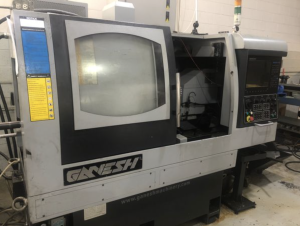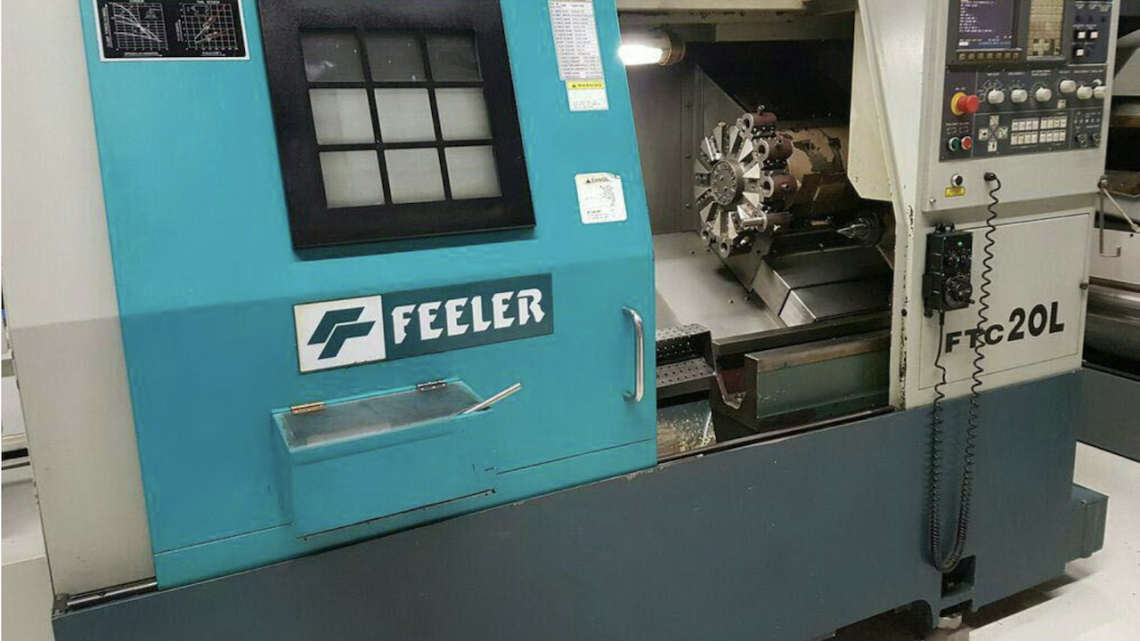
From Factory Floor to Your Workshop: Evaluating a Pre-Owned , Used , Secondhand, Surplus CNC Machines Before Purchase Feeler FTC 20L CNC Lathe made in Taiwan
Here’s a detailed guide / framework you can use specifically for evaluating a pre-owned / used / surplus FEELER FTC-20L CNC lathe (or similar mid-size CNC lathe) before you commit. You can adapt this to your shop’s priorities (precision, uptime, maintenance, parts, etc.).
1. Know the “as new” baseline – spec sheet & capabilities
Before you go see the machine, arm yourself with the factory specifications. This gives you reference values to compare against what you see in the field (wear, degradation, etc.). For the FEELER FTC-20L, some published specs are:
| Parameter | Typical Spec |
|---|---|
| Swing over bed / front cover | Ø 600 mm |
| Max turning diameter | Ø 350 mm |
| Max turning length | 613 mm |
| Spindle speed (max) | 4,500 rpm |
| Spindle bore / through-hole | 52 mm draw tube / spindle bore 62 mm |
| Spindle motor power | ~ 15 kW (continuous) |
| X / Z strokes / travels | ~ X = 175+25 mm, Z = 650 mm (or similar) |
| Tooling / turret | The machine you saw for sale lists 12 tool positions, fixed tool holders, etc. |
| Footprint / weight | ~ 2,630 × 1,535 mm floor space, ~ 4,000 kg weight (for one used unit) |
These specs give you a “target envelope” — you should check whether the actual machine is close, or how far it’s degraded.
2. Prepare your evaluation checklist
Use a structured approach. Many used-CNC buying guides offer “7-step inspection” or “ultimate checklist” frameworks.
Here is a refined version tailored to a lathe like the FTC-20L:
| Inspection Area | Key Checks / Questions | Acceptable Tolerances / Warning Signs |
|---|---|---|
| Visual / general condition | Cleanliness, rust, chips stuck, signs of flooding, damage to covers, missing panels | Surface rust or light pitting is okay; deep scratches, cracked castings, missing guards are red flags |
| Bed, ways, carriage | Check wear on the ways (bed, cross slide, saddle). Use feeler gauges, test for binding or uneven friction along travel. | Significant wear > 0.1 mm over length is worrisome; check for consistent lubricant film & replenishment |
| Ball screws / lead screws | Check backlash, smoothness, axial play, noise when driving slowly. Observe nut wear. | Backlash beyond spec (often few hundred microns) is bad; audible noise or binding means wear |
| Spindle & bearings | Run spindle at low and high speeds. Listen / feel for noise, vibration, thermal drift, runout. Use test bars or dial indicators. | TIR (total indicator reading) beyond ~ 0.005 mm (or whatever the original spec) is suspect. Bearing noise, overheating are red flags |
| Tool turret / tool changer / tool slides | Does turret index cleanly? Any misalignment? Tool holders tight? Slop or play? | If indexes slowly, sticks, or is off by > tolerance, something’s worn or misaligned |
| Electrical, wiring, drives, control | Open panels, inspect wiring harnesses, connectors, signs of repair, heat damage, dust / coolant infiltration. Test control panel, buttons, display, CNC program memory. | Exposed or broken wire insulation, corrosion, missing covers, burnt traces are bad. Control errors or inconsistencies in memory are big issues |
| Hydraulics / lubrication / coolant | Check oil cleanliness, absence of leaks, hydraulic pressure stability, coolant pump and filtration, coolant tank condition | Dirty oil, sludge, leaks, nonfunctional pumps, clogged filters are red flags |
| Coolant & chip handling | Is coolant system working (pumps, nozzles, flow)? Chip conveyor / augers still functional? | Nonfunctional coolant or chip handling will severely reduce usability |
| Documentation / history | Maintenance logs, repair history, hours of operation, original manuals / circuit diagrams, retrofits, crash history | No maintenance history or “black box” machines are riskier |
| Test cut demo | Ask for a demonstration: turn a known geometry, perform a test cut, measure tolerances, repeatability, thermal drift after some time running | If the demo cuts out-of-spec or drifts with heat, that’s a red flag |
| Spare parts & consumables support | Are spares available (bearing sets, ways, electronics, control modules) for FEELER / FFG / this model? | If the model is rare or obsolete, repairs might be very expensive |
| Logistics / site conditions | Check floor loading capacity, access for rigging, crane or forklift clearance, foundation, utilities (power, grounding, cooling, air) | If your shop floor can’t support weight or vibration, you’ll need extra cost |
3. Special considerations for the FTC-20L and Taiwanese machines
Because the FTC-20L is a Taiwanese machine (FEELER / FFG), here are some extra points to pay attention to:
- Parts / supplier network in your country (region). Taiwan machines may have good global support (especially FFG / FEELER) but spare parts (bearings, control boards, guides) may take some lead time.
- Control system model / version. Sometimes older machines have older or obscure CNC controllers. If the controller is too obsolete, lack of software support or inability to repair is a danger.
- Original tooling / attachments. Check whether the unit comes with chucks, live tooling, collets, tooling. Often these are stripped off before resale.
- Retrofitting / alignment history. Ask whether the machine has ever been realigned, re-scraped, had ways re-ground, or had major repairs. These influence remaining life.
- Thermal stability / wear compensation. Over time, bed deflection, cast-iron stress relaxation or misalignments can creep in. During test cuts, run the machine for a while to see how accuracy changes.
- Spare turret / backup parts. Having a spare set of turret indexing parts or backup modules is helpful.
4. Walk-through / field inspection strategy
Here’s a step-by-step you could follow on site (or have your technical advisor follow):
- Initial walk & visual scan — look for leaks, rust, structural damage, cleanliness
- Open electrical panels — inspect wiring, relays, connectors, fuses, signs of overheating
- Manual movement tests — disconnect motor drive; manually move axes, check smoothness, binding
- Drive tests — slowly jog axes, verify smooth motion, listen for abnormal noise
- Spindle test — run spindle at low speed and high speed, watch vibration, listen, feel temperature after some minutes
- Index turret / tool change — cycle tool changes, look for misindexing, binding, slop
- Demo machining — cut a test part or a geometric benchmark (e.g. a turned stepped cylinder), measure with gauge blocks or micrometers
- Thermal drift test — leave machine running for some minutes (warm-up) and repeat reference cuts / measurements
- Review maintenance documentation — compare wear intervals, major repairs, replacement parts used
- Ask “what’s wrong / what’s been fixed” — often the seller may hide minor but significant issues; ask direct questions
- Check spare parts availability / local support — call FEELER / FFG / distributors to see the availability of parts or modules
- Logistics check — measure door clearances, floor strength, crane / rigging path, power supply compatibility
5. Red flags & deal breakers (examples)
If you find any of the following, be very cautious or negotiate accordingly:
- Spindle runout beyond tolerance, or excessive bearing noise
- Major scoring or damage on bed ways or cross slides
- Tool turret indexing problems or skipped positions
- Electrical damage: signs of burning, smoke, shorted wiring
- Control memory errors, inability to load / run programs
- Excessive corrosion or rust in critical sliding surfaces
- Missing or nonfunctional coolant / lubrication systems
- No maintenance history (black box)
- Obsolete control with no support or spare parts
- Improper foundation / mounting that cannot be corrected
- Drone of hidden repair cost (e.g. hidden refurbishment needed)
If some issues are present but repairable, use the condition as a negotiation lever (i.e. reduce the asking price by estimated repair cost).
6. Estimating residual life & value
- Ask how many hours (cutting hours) the machine has run (not just powered-on hours).
- Compare its wear pattern vs typical usage for similar machines.
- Consider the “wear budget” left: for example, if the bed ways have lost 30% of tolerance allowance, you have only 70% of your margin left.
- Assess whether critical components (ball screws, spindle bearings, ways) are original or have been replaced.
- Estimate cost of consumables and spare parts to bring it into good working condition; that should be subtracted from your willingness to pay.
A solid used lathe, well maintained, can still produce good results for many more years. But once too many major systems need overhaul, the risk increases sharply.
7. Post-purchase / commissioning tips (if you buy it)
- Have it fully re-leveled and aligned (bed-saddle-spindle)
- Run warm-up cycles and stabilization before high-precision work
- Run full calibration / geometry checks (e.g. test bar, dial test, straightness, perpendicularity)
- Replace coolant, filters, lubricants, seals if needed
- Stock critical spares (bearings, belts, fuses, drive modules)
- Implement preventive maintenance schedule (daily, weekly, monthly checks)
- Keep usage records (hours, loads, cutting types) to monitor wear progression