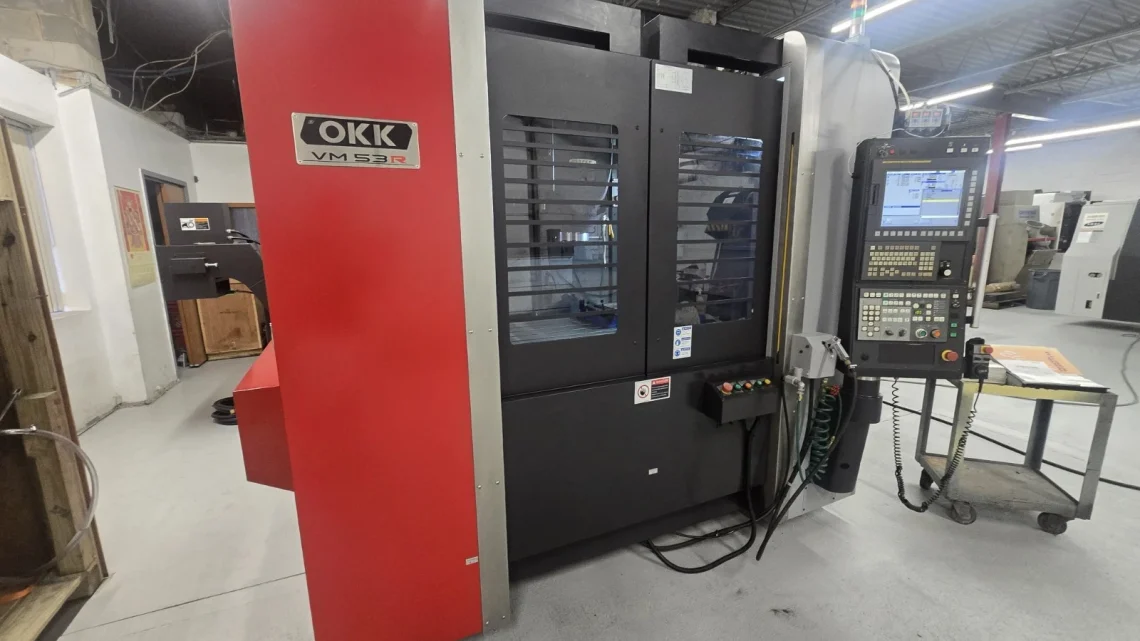
From Factory Floor to Your Workshop: Evaluating a Pre-Owned , Used , Secondhand, Surplus CNC Machines Before Purchase OKK VM 53R CNC Vertical Machining Center Heavy Duty Gear Head made in Japan
Here’s a detailed, domain-specific guide for evaluating a pre-owned / used / surplus OKK VM 53R (vertical machining center, heavy duty gear head version, made in Japan). The goal is to help you walk into a purchase inspection with confidence, spot serious red flags, and assess refurbishment risk.
1. Know the Machine — Baseline Specs & What to Use as Reference
Before you go onsite, get as much documentation as possible (spec sheets, manuals, OEM brochures, wiring diagrams). Use those as your benchmark. For the OKK VM series (including VM53R), the following published specs are typical and useful for comparison:
| Parameter | Typical / Catalog Value | Notes / Variants |
|---|---|---|
| X / Y / Z travels | 1,050 mm / 530 mm / 510 mm | These are from the VM53R II spec — older versions might have slightly different strokes. |
| Table size | 1,050 × 560 mm | Some machines use optional “OP” longer tables. |
| Table load capacity | 800 kg | Exceeding load stresses bearings, guides. |
| Rapid traverse rates (X/Y / Z) | 30 m/min (X/Y), 20 m/min (Z) | Check actual responsiveness — wear may reduce these. |
| Spindle speed & taper / power | 8,000 rpm standard (some variants go to 12,000 rpm) Power: 40 hp (~29.8 kW) in many “gearhead” listings Taper: CAT-50 in many units | Sometimes machines have been modified, e.g. lower-speed spindles, changed taper. |
| Number of tools / ATC | Standard ~30 tools (option 40) | In used machines, magazines may be damaged or missing. |
| Machine weight | ~ 17,600 lbs (≈ 8,000 kg) | Heavy footprint and require solid foundations. |
| Control | Many VM53R machines use FANUC F31i-B or equivalent CNC control | Check type, firmware, I/O boards, spare parts availability. |
A few observations to keep in mind:
- The VM series emphasizes rigidity with box-ways and a heavy gearhead spindle design.
- The “heavy duty gearhead” term suggests this machine is optimized for tougher, heavier cuts rather than ultra-high speed.
- Many listings for used VM53R machines mention 8,000 rpm spindles, gear drives, and CAT-50 taper.
- Because of their robustness, OKK machines often enjoy solid reputations in shops with demanding cutting requirements.
Use these as your “expected envelope” — if what you inspect deviates heavily (worse speeds, lower power, missing components), those are red flags or signs of heavy modification / wear.
2. Pre-Inspection / Offsite Due Diligence
Before you even arrive at the machine, ask the seller or broker to supply:
- Maintenance / service history (spindle overhauls, bearing replacements, ATC work, re-lubrication records)
- Usage / operating hours (spindle hours, axis hours, duty cycles)
- Accident / crash history (overtravel hits, head collisions, table crashes)
- Retrofits / modifications (e.g. changed spindle, control upgrades, added cooling, chip conveyor changes)
- Parts / spare inventory (Is there stock of OKK spindle bearings, gearheads, drives, control modules)
- Accessories / tooling included (toolholders, workholding, fixtures, probes, manuals, wiring diagrams)
- Transport / rigging plan (how will machine be disassembled, moved, reassembled, aligned)
- Inspection / test rights (permission to power up, test cuts, run full motions)
- Warranty / acceptance period (ideally after delivery test period)
If the seller is evasive, or has no documentation, that should raise caution.
3. Visual & Structural Walkaround (Before Power-On)
Once you reach the machine, inspect thoroughly before applying power. Many serious issues are visible without electricity.
A. Structure & Castings
- Look for cracks, weld repairs, filler, patching on the base, column, saddle, and front face.
- Inspect the box-ways / guide surfaces for scoring, pitting, corrosion, surface damage.
- Examine way covers, bellows, guards, telescopic covers — torn or missing ones allow coolant/chips to reach the ways.
- Check for rust, corrosion, especially in coolant zones, inside covers, near base, footings.
- Inspect exterior panels, doors, interlock guards — missing or jury-rigged panels may hint at previous damage or modifications.
- Examine the ATC magazine, robotic arms, indexing mechanisms for bent arms, broken fingers, signs of collisions.
- Check the wiring harnesses, conduits, connectors — look for signs of chafing, spliced wires, non-standard repairs.
- Look closely at the spindle nose / taper surface, check for dents, corrosion, damage from tool crashes.
B. Manual Mechanical Probing & Static Checks
- Where safe / permissible, manually jog or push the table in X, Y, Z to feel for unevenness, binding, or “harsh spots.”
- Use feeler gauges, small dial indicators, or test instruments to check backlash / deadband in each axis: push in one direction, reverse, measure the movement before motion starts.
- Mount a test arbor or dummy tool and check for axial / radial play in the spindle (wiggle).
- Inspect the ATC magazine indexing — move magazine manually if possible, check for smooth indexing, no binding or unusual resistance.
- Check lubrication lines, oil ports, fittings — clogged, corroded or missing lube lines are a warning sign of neglect.
If you observe structural repairs, cracks, or serious damage, that should be considered a major negative unless the price is heavily discounted.
4. Power-Up / Electrical & Control Checks
If everything looks acceptable so far, apply power (with care) and begin control & drive system checks.
- Observe the power-up / boot sequence on the CNC control: check for any error codes, missing modules, failed diagnostics.
- Test all panel buttons, switches, displays, indicator lights to ensure they are responsive.
- Switch to manual/jog mode; move each axis slowly and listen / observe for irregular motion, drive faults, alarms, or stuttering.
- Test safety circuits: emergency stop, limit switches, door interlocks, guard sensors.
- Monitor power draw (if instrumentation is available): spikes, instability, or overcurrent warnings might hint at underlying problems.
- Test overrides (feed override, spindle override) and see whether they behave proportionally.
If the control refuses to boot, drives fault, or display modules are missing / unresponsive, that’s a major problem — control replacement is costly.
5. Dynamic / Motion Tests & Accuracy Checks
Assuming the control and basic motions are functional, push into more rigorous dynamic and accuracy testing.
A. Axis Motion / Reversal Tests
- Command axis moves at various speeds (slow, medium, fast), and watch for jerkiness, noise, hesitation, unusual resonances.
- Reverse directions and use a dial indicator to measure backlash / reversal error for each axis.
- Jog to a known position, then reverse back, and measure how closely the axis returns — that gives repeatability.
- Perform combined-axis moves (e.g., X+Y diagonals) to check for coordinated motion smoothness.
- If you have a ballbar test rig, run a circularity / ballbar test to expose geometric / servo tuning errors.
B. Spindle Testing
- Run the spindle at different speeds (low, mid, high). Listen for bearing noise, hum, vibration.
- Use a dial or test indicator to check radial runout at the spindle nose or on a mounted tool.
- Run it continuously for a moderate period to see if vibration, noise, or temperature change emerges.
- If feasible, run a light test cut in soft material and monitor how stable the spindle is under slight load, whether chatter or deflection arises.
C. Sample Machining / Test Cut
- Insist on a realistic test cut: face, pocket, peripheral milling, holes, perhaps even ramping.
- Measure the output: dimensional accuracy, tolerances, surface finish, repeatability across locations.
- Try worst-case cuts (long traverse, heavy cuts) to stress the machine — see if vibration, deflection or thermal shift becomes visible.
- Observe chip evacuation, coolant behavior, cleanliness of the work area. Poor chip / coolant control often reveals neglected systems.
6. Geometric & Metrological Inspection
If you or a metrology technician bring precision tools (gage blocks, straight edges, indicators, laser etc.), perform these:
- Test straightness / flatness of axes over full travel (check for bow or sag).
- Verify parallelism between table axes and spindle axes (X vs spindle axis, Y vs spindle axis).
- Measure squareness / orthogonality (e.g. Y axis vs X axis across travel).
- Command a series of moves (various distances), measure actual vs commanded — check for linear scale errors or nonlinearity.
- After warm-up, monitor thermal drift in dimensions or positions over time.
- At extremes of travel (Z fully up/down, toward edges of X/Y travel), test for deflection or geometric distortion.
Note: some geometric errors (out-of-square, skew) can be compensated to a degree by shims and alignment, but large wear or bent structures may not be fully repairable.
7. Estimate Refurbishment / Hidden Costs
Even a “good” used machine typically requires some work. Plan ahead and budget for the following possible repairs and upgrades:
- Spindle bearing overhaul or replacement
- Refurbishing or repairing the gearhead mechanism (if damaged or worn)
- Regrinding or re-lapping of ways, way surfaces, box-way reconditioning
- Ball screw nut replacement, screw regrinding, or backlash compensation work
- ATC magazine / tool changer repair or rebuild (fingers, cams, slides)
- Control / electronics repairs: servo drive modules, wiring harness, control boards
- Replacing sensors, limit switches, proximity switches, encoder feedback systems
- Overhauling lubrication / oiling systems, piping, filters
- Coolant system overhaul (pump, piping, seals, filters, cleaning)
- Alignment, leveling, calibration and shimming work
- Transport, rigging, disassembly, reassembly and commissioning
- Spare parts package (bearings, seals, nuts, motor spares)
- Contingency buffer: always add margin (e.g. 15-25 %) for unexpected issues
When negotiating, factor all of that into your “all-in” cost, not just purchase price.
8. Red Flags / “Deal Killers”
As you inspect, be particularly alert to these serious warning signs (unless you’re getting an extreme discount and willing to take high risk):
- Spindle with audible noise, vibration, or heating — signs of worn bearings
- Control that fails boot, has recurring faults, or modules missing / damaged
- Excessive backlash, binding, or erratic motion that seems beyond simple compensation
- Structural cracks, weld repairs, or heavy past damage to base, column, or head
- ATC / tool changer damage (bent arms, missing fingers, misindexing)
- Inability to carry out any real test cuts under reasonable load
- Missing or badly damaged way covers, exposed ways, signs of coolant intrusion
- No documentation, wiring diagrams, or parts lists
- Obsolete electronics with no local support or difficult-to-source parts
- Seller denying testing / trial use or refusing acceptance window
If multiple red flags appear, either insist on a steep discount, or walk away.
9. Offer Strategy & Negotiation
- Start with a conditional offer subject to full inspection, trial cuts, and acceptance.
- Document all defects / deviations and propose deductions or repair allowances.
- Request spare parts, repair kits, or a warranty period be included in the deal.
- Build in margin for unknown defects and refurbishment cost.
- When comparing multiple machines, weigh not just purchase price but “cost-to-turn-key-ready” — the machine plus all repair / setup costs.
- Be prepared to walk away if hidden liabilities exceed the value difference.