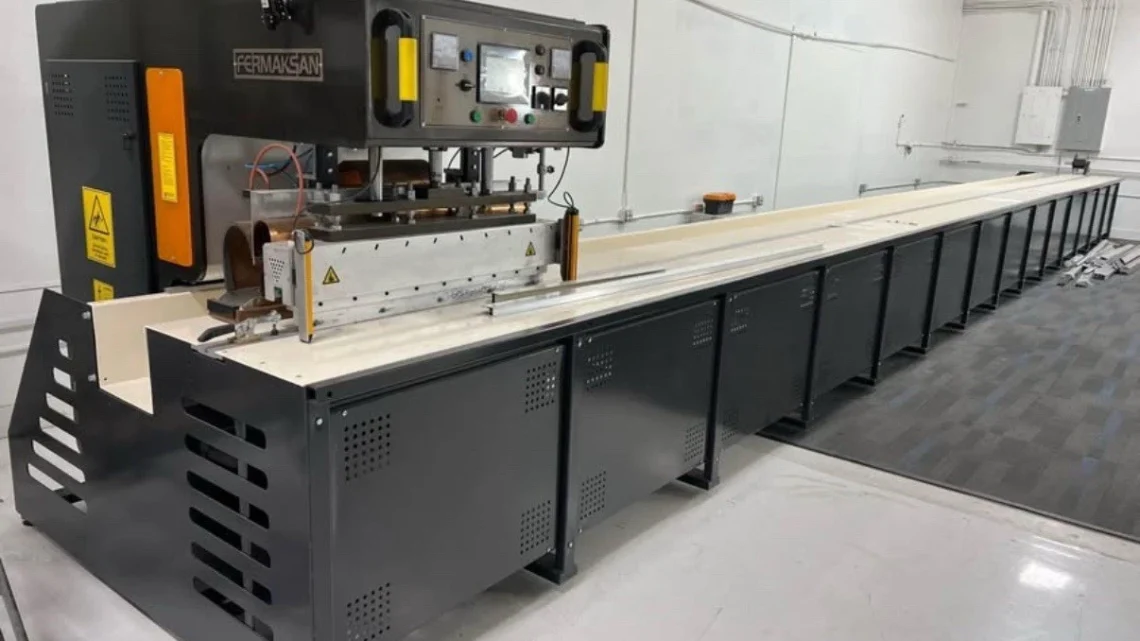
From Factory Floor to Your Workshop: Evaluating a Pre-Owned , Used , Secondhand, Surplus CNC Machines Before Purchase FERMAKSAN High Frequency PVC Welding Machine Table 14 Meters made in Türkiye
Here is a detailed, step-by-step evaluation guide (plus domain-specific cautions) for assessing a pre-owned / used / surplus FERMAKSAN high-frequency PVC welding table (≈ 14 m length, made in Türkiye) before purchase. The principles are similar to other industrial machines, but HF welding machines have their own peculiar risks (RF circuits, insulation, high voltages, dielectric materials, head wear, etc.), so I’ll emphasize those.
What to Know Up Front — Baseline Specs, Architecture & Typical Risks
Before inspecting the machine, try to acquire as much documentation, as-built information, and even factory drawings as possible. Use them as benchmarks and comparison points. For a FERMAKSAN HF welding machine:
- FERMAKSAN is a Turkish manufacturer that produces high-frequency plastic/PVC welding machines (among other plastic machinery) and exports them.
- Their machines are used for welding tarpaulin, PVC membranes, PVC sheets, banners, etc.
- The 14 m “table” suggests this is a large format, continuous or long welding machine (with conveyor / feeding / guiding systems).
- Key systems to expect: RF generator / high-frequency power supply, transmission lines (coils, matching network, capacitors, tuning elements), electrodes or welding heads, cooling systems (for electrodes / generator), mechanical conveyor or motion system, guiding / alignment system, insulation / dielectric barriers, safety interlocks, control electronics, and possibly vacuum or pressure systems (if used for certain membrane types).
Because HF welding machines operate with high voltages, strong electromagnetic fields, and sensitive insulation, hidden faults (insulation breakdown, coil damage, capacitor leakage, generator aging, head wear) are more subtle and more dangerous than in mechanical machines.
Use your documentation to identify expected values: e.g. the generator power (kW), RF frequency (commonly 27.12 MHz or other standards), electrode length and spacing, dielectric clearances, cooling flow rates, insulation resistances, mechanical travel accuracy, conveyor indexing accuracy, and so forth.
Pre-Visit / Off-Site Inquiries & Documentation
Before visiting the plant or warehouse, request the following:
| Topic | Questions / Documents to Request | Why It Matters |
|---|---|---|
| Machine history & usage | How many years it has been in service, how many hours/duty cycles of operation, maintenance logs | HF machines degrade with time; component aging is important |
| Generator / RF system records | Any servicing, capacitor replacements, coil retuning, matching network changes | RF components wear, lose tuning, degrade insulation |
| Failures / breakdown history | Any insulation breakdowns, arcing, generator replacement, head collisions | Past faults often leave long-term damage |
| Retrofitting / modifications | Changed electrode heads, changed RF frequency, altered conveyor, added vacuum or compression systems | Modifications may complicate spare parts or reliability |
| Spare parts & consumables availability | Are capacitors, coils, dielectric plates, heads, insulators, RF tubes / solid-state modules available locally? | Replacement parts for HF machines are sometimes specialized |
| Accessories & tooling included | Electrode heads, dies, matching networks, insulation plates, cooling system parts, documentation, wiring diagrams | Missing accessories often incur high replacement cost |
| Electrical / power / cooling infrastructure | What the required incoming voltage, cooling water supply (flow, temperature), grounding, shielding are | The machine’s supporting systems are critical for safe operation |
| Inspection / trial rights | Permission to power up, run test welds, measure RF outputs, check insulation, see dynamic performance | Without real testing, you risk hidden faults |
| Warranty / acceptance clause | A short trial or conditional acceptance after delivery is highly desirable | Because HF machines often have latent defects, this offers protection |
If the seller is reluctant to provide or share these, be cautious.
Visual & Structural Inspection (Before Powering Up)
Once on site, before applying power, thoroughly walk around and visually (and manually) inspect every system. Many problems are visible or inferable without energizing.
A. Mechanical / Structural Systems
- Check the frame, table, conveyors, guide rails, supports, alignment rails for bending, corrosion, distortion, cracks, weld repairs, or fatigue damage.
- Inspect the electrode head supports / carriage / travel system for smoothness, wear, mechanical backlash, binding, or misalignment.
- Examine conveyor belts / chains / rollers / guides where the material passes — any wear, slippage, broken guides, misalignment, sagging.
- Inspect insulating plates / dielectric support surfaces for cracks, pitting, burn marks, carbonization, or wear.
- Check mounting / grounding / shielding enclosures: ensure panels, covers, and shielding are intact; missing shielding or covers allow EMI (electromagnetic interference) or leakage.
- Examine cable harnesses, high-voltage leads, connectors, feedthroughs, flexible cables: look for cracks, insulation damage, burn marks, patched wires, or signs of arcing.
- Inspect cooling lines, water jackets, heat exchangers, pumps, piping—leaks, corrosion, blockage, old fittings.
- Check control cabinet / RF cabinet / electronics enclosures for cleanliness, corrosion, leak evidence, moisture ingress, and tampering.
- Inspect insulators, standoffs, dielectric substrates near high-voltage parts to ensure no surface tracking or pollution.
If you see signs of past arcing (carbon tracks, scorch marks), cracked insulators, or tampered shielding, that’s a red flag.
B. Static / Manual Checks (Non-Energized)
- Gently move the electrode head or carriage (if safe) to see if motion is smooth, no binding or weird friction spots.
- Check alignment of the table / conveyor path visually; use straightedge or laser level (if available) to see whether the path is straight / level.
- Inspect the clearances between electrodes and dielectric surfaces; confirm they haven’t been reduced by wear or repairs.
- Check that all fasteners, clamps, mounts, insulators, spacers are present and properly installed.
- Inspect wiring tray / cable routing near moving parts — make sure no abrasion or chafing.
Safe Power-Up & Electrical / RF Checks
Powering up an HF welding machine is riskier than powering a mechanical machine because of high voltages, RF emissions, and insulation integrity. Do this only if you have the correct safety setup, insulation checks, and the system is ready. Proceed carefully.
- Before turning on, perform insulation / megger tests (if accessible) on high-voltage circuits, electrode circuits, generator to ground, etc., to ensure no breakdown or leakage.
- Apply power to the control / logic circuits (low-voltage side) first, check for normal boot, diagnostics, error messages.
- Gradually energize the RF generator / matching network (if possible in a safe, step mode) — monitor current, voltages, reflected power, matching metrics.
- Check that interlocks, emergency stops, shielding enclosures, RF absorbers / termination units are functional.
- Monitor for strange noises, hums, sparks, arcing, ozone smell, smoke, or any unusual sign when the system is energized.
- Observe generator cooling (air / water) — make sure cooling circuits are active and stable.
- Use an RF power meter, directional coupler, or diagnostic instrument (if available) to measure forward power, reflected power, VSWR / matching, and ensure that the machine is correctly tuned and within the design envelope.
If you detect any arcing, abnormal RF reflection, or instability immediately shut down and inspect.
Dynamic / Welding Trials & Performance Testing
If the machine powers up and basic checks pass, you must do real welding trials to stress the system and reveal latent defects.
- Use typical materials the machine would weld (PVC, membrane, etc.) and perform test welds at different speeds, pressures, and power levels.
- Inspect weld quality: bond strength, seam appearance (no voids, spots, discoloration), consistency, leak tightness (if applicable).
- Vary parameters (speed, power, pressure) to test the machine’s adjustability and linearity.
- Monitor how stable the RF power delivery is during ramping and holding phases—does indication drift, does matching change?
- Run extended weld periods to test thermal stability, drift, component heating (coils, heads, capacitor banks).
- After welding, inspect the electrodes / heads: check for excessive wear, hotspot damage, erosion, carbon buildup, dielectric damage.
- Monitor cooling circuits during welding (temperature rise, flow drops, coolant leaks) to see if cooling adequacy is problematic.
- Observe the machine’s feeding / transport of material during welding: any slippage, misalignment, inconsistent feed, jitter or mechanical backlash will degrade weld consistency.
Essentially, treat it like doing “cutting trials” on a CNC: apply stress, vary parameters, push to limits, and watch for instabilities or performance drop.
Electrical & RF Component Health Checks
Because HF welding machines rely heavily on sensitive RF components, inspect and test them as thoroughly as possible.
- Inspect capacitors (if visible): bulging, discoloration, leaked dielectric fluid, or signs of internal breakdown.
- Inspect coil windings, matching inductors, tuning coils: insulation cracks, discoloration, burn marks, partial shorts.
- Check tuning components (variable capacitors, vacuum capacitors, trimmers, matching network switches) for wear, arcing pits, misalignment, mechanical play.
- Inspect transmission lines / coax / feed cables for dielectric breakdown, cracks, partial discharges, or signs of corona.
- Check ground and shielding integrity carefully — any poor grounding or shielding gaps may leak RF, pose hazards, or reduce performance.
- Monitor generator cooling and ventilation fans; overloaded or dusty fans may be weak, reducing cooling capacity.
- If the generator has service indicator logs, check error history, power cycling, protection trips, and component usage data.
In older machines, capacitors and tuning components are often the first to degrade; replacing them may be costly and require calibration.
Metrology, Alignment & Tolerances
While HF welding machines are less about strict “positional tolerance” like a CNC, some alignment and mechanical accuracy is still critical.
- Check straightness / alignment of electrode head to table / dielectric surfaces. Poor alignment causes uneven welding, inconsistent pressure.
- Measure parallelism of electrode surfaces, ensure the faces are aligned across the width or length of the welding head.
- Check flatness / planarity of dielectric plate surfaces or insulation mating surfaces.
- Verify that clearances (spacing between moving electrodes and insulating surfaces) are within acceptable tolerances.
- Test the motion / travel repeatability of electrode heads, carriage, or positioning systems — small errors can degrade weld quality.
- After warming the machine, re-check key alignments to see whether thermal expansion has skewed alignment.
If possible, compare measured deviations to acceptable tolerances (if the documentation provides them) or consult with a service technician.
Estimate Refurbishment, Hidden Costs & Risk Buffer
Every used HF welding machine will require repair or adjustment. Plan ahead and budget accordingly. Here’s what to watch for:
- Capacitor replacement / bank rebuild
- Coil / inductor repair or rewinding / insulation rework
- Electrode head refurbishment / electrode wear replacement / machining surfaces
- Matching network / tuning component repair or replacement
- Insulator / dielectric plate replacement (cracked, pitted, carbonized)
- Cooling circuit repairs / pump replacement / piping / leaks
- Generator servicing (cooling, fans, ventilation, diagnostics)
- Control electronics refurbishment or replacement (PLC, interface boards, sensors, displays)
- Wire / cable replacement, high-voltage line refurbishment, connector replacement
- Shielding, grounding, RF absorbing material replacement
- Mechanical alignment, straightening, carriage / guide rework
- Installation, calibration, commissioning, safety compliance
- Spare parts package (capacitors, electrodes, coils, connectors, dielectric plates)
- Downtime, hidden damage discovered after reassembly, safety certification
Importantly, in HF systems, “latent damage” from arcing or insulation fatigue may not manifest until after reassembly or heavy use. Always budget a healthy “risk buffer” (e.g. 20–30 %) over your estimates.
Red Flags & Deal-Breakers
Some conditions are risky enough to demand walk-away unless the discount is steep and you accept risk:
- Evidence of past arcing, carbon tracks, burn marks, insulation carbonization
- Cracked, pitted, or damaged dielectric plates / insulators
- Generator / matching network with missing or visibly damaged capacitors, tuning elements or coils
- RF leakage, poor grounding, missing shielding or covers
- High reflected power during trial operation, inability to tune or match
- Cooling system failure, overheating, leaks, low coolant flow
- Head / electrode wear beyond repair or misalignment
- Mechanical carriage or electrode motion that is sloppy, binding, or with excessive backlash
- Control electronics that fail to power, have repeated faults, or use obsolete modules with no replacements
- No documentation, wiring diagrams, or parts lists
- Seller restricting you from doing real welding trials or RF tests
- Latent faults (insulation breakdown) that only manifest under high-power operation
If several of these red flags are present, demand large discounts or walk away.
Offer Strategy & Negotiation
- Always make your offer contingent on full inspection, test weld trials, and acceptance, not blind.
- Document all defects / deviations you find, and deduct accordingly or ask for repair allowances.
- Ask seller to include spare parts (capacitors, electrode sets, dielectric plates) as part of the sale.
- Negotiate a trial / acceptance window after delivery (e.g. run 100 m weld, check performance, allow return or refund).
- Base your valuation on “turnkey-ready performance,” not just the asking price—account fully for refurbishment, repair, and commissioning costs.
- If possible, bring a specialist in HF welding machines with you to evaluate the RF / insulation side (they’ll see what you might miss).
- Be ready to walk away if the unknowns or hidden costs exceed your acceptable risk.