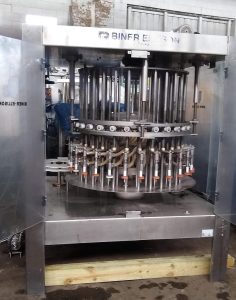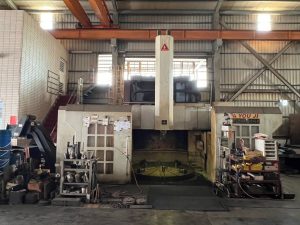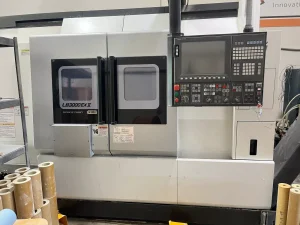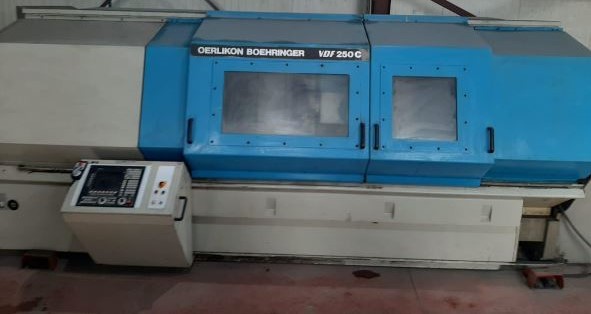
From Factory Floor to Your Workshop: Evaluating a Pre-Owned , Used , Secondhand, Surplus CNC Machines Before Purchase Oerlikon Boehringer VDF 250C CNC Lathe made in Germany
Here’s a detailed checklist + guide you can use when evaluating a pre-owned / used / surplus Oerlikon / Boehringer VDF 250C (or variant) CNC lathe (made in Germany). The VDF / Boehringer machines are heavy-duty, high-precision machines, so you’ll want to be extra thorough. I’ll also include known specs and “red-flag thresholds” based on listings to help you spot exaggerations or hidden issues.
Known / Reference Specifications & Context
Before inspection, it helps to know what to expect. These reference values let you detect deviations or misrepresentations.
From used listings:
- The Boehringer VDF 250C / VDF 250 Cm is often offered with:
• Swing over bed (max) ~ 550 mm; over cross slide ~ 480 mm
• Cross (X) travel (approx) ~ 405 mm
• Longitudinal (Z) travel (approx) ~ 1,099 mm (for a ~1,000 mm turning length)
• Spindle bore ~ 103 mm
• Max drive power (50% duty) ~ 53 kW
• Max torque ~ 780 Nm
• Speed range ~ 30 to 3,000 rpm
• Turret: 12 stations, VDI 50 toolholders often listed
• Rapid traverse / feed speed ~ 10,000 mm/min (or 10 m/min) in X and Z axes
• Machine weight in the 10–13 ton range depending on variant
• Control types vary: some units show Siemens 840C, some older Phillips / B2T variants
Because there are variant suffixes (e.g. VDF 250C-U, VDF 250C-F, etc.), real travel, spindle bore, and features (driven tools, tailstock, C-axis) may differ. Always confirm the exact spec of the machine you inspect.
If a seller claims vastly larger travel, torque, or speed ranges, ask for proof or test data.
Evaluation / Inspection Framework for VDF 250C
Use the following structure when assessing the machine in person. Bring measuring tools, test bars, and possibly a technician who knows heavy lathes.
1. Pre-Visit / Documentation Review (Remote)
Before stepping onto the floor, request:
- Nameplate photos (mechanical & electrical), including serial/model identifiers
- Electrical schematics, wiring diagrams, control logic documentation
- Maintenance / repair history (especially major components: spindle, turret, guideways)
- Operating hours / usage logs (power-on vs cutting hours)
- Details of any overhauls or retrofits (new spindle bearings, control replacement, turret rebuilds)
- List of included accessories, tooling, spare parts (chucks, jaws, measuring heads, turret modules)
- Photos or video of the machine operating (turret indexing, axis motion, control screen)
- Reason for sale (replacement, failure, upgrade)
- Shop environment (coolant type, cleanliness, dust, shop conditions)
- Floor plan / shop structure (foundation, crane / rigging access, utilities)
If the seller cannot provide many of those, treat that as a warning.
2. Structural & Mechanical Inspection
Once on site, start with the “shell” and mechanical integrity checks:
- Machine frame, casting, bed: inspect for cracks, repairs, distortion, welds
- Guideways, slides, cross slide ways: look for gouges, pitting, scoring, corrosion
- Way covers, bellows, guards: are they intact, properly installed, not torn or patched?
- Mounting / foundation: check how the machine is anchored or shimmed; look for evidence of shifting
- Turret housing, turret slideways, tool stations: wear or misalignment in turret carriage
- Chuck / spindle nose, chuck mounting: wear, misalignment, damage
- Tailstock (if present): quill condition, movement, locking stability
- Couplings, linkages, servo motor mounts: looseness, alignment
Move the components (with machine off) manually or with slow motor actuation to feel for binding or unusual friction.
3. Kinematic / Motion Tests & Axes Inspection
- Jog / move the X and Z axes slowly through full travel; feel for stiction, binding, inconsistent motion
- Use a dial test indicator to measure backlash in both axes (X, Z)
- Move near extremes and reversal to check for hysteresis or “dead-band”
- Inspect ball screws / leadscrews, nuts, couplings, bearing supports for play, wear
- Index the turret through all tool stations repeatedly to see if it mis-indexes, hesitates, or fails
- Check rapid traverse motions, see if X/Z traverse speeds approach spec, check for vibration or overshoot
- Under no load, command faster feed rates to see if motion remains stable
4. Spindle, Turret & Drive System Testing
- Run the spindle at multiple speeds (low, mid, high); listen carefully for bearing noise, vibration, roughness
- Measure spindle runout (with test bar + dial indicator) at spindle nose
- Monitor spindle temperature over a short run
- Test acceleration / deceleration of the spindle; see if it responds cleanly
- Check turret tool clamping and repeatability of tool positioning
- If driven tools (live tooling) or C-axis are present, test their operation carefully
- Monitor any vibration or resonance under moderate speed
5. Control / Electrical / Electronics Inspection
- Open the electrical / control cabinet; inspect wiring, terminations, insulation, dust, signs of overheating
- Look for burnt connectors, discoloration, melted insulation, corroded contacts
- Examine servo drives, inverters, control boards, interface modules
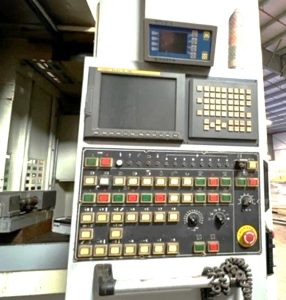
- Test control panel: buttons, switches, knobs, display, emergency stop, interlocks
- Navigate menus, check alarm / fault logs, parameter integrity
- Test safety interlocks, limit switches, door safety circuits
- Check grounding, shielding, cable routing, strain reliefs
6. Operational / Load Testing
If the seller allows, run the machine under real or simulated load to see performance:
- Do a “dry run” of a turning cycle (no cutting) to verify motion, turret coordination, and axis synchronization
- Run a short test cut (preferably a known geometry or test part) to evaluate surface finish, chatter, dimensional accuracy
- Run a continuous cycle (30–60 min) at moderate load, then remeasure critical points to detect drift, thermal expansion, alignment shift
- After warm-up, repeat measurements (backlash, runout, alignment) to see if anything shifts
- Turret indexing under repeated cycles, check for mis-indexes or failures
- If tailstock / quill is used, test its performance and stability under load
7. Metrology & Accuracy Checks
Because the VDF 250C is expected to deliver precise work, perform these checks:
- Use a known test bar or gauge to check straightness, concentricity, runout
- Check repeatability: move to a reference, retract, return, and check deviation
- Check alignment of spindle axis vs bed travel
- Verify turret tool offsets and angular positioning
- Check for drift or change after thermal warm-up
- Compare measured values against the reference specs (or acceptable tolerances for your parts)
8. Infrastructure / Installation Constraints & Risks
Don’t forget practical / shop constraints:
- Floor load: the machine is heavy (10+ tons), ensure your workshop floor can support it
- Foundation: is there existing grouting or base; you may need to re-level or re-grout
- Rigging / removal: access, crane capacity, clearances, door heights
- Utilities: power supply (voltage, phase, current), coolant systems, chip removal, ventilation
- Maintenance space: access to electrical cabinet, slideways, turret, belt / drive components
- Safety: guarding, interlocks, local regulations
9. Post-Evaluation / Decision Criteria
Once all inspections and tests are done, assess:
- Deviation from advertised specs: if actual travel, spindle bore, torque etc. differ significantly, that’s a negotiation point
- Mechanical wear / defects: serious wear on ways, screws, turret may require expensive rework
- Spindle health: bearing noise, high runout, vibration are red flags
- Control / electronics state: faulty or obsolete control modules, wiring issues, corrupted parameters are serious issues
- Repair / refurbishment cost vs risk: estimate cost of repairing spindle, reworking slides, replacing parts
- Test cut / performance: if test cuts are good and stable, that is a strong positive signal
- Part / support availability: can you source parts for Boehringer / VDF machines, control modules etc.
- Negotiation leverage: use observed defects as leverage for price reduction, spare parts inclusion, or guarantee
- Warranty / guarantee: try to obtain performance guarantee or return clause