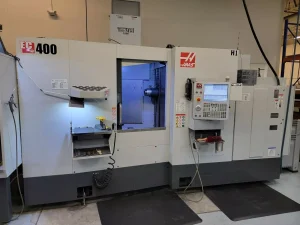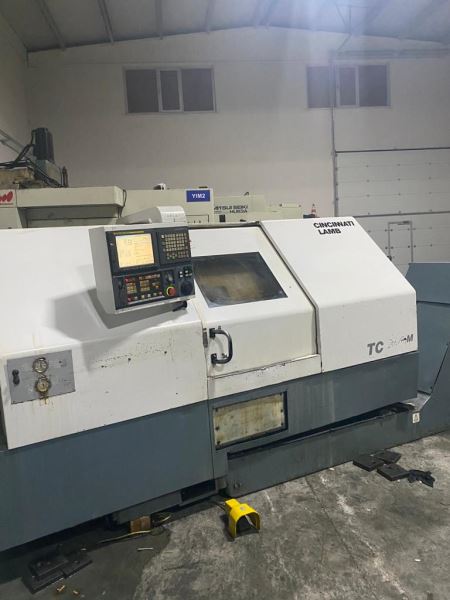
From Factory Floor to Your Workshop: Evaluating a Pre-Owned , Used , Secondhand, Surplus CNC Machines Before Purchase Cincinnati TC-200M CNC Turning Center made in USA
Here is a detailed evaluation guide you can use (or adapt) when assessing a pre-owned / used / surplus Cincinnati TC-200M / Hawk TC-200M CNC turning center (manufactured in the USA). It covers what to check before purchase, what to test on site, and how to analyze findings.
Where helpful, I’ve included known specs or model-specific considerations (from publicly available sources) to help you calibrate what “normal vs red flags” look like.
Known / Typical Specifications & Model Context
Before inspection, it’s good to know what the machine is supposed to deliver. Below are some reference specs for the Cincinnati / Hawk TC-200M (or Hawk M-Class series) to help you validate seller claims.
- It is part of the Hawk Digital M-Class Turning Centers line.
- For the TC-200M:
- Swing over bed: ~ 24.40″ (≈ 620 mm)
- Thru-spindle bore: ~ 65 mm (2.5″)
- X-axis travel: ~ 245 mm
- Z-axis travel: ~ 520 mm
- Spindle power: ~ 15 kW (20 hp class)
- Turret: 12-station turret is common in used units listings
- Control / drive: in used listings, for example a used TC-200M is equipped with a Fanuc 21i control in one instance.
- Accuracy claims: the M-Class line claims X-axis accuracy ±0.00011″ (≈ 3 μm) and Z-axis ±0.00015″
Use these as benchmarks during your evaluation. If you see dramatic deviations (e.g. Z travel much lower, spindle power far off, missing turret stations), that could indicate misrepresentation or substantial modifications/repairs.
Pre-Screening & Documentation (Before Visiting)
Before you physically inspect the machine, gather as much background information as possible. This helps you weed out problematic offers and arrive better prepared.
Ask the seller for / verify:
- Machine identity & history
- Serial number, model revision, year of manufacture
- Photos of nameplates (mechanical, electrical)
- Any history of relocation, accidents, major repairs
- Operating hours / usage
- Power-on time vs cutting (load) hours
- Duty cycles, types of parts run, materials processed
- Maintenance & repair records
- What preventive maintenance was done, intervals, parts replaced
- Spindle rebuilds, turret overhauls, ball screw replacements
- List of included accessories / tooling / attachments
- Tailstock, steady rest, bar feed, collet chucks, tooling sets, live tooling (if present)
- Spare parts (motors, drives, turrets, control modules)
- Control / CNC details
- Type of control (Fanuc, Cincinnati / Hawk proprietary, etc.), version, upgrades
- Whether software / parameters / offsets are intact and backed up
- Photos / video under operation
- Video of turret indexing, axis motion, spindle running
- Close-ups of slides, turrets, wiring
- Reason for sale
- Is the machine being retired, replaced, or failing?
- Shop conditions / environment
- Was it in a clean environment, heavy production with coolant sludge, etc.
- Environmental exposure (humidity, dust)
If the seller cannot or will not provide many of these, treat that as a red flag.
On-Site Mechanical & Structural Inspection
When you arrive at the location, proceed methodically through mechanical, structural, electrical, and control areas. Use measuring tools, visual inspection, and feel. Bring or have an expert with you if possible.
1. Structural / Frame / Base
- Check the bed / base for cracks, repairs, welds, distortion
- Inspect mounting / anchoring (grouting, shims, leveling)
- Examine guideways, slides, box ways or linear ways: look for wear, scoring, pitting, corrosion
- Check way covers, guards, bellows—missing or damaged covers are warning signs
- Inspect turret housing, turret slideways for wear
- Check tailstock (if installed) for alignment, movement, clamping stability
- Check chuck or spindle nose area for damage, wear, alignment
2. Motion & Kinematics
- Jog axes slowly (X and Z) and feel for smoothness, binding, gritty motion
- Move axes through full travel and watch for any sticking/pulling/delays
- Use dial test indicators to measure backlash or lost motion in both axes
- Check ball screws, leadscrews, couplings, nuts for wear or looseness
- Index the turret multiple times and watch for mis-indexing, hesitation, or tool misalignment
- Under no load, command some higher speed feed moves to see if motion remains stable
- Test rapid traverses (if safe) to see if axes keep up without chatter or lag
3. Spindle / Drive / Turret System
- Run the spindle at multiple speeds; listen/feel for rough bearings, vibration, noise
- Measure spindle runout (e.g. with a test bar + DTI) at spindle nose
- Test the spindle’s acceleration / deceleration behavior
- Check turret tool holding, clamping, index repeatability, and tool face alignment
- Operate live-tool (if present) or driven holders (if equipped) and observe their performance
- Check for heating in spindle, bearings, motor during test run
4. Electrical / Control / Cabinet
- Open the control / electrical cabinet; inspect wiring, terminal blocks, fuses, relays, connectors
- Look for signs of overheating (discoloration, burnt insulation, melted parts)
- Inspect servo drives, inverters, control boards, interface cards
- Check cable routing, flexibility, shielding, strain reliefs
- Power on control panel: test all buttons, override knobs, e-stop circuits, touch screens or displays
- Navigate menus, examine alarm logs, parameter memory, offsets
- Test limit switches, interlocks, safety circuits (doors open, e-stop, etc.)
- Check whether the CNC control is stable, responsive, and free of suspicious errors
Operational / Performance Testing (Live Tests)
If the seller allows, doing live overhead / test cuts is the most informative step. If they refuse, be wary.
- Start with dry (air) runs: simulate a turning program to ensure axis coordination, turret indexing, safe motion
- Jog and feed movements under control to see how the machine tracks commands
- Execute a test cut or short turning job: profile, finish, dimensional accuracy
- Under load, observe vibration, chatter, tool behavior, surface finish, dimensional drift
- Run a continuous cycle for a period (30–60 minutes) under moderate load; re-check critical dimensions before and after for thermal drift
- After warm-up, re-measure backlash, alignment, runout to see if things shift
- Perform repeated moves (move to a point, retract, come back) and check repeatability errors
- Operate turret index cycles continuously, check for mis-index or failures
- If available, test any special functions (C-axis, live tooling, sub-spindle, etc.)
Metrology & Precision Evaluation
Because the machine is supposed to maintain repeatability and geometry, perform checks with measurement tools:
- Use gauge blocks, test bars, or calibrated artifacts to check straightness, alignment, and runout
- Check concentricity, circularity, radial runout on test stock
- Check whether the machine maintains accuracy after warm-up
- Verify backlash, hysteresis, reversal error in axes
- Check turret alignment accuracy (tool center offsets, angular precision)
- Compare measured results vs original spec tolerances
Infrastructure & Installation Considerations
When evaluating a large, used CNC turning center, don’t ignore the practical constraints:
- Check the shop’s floor capacity (machine weight, dynamic load)
- Confirm there is sufficient crane / rigging / access to install or remove the machine
- Verify your power supply (voltage, phase, current) meets requirements
- Check coolant, air supply, chip handling, exhaust, ventilation
- Check alignment and leveling conditions; the new site’s foundation must be prepared
- Confirm working clearance, maintenance room, and access to all sides
Post-Inspection Analysis & Decision Criteria
Once you’ve collected all your observations, test results, and measurements, analyze them and decide whether (or under what terms) to proceed.
Some key evaluation criteria:
| Criteria | Positive / Acceptable Signs | Red Flags / Deal-Breakers |
|---|---|---|
| Geometric / accuracy performance | Backlash, runout, repeatability within acceptable tolerances; test cuts produce good quality | Large errors, drift, misalignment, shift after warm-up |
| Spindle / drive health | Smooth, quiet, stable under load, minimal vibration | Bearing noise, inconsistent running, high vibration, overheating |
| Turret / tooling system | Reliable indexing, no misfires, good tool clamp integrity | Mis-indexing, tool slippage, inconsistent alignment |
| Control / electronics state | Clean control panels, stable control, no error logs, wiring in good condition | Corrosion, damaged boards, unstable control, missing modules |
| Wear & maintenance risk | Wear is manageable (slides, screws, guides), parts still available | Excessive wear, obsolete or unobtainable parts |
| Repair / refurbishment cost | Known defects with predictable repair cost, parts availability | Hidden faults, unknown modules failing, high cost to refurb |
| Operational test success | Test cuts acceptable, no major anomalies over extended run | Surface defects, tool breakage, drift, crashes |
| Total cost vs benefit | Lower total cost including repair, transport, installation compared to alternatives | Repair cost + purchase cost edging close to new / reconditioned alternatives |
| Warranty / guarantees | Seller willing to offer limited performance guarantee or test-cut warranty | “Sold as is,” no recourse, hidden defects uncovered after sale |
Make sure to leverage all defects or discrepancies in your negotiation — ask for spare parts, discount, or performance guarantees. Also, document everything (photos, measurements) so you have evidence.