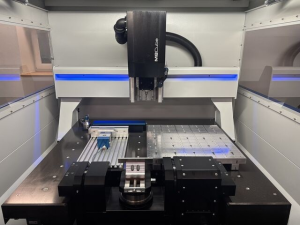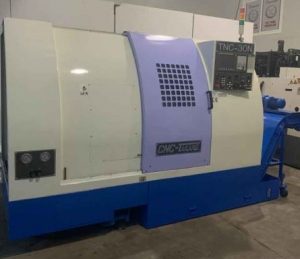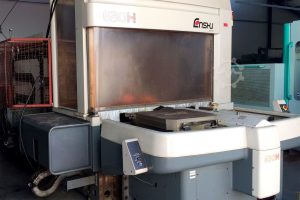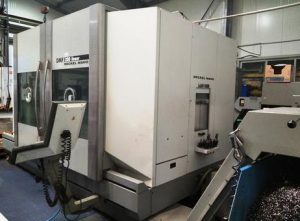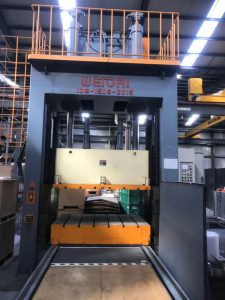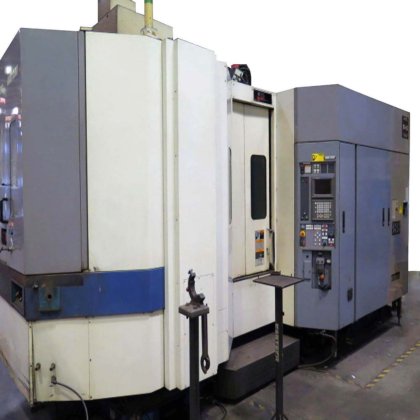
From Factory Floor to Your Workshop: Evaluating a Pre-Owned , Used , Secondhand, Surplus CNC Machines Before Purchase Mori Seiki SH-630 CNC Horizontal Machining Center made in Japan
Here’s a detailed, structured guide (with Mori Seiki SH-630–specific notes) for evaluating a pre-owned / secondhand / surplus horizontal machining center before purchase. Use this as your on-site and off-site “due diligence” checklist.
1. Know the Machine — Baseline Specs & What to Verify
Before going on site, get the machine’s spec sheet, original manual, and any as-built or modification records. Use those numbers as your reference. Here are typical published specs & variants for the Mori Seiki SH-630:
| Spec | Typical / Catalog Value* | Notes / Variation Possibilities |
|---|---|---|
| X travel | ~ 33.1 in (≈ 840 mm) | Some units might be re-built or re-stroking; verify physical travel with dial indicator. |
| Y travel | ~ 29.9 in (≈ 760 mm) | |
| Z travel | ~ 33.1 in (≈ 840 mm) | This is from table to spindle or table travel depending on variant. |
| Spindle speed (max) | 10,000 rpm | Verify whether original or upgraded; also need to check condition at high rpm. |
| Spindle taper / tool holding | CAT-50 (or BT/ISO 50 variant) | Confirm exact taper and toolholder interface; check if the spindle nose is modified. |
| Spindle motor power | ~ 40 hp (≈ 29.8 kW) | Some listings show 30 HP or 40 HP depending on variant. |
| Tool changer / ATC | 60-station typical in many ads | Some units may have 120+ or dual magazines. |
| Pallet size & system | ~ 24.8″ × 24.8″ (≈ 630 × 630 mm) pallets, 2 pallets typical | Some units may have more pallets or rotary indexing pallets. |
| Control & electronics | Often MSC-516 or MSC-502 (Mori Seiki’s controls) | Confirm the control version, firmware, spare parts availability. |
| Machine weight & footprint | Large / heavy — substantial foundation & crane needs | Be prepared for high rigging and transportation costs. |
* Always confirm the as-sold unit’s specs; modifications and retrofits are common in used machines.
Knowing these baselines helps you immediately spot deviations or red flags (e.g. a model claimed to be “SH-630” but with only 6,000 rpm spindle, or missing ATC, or very short travels).
2. Preliminary Paperwork & Questions (Before Visiting)
Ask for the following ahead of your visit — the answers (or absence thereof) will guide how deep you dig on site:
- Service / maintenance logs — especially spindle rebuilds, bearing replacements, ATC repairs, major collisions or overtravel events
- Operating / cutting hours on spindle / axes
- History of crashes, collisions, or repairs (e.g. spindle crashes, table strikes)
- Retrofits or upgrades — e.g. spindle upgrade, ATC change, electronics upgrade, pallet system changes
- Parts availability & sources for Mori Seiki / MSC controls, spindle bearings, etc. in your region
- Accessories included — pallets, fixtures, chucks, workholding, tool holders, software licences, manuals, wiring diagrams
- Transport & rigging plan — how the seller plans to move it, disassemble/reassemble, alignment included?
- Warranty / return or test period — even used sellers sometimes provide limited guarantees or test-cut periods
If the seller cannot provide credible logs or is vague, consider that a risk.
3. Visual & Structural Inspection (Before Powering On)
Walk the machine thoroughly. Many serious defects can be caught or inferred without powering it. Here’s what to look for:
A. Structure, Castings & Enclosures
- Check for cracks, weld repairs, or distortions on the base, column, saddle, and bed.
- Inspect the guideway covers, wayguards, bellows — tears, missing sections, or damage probably allowed chip/coolant ingress, which wears down surfaces.
- Examine for corrosion, rust, pitting especially in coolant zones, base, bed surfaces, column edges.
- Look at panels, doors, guards, limit switch covers — are they original, missing, patchwork repairs?
- Inspect the wiring harnesses, conduit, cable carriers for chafing, splices, nonstandard patches, etc.
- Evaluate the ATC / magazine assembly for bent parts, missing fingers, alignment marks, or signs of collision.
- Check coolant sump, pumps, piping, filtration, chip conveyor — heavy sludge or rust may point to neglected maintenance.
B. Static / Mechanical Checks (Manual Probing)
- Try to manually jog or move axes (if safe) or carefully use hand jog to feel for binding, stiff spots, or jerkiness.
- Check for backlash / play in each axis: push in one direction, reverse, measure how much “dead” movement before motion.
- Mount a test bar or known tool in spindle and gently check for axial / radial play (wiggle).
- Examine the ATC magazine indexing / turret (if a rotary or linear magazine) for smooth motion, missing parts, or damage.
- Check for lubrication feed lines, oil ports, fittings — clogged, missing, or corroded lines indicate neglect.
- Check table surfaces, pallet faces, and pallet locating surfaces: are they flat, undamaged, or worn?
If you see serious structural repairs, cracked castings, or heavy damage, that’s a major red flag.
4. Power-Up & Basic Electrical / Control Checks
With power applied (safely, following electrical protocols), start basic control and drive checks.
- Observe the boot sequence of the control: any alarms, errors, missing modules, or unusual messages?
- Test control panel buttons, switches, jog keys, display responsiveness.
- Engage drives in manual jog or “remote mode,” moving each axis slowly: see whether drives fault, alarms occur, or movement is erratic.
- Test safety circuits: E-stop, door interlocks, limit switches.
- Monitor power draw, voltage stability, any surges — though full loads may not be tested yet.
If the machine refuses to boot cleanly or the drives show repeated faults, you have a serious problem.
5. Dynamic Motion & Accuracy Tests
Assuming control and axes respond, run through a structured motion and accuracy test:
A. Axis Motion & Repeatability
- Jog each axis through full travel (slow → medium → faster speeds). Listen for abnormal noises (grinding, whine, squeal).
- Reverse directions and measure backlash / reversal error for each axis using a dial indicator or test instrument.
- Move, stop, reverse: measure how precisely the machine returns to a commanded point (repeatability).
- Command combined-axis moves (e.g. circle interpolation) to test smoothness and consistency.
- If available, run a ballbar test (or circularity test) — it’s a powerful tool to detect geometric and servo errors.
B. Spindle Performance
- Run spindle at several speeds (low, mid, high). Listen for bearing noise, hum, vibration.
- Use a dial indicator to measure radial runout (on the spindle nose or a held tool).
- Let it run for a short period to see if temperature, vibration, or noise changes (heating issues might emerge).
- If possible, run a light cut in soft material and monitor how the spindle behaves under load.
C. Test Cuts & Realistic Machining
- Always insist on a test cut / sample part: turning, facing, boring, side milling, etc.
- Check dimensional accuracy, surface finish, consistency across locations on the part or table.
- Try cuts pushing toward limits (long traverse, heavy cuts) to see if deflection, chatter, or vibration manifests.
- Monitor coolant flow, chip evacuation, chip accumulation, coolant leakage issues.
6. Geometric, Alignment & Metrology Assessment
If you have access to inspection tools (or bring a metrology technician), these checks are critical for understanding how far the machine is from ideal alignment.
- Check straightness / flatness of axes over travel using gauge blocks, straight edges, or laser interferometry.
- Evaluate parallelism of axes (e.g. spindle axis relative to axes, axis-to-axis parallelism).
- Assess squareness: e.g. whether Y-axis or X-axis is square to spindle axis across travel.
- Measure positional accuracy / linearity: command various distances and measure actual distances across full strokes — check for scale errors.
- After warm-up, monitor thermal drift over time in X, Y, Z.
- At extremes of travel (e.g. full extension of Z, or far end of X), test for sag, deflection, or geometric distortion.
Be aware: some geometric errors can be corrected (shimming, alignment, software compensation), but structural or severely worn ways often are expensive or impossible to fully restore.
7. Estimate Refurbishment & Undisclosed Costs
Even a well-maintained used machine will likely need some work. Budget accordingly. Possible refurbishment or deferred maintenance items include:
- Spindle rebuild / bearing replacement
- Replacing or refurbishing ATC magazine, indexing gear, fingers, cams
- Ball screw nut replacement or regrinding
- Re-scraping / re-lapping / way grinding / surface restoration
- Servo drives, feedback systems, wiring harness repairs
- Replacement of sensors, limit switches, proximity switches
- Coolant system overhaul (pump, piping, filters, seals)
- Re-leveling, alignment, shim work, calibration
- Electrical / control modernization if needed
- Spare parts (bearings, seals, servo modules, tools)
- Transportation, rigging, disassembly, reassembly, alignment and commissioning
- Software backup / control licensing / maintenance contracts
Also include cost of downtime and risk of hidden damage discovered post-installation.
8. Red Flags & Deal-Breakers
Some conditions should either push you to demand a big discount or walk away altogether:
- Spindle with audible noise, high vibration, or overheating issues
- Control that refuses to boot cleanly, drive modules that fault, or missing control modules
- Excessive backlash or play that seems beyond repair
- Major structural defects (cracks, welded repairs) on bed, column, base
- Catastrophic ATC / magazine damage (bent arms, missing fingers)
- Inability to perform any sample cuts or test under load
- No documentation, wiring diagrams, or spare parts available
- Obsolete electronics with no end-of-life support or hard-to-source replacements
- Seller unwilling to permit inspection, trials, or limited acceptance window
9. Strategy for Making an Offer & Negotiation Tips
- Start with a conditional “subject to inspection / trial / acceptance” offer, rather than blind full price.
- Itemize faults or deviations you discover, and deduct appropriately.
- Ask seller to include spare parts or a refurbishment allowance for known issues.
- Negotiate a limited warranty or acceptance period after installation and test-cuts.
- Factor in your total “installed cost”, not just purchase price (transport, rigging, alignment, reman costs).
- Walk away when the total cost to bring to reliable production condition exceeds a new, refurbished, or better-used alternative.