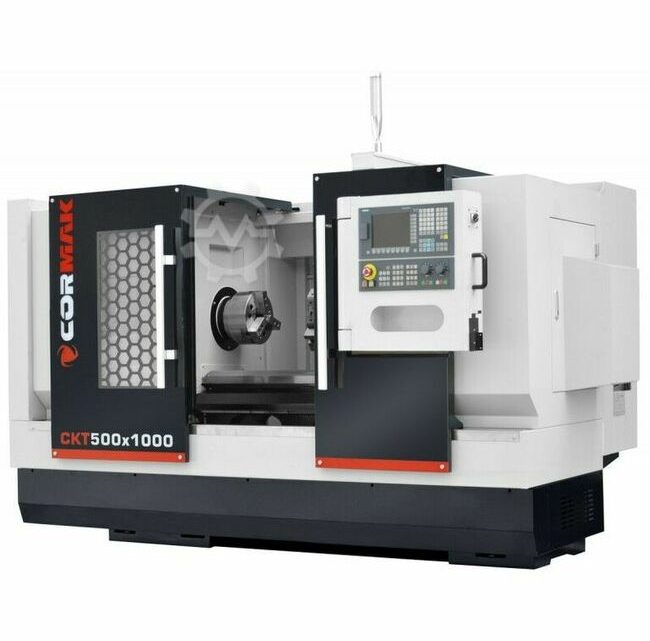
From Factory Floor to Your Workshop: Evaluating a Pre-Owned , Used , Secondhand, Surplus CNC Machines Before Purchase CORMAK CNC CKT 500×1000 CNC Lathe made in Poland
Here’s a tailored checklist and inspection guide for evaluating a pre-owned / secondhand / surplus CORMAK CKT 500×1000 CNC lathe (made in Poland) before acquisition. The general method is similar to any used CNC system, but I’ll flag things specific to the the CKT 500×1000 (based on its published specs) to help you spot potential trouble.
What is the CORMAK CKT 500×1000? — Key Specs & What to Use as Benchmark
Before inspection, you should know what the machine should be capable of, so deviations stand out.
From the manufacturer’s spec sheet, here are typical parameters:
- Swing over bed: 500 mm
- Swing over support / cross slide: ~250 mm
- Max workpiece length (between centers): 1000 mm
- Spindle speed range: 100–1800 rpm (or variants: 200–1800)
- Spindle bore / pass: 66 mm bore (some variants up to 75 mm or 91 mm)
- Spindle taper: A2-11
- Tool turret / tool count: 6 standard (optional 8 or 10)
- Feed speeds (X / Z axes): ~8 / 10 m/min
- Motor power: 7.5 kW (with optional 11 kW)
- Control / drives: Often Siemens SINUMERIK (e.g. 808D) and servo drives.
- Weight & size: Roughly 2,850 kg, footprint ~2,950 × 1,520 × 1,750 mm
Use these values as your “reference envelope.” If you observe a used machine that deviates significantly (e.g. spindle bore too large, sluggish feeds, or modified axes), that may either be a red flag or an intentional retrofit—but ask for documentation.
Preliminaries Before Visiting / On-Site Questions
Before committing to travel or inspection, try to collect:
- Maintenance history / service logs: spindle rebuilds, bearing replacements, turret work, etc.
- Operating hours or equivalent usage metric (if the control logs them).
- Crash / accident history: collisions, overtravels, repairs.
- Any known retrofits, upgrades or parts replacements (e.g. spindle, drives, new control).
- Parts availability: are spare parts for the CORMAK CKT series still stocked or accessible (locally or via EU suppliers)?
- Accessories included: chucks, soft/hard jaws, steady rest, tailstock, tool holders, tooling, documentation, electrical schematics, manuals.
- Transport / disassembly needs: how will the lathe be moved, rigged, reassembled, aligned at your site.
- Warranty or acceptance period: can you test it after delivery and return if issues emerge?
If the seller cannot provide reasonable documentation or is vague, be cautious.
Visual & Structural Inspection (Before Power-Up)
Walk around the lathe and examine every component. Key areas:
A. Structure, Bed & Castings
- Inspect the bed ways for scratches, scoring, pitting, corrosion, or wear. Excess wear here means loss of straightness, more backlash, or need for regrinding.
- Look at the bed casting, columns, tails, headstock for cracks, welds, or repair scars.
- Examine guide covers / way covers / guards — torn or missing covers often allow chips and coolant to intrude and damage ways.
- Look for surface rust, especially on the bed, carriage, cross slide, and inner surfaces of covers.
- Inspect base / foundation mating surfaces for flatness, bolt holes, and whether any shims or leveling corrections have been made repeatedly.
- Check all guard panels, covers, enclosures, doors, interlocks. Are they all present and in good condition?
B. Mechanical Components (Stationary Checks)
- Manually (safely) move the carriage / cross slide / tailstock (if possible) by hand to feel for binding, uneven motion, rough spots.
- Check for play / backlash: push in one direction, then reverse, measure how much “dead” motion before movement.
- Insert a test bar or tool in the spindle (if safe) and check for axial / radial play or wiggle.
- Inspect the tool turret / turret head: inspect fingers, magazine arms, indexing surfaces, cams, and follower surfaces.
- Examine the tailstock / quill for smooth travel and for play in the quill.
- Check lubrication lines, oiling ports, piping, fittings: clogged or missing lubrication is a sign of neglect.
- Inspect chip / coolant drainage / sump / coolant lines for heavy sludge, signs of corrosion, leaks, or clogged paths.
Power-Up & Dynamic Testing
Once satisfied that nothing catastrophic is obvious, power up carefully and perform controlled tests.
A. Electrical & Control
- Perform the boot sequence: does the CNC control start cleanly, with no major faults or error codes?
- Test all control panel keys, buttons, switches, display responsiveness, etc.
- Engage servo drives in “jog” or manual mode, checking for drive faults, alarms, or errors.
- Check safety circuits: E-stop, door interlocks, interlock switches, limit switches.
- Monitor power draw (if possible) — overcurrent or unstable draw may indicate failing drives or motors.
B. Axis Motion Tests
- Move each axis (X and Z, perhaps Y if a cross-slide) through its full travel in increments: at slow speed, medium, and faster speed.
- Listen for clunking, grinding, jerky motion, or any weird noises.
- Perform reversals / direction changes and note backlash, overshoot, or hysteresis.
- Use a dial indicator or test gauge to check repeatability: move a known distance out, reverse, come back, see if you return to original position within acceptable tolerance.
- If possible, run a circular interpolation / combined axis move (e.g., to trace a circle) and observe smoothness.
- If you have or can bring a ballbar test rig, run the ballbar test to detect geometric errors, servo tuning deficiencies, or backlash.
- Check how the axes behave near travel limits (soft/hard limits) — sometimes wear or misadjustment is worst at travel ends.
C. Spindle Testing
- Run the spindle at various speeds (low → medium → maximum) and listen for bearing noise, vibration, hum.
- Use a dial indicator to check for radial runout on the spindle nose or with a known toolholder.
- Let it run for a moderate period (if feasible) to see if it heats up, vibrates more, or develops abnormal behavior over time.
- If possible, do a light cut on a known workpiece and see how the spindle holds under light load, how insert chatter behaves, etc.
D. Cutting Trials / Test Part
- Always request or perform a realistic test cut. For example, turn a cylinder, face, bore, cut threads, etc.
- Check dimensional accuracy, surface finish, repeatability across multiple passes.
- Try worst-case or long-travel cuts to find deflection, vibration or thermal drift.
- Observe chip control, coolant flushing, evacuation of chips, cleanliness of cut.
- Monitor whether chatter or vibration appears under load.
Geometric / Alignment & Metrology Checks
If possible (or bring a metrologist or test equipment):
- Check straightness / flatness of bed and carriage travel across the span.
- Check parallelism between spindle axis and bed, or spindle to carriage surfaces.
- Measure squareness: is the cross slide perpendicular to spindle axis across the table travel.
- Check positional accuracy / linearity: command various distances and measure actual distances across full strokes.
- After warm-up, monitor thermal drift: any slow movement over time due to heating.
- At extremes (e.g. end of Z travel or near tailstock), test for deflection / sag error.
Note that some geometric errors can be corrected (shimming, alignment adjustments), but large structural misalignment or worn ways may be costly or impossible to fully restore.
Specific Risks / Red Flags to Watch for in a CORMAK CKT 500×1000
Based on its design, spec, and probable history, these are domain-specific caveats:
- Spindle bearing wear: Since the machine is relatively modest speed (max ~1,800 rpm) but still significant, worn spindle bearings are a likely weak spot. Any humming, vibration, or heating is red warning.
- Turret / tool indexer issues: the 6-position turret is mechanical and can suffer wear in indexing cams, fingers, splines, or drive mechanisms. Misindexing or skipping is bad.
- Ball screws and drives: for cross/longitudinal feed — backlash, wear, or nut play can degrade precision.
- Guideway wear: since this is a flat-bed lathe, the bed is used constantly under load, so wear on ways, especially near the chuck end, can be accentuated.
- Control / electronics aging: even though Siemens SINUMERIK or similar are robust, older drives, wiring, connectors, or servo feedback circuits may be stressed or nearing end-of-life.
- Parts obsolescence: for CORMAK machines, some parts may be harder to source depending on local dealers or spares inventory in your region.
- Coolant / chip management system: deformed or leaky coolant lines, filters, sump, coolant pump failure could reflect neglect.
- Thermal stability: excessive heating or thermal drift may indicate worn bearings or inadequate cooling.
- Hidden structural damage: in older machines, collisions, overtravels or forced crashes may have induced internal misalignment or damage (even if superficially repaired). Always probe for internal misalignment or distortion.
Risk Mitigation & Cost Estimation
Even a “good” used machine will require some maintenance or refurbishment. Plan ahead and budget for:
- Spindle rebuild or bearing replacement
- Replacement of turret fingers, indexer parts
- Ball screw nut replacements, drive recalibration
- Re-scraping or re-grinding of ways / slides
- Servos, cables, connectors refurbishment
- Replacement of sensors, limit switches, proximity sensors
- Replacement or overhaul of coolant and chip systems
- Re-leveling, alignment, shimming, calibration
- Electrical / wiring overhaul or modernization
- Spare parts package (nuts, seals, bearings, etc.)
- Transport, rigging, disassembly, reassembly, alignment and commissioning
Also plan for the cost of downtime if issues arise later, and the possibility that the seller may need to provide a short warranty or acceptance period.
Decision Strategy & Red/Green Flags
Use a scoring or tiered approach for subsystems (spindle, axes, turret, control, geometry). Some absolute disqualifiers (unless heavily discounted) include:
- Spindle with audible noise, vibration, or overheating
- Major damage, cracks, or structural repairs in bed or headstock
- Unrecoverable misalignment or bent guideways
- Turret that fails indexing or has serious wear
- Control / drive faults that prevent reliable operation
- No possibility to test under load
- Seller unwilling to provide any recourse (warranty, trial, spares)
- Lack of documentation or schematics
If a machine passes visual + dynamic + cutting tests within acceptable tolerances and offers the prospect of refurbishment at reasonable cost, then you may have a viable acquisition.