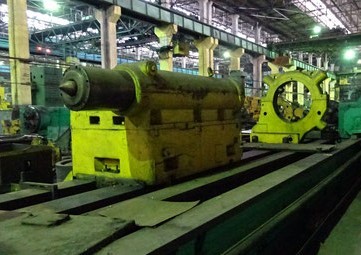
From Factory Floor to Your Workshop: Evaluating a Pre-Owned , Used , Secondhand, Surplus CNC Machines Before Purchase Kramatorsk 1680 Universal Heavy-Duty Lathe 10 Meters
Below is a structured approach and checklist you can use to evaluate a pre-owned / secondhand / surplus Kramatorsk 1680 universal / heavy-duty lathe (~10 m or more capability) before committing to purchase. The goal is to uncover hidden costs, assess risk, and determine whether the machine is fit for your shop. Use this as a working template—adjust according to your shop’s capabilities and requirements.
1. Understand the baseline spec & context
Before inspection, compile the technical specifications, original design tolerances, and known strengths/weaknesses of the model. For the Kramatorsk 1680 (heavy duty lathe) for example:
- According to listings, the Kramatorsk 1680 has a maximum working length (distance between centers) of ~10,000 mm (10 m).
- Turning diameter (over bed): ~2000 mm; over support: ~1580 mm; center height: ~1040 mm.
- Spindle speed range: ~2.5–128 rpm; main motor ~100 kW.
- Machine footprint: ~18,260 × 4,060 × 2,750 mm; weight ~138.5 tons.
Knowing these, you should verify that the machine on site matches or approximates these specs (or deviations are justified by rebuilds/modifications).
Also, do some background: see if there are known reliability issues or common failures on Kramatorsk heavy lathes (e.g. wear on beds, drive train components, alignment drift, spindle bearing wear).
2. Request Documentation, History & Records
Before visiting physically, ask the seller for:
| Document / Data | Why Important | What to Look For / Red Flags |
|---|---|---|
| Maintenance logs & service records | Shows how well the machine was cared for | Gaps or missing records, evasive replies |
| Repair / overhauls / part replacements | Indicates prior major issues | Frequent major rebuilds, lacking details |
| Machine manual(s), parts lists, schematics | Essential for future maintenance & repairs | If missing, replacing parts later will be harder |
| Original alignment / acceptance reports (if available) | You can compare deviations | Unavailable or no “as new” baselines |
| Running hours / usage metrics | Machines with very high usage may have more wear | If usage is undisclosed, assume worst |
| Upgrades / modifications history | Helps you understand non-standard parts or mismatches | Poor documentation of modifications is a risk |
If the seller cannot provide credible documentation, that is a red flag.
3. Visual & Structural Inspection
Walk around the machine thoroughly. Use good lighting, magnifier, feel for unevenness, etc.
3.1 External examination
- Rust, corrosion, pitting on bed surfaces, saddle, ways, external surfaces
- Cracks, welds, repairs in the frame, housing, bed
- Alignment of major components (headstock, tailstock, carriage) — see if things look crooked
- Missing guards, covers, panels, shields
- Signs of abuse: dents, distortion, tool marks, overloading scars
3.2 Bed, Ways & Slides
- Use a straight edge and feeler gauge or better tool to check straightness / flatness
- Look for grooves, scoring, chatter marks, wear zones
- Check the way lubricant channels, wipers, seals
- Move carriage and cross slide (if possible) by hand; feel for binding, stick/slip, uneven resistance
3.3 Spindle, Headstock & Chuck
- Rotate spindle (by hand or slow drive) and listen for abnormal noise, roughness, vibrations
- Test run at low speed and gradually up; monitor noise, bearing heat, run-out
- Spindle play / axial & radial clearance — use dial indicators to detect run-out or wobble
- Check spindle bore (e.g. taper or straight bore) for wear or scoring
- Inspect chuck (if included) — jaws, mounting surfaces, alignment
3.4 Tailstock & Quill
- Check quill travel, alignment, fit, locking mechanism
- Check for wear in guiding surfaces
- Ensure it can lock firmly and reposition smoothly
3.5 Carriage, Cross Slide, Tool Post
- Move under power or manually; detect backlash, play, slack, jerks
- Check ways and sliding surfaces for wear
- Inspect tool post, tool holders, turret (if any)
3.6 Supports, Steady Rests, Lunettes
- If the machine has steady rests or supports, check their adjustment, wear on bearing surfaces
- Ensure all rails, supporting structures are stable
3.7 Lubrication / Hydraulic / Cooling Systems
- Check oil/grease levels, condition (contaminants, sludge)
- Inspect oil lines, pumps, filters, reservoirs
- Check coolant system: tank, pumps, lines, nozzles, leaks
- Check hydraulic systems (if used) for leaks, pressure integrity
3.8 Electrical & Cabling
- Inspect wiring, junction boxes, connectors, cable insulation for wear, heat damage, corrosion
- Check control panel, buttons, display units, switches
- Ensure emergency stops, safety interlocks are present and functional
- Inspect grounding and electrical safety
4. Dynamic Testing & Functional Trials
If possible, arrange a test session (ideally with an operator) to run the machine under load.
4.1 Power-Up & Control Diagnostics
- Turn the machine on; watch for alarm codes, errors, warnings
- Run through diagnostic modes (if available)
- Check control axes, motors, drives
- Confirm the CNC or control (if retrofitted) is functional and responsive
4.2 Movement Tests
- Command motion on longitudinal, cross, and possibly rotary axes
- Move slowly in both directions; check for backlash, hysteresis, sloppiness
- Move at different speeds; check for smoothness
- Listen/feel for unusual noises
4.3 Spindle Under Load / Test Cut
- If possible, perform a light test cut on a sample workpiece
- Measure the result (diameter, form, taper, straightness) to assess actual accuracy
- Test different feed rates, depth cuts, cutting conditions
- Monitor surface finish, tool vibration, chatter
4.4 Repeatability & Accuracy Checks
- Use dial indicator or measuring equipment to check repeatability (e.g. commanding return to a reference point)
- Check parallelism, perpendicularity, geometric deviations
4.5 Thermal Behavior
- Run the machine for an extended period; monitor for heating of bearings, slides, drive motors
- See if thermal expansion causes drift or deviation
5. Geometric & Alignment Checks
Here you’ll need metrology tools (dial indicators, straightedges, test bars, level, etc.).
- Check squareness between axes
- Test parallelism of carriages relative to bed
- Use test bars or mandrels to check spindle alignment
- Use run-out indicators to see deviations over length
- Use alignment jigs or telescoping gauges
6. Parts, Support & Spares
- Determine availability of spare parts (bearings, gearboxes, slides, screws) for Kramatorsk or modified versions
- Check for support (local or regional) for control electronics, motors, drives
- Estimate cost and lead time for major components
- See whether proprietary or custom parts make maintenance or repairs harder
7. Transport, Installation & Infrastructure Costs
Large heavy machines like a 10 m heavy-duty lathe imply significant costs beyond purchase:
- Dismantling / removal costs at the seller’s site
- Transport & shipping, including special handling, heavy‐lift cranes, road permits
- Foundation, flooring, anchoring, leveling at your workshop
- Power supply upgrades, cabling, electrical infrastructure
- Cooling, air, hydraulic supply in your shop
- Commissioning, alignment, calibration, balancing on site
- Safety, guarding, ventilation compliance
Include a buffer in your budget for these.
8. Risk Assessment & Pricing Strategy
- Based on the inspection findings, assign risk levels to major subsystems (spindle, ways, controls, etc.).
- Estimate cost to repair or refurbish the machine to acceptable tolerance.
- Subtract those costs (plus margin) from your “ideal” maximum price.
- Be prepared to walk away if costs or uncertainties are too high.
- Negotiate based on detected defects or missing components.
- If possible, include a clause in the sales contract for acceptance after trial or guarantee of basic functionality.
9. Special Considerations for This Size / Era
Because the machine is very large, old, and likely modified or retrofitted, watch out for:
- Creep, sag, structural deformation in the bed over decades
- Wear patterns from long use under heavy loads
- Retrofitted controls or electronics that may not integrate well or be obsolete
- Non‐linear errors over long spans
- Calibration drift over long length
- Foundational settling or misalignment from prior installation
Also note that heavy machinery from older Soviet/Ukrainian origins may have been maintained differently, and some components may be more difficult or costly to replace or refurbish.
10. Final Go/No-Go Checklist & Decision Factors
Before finalizing, check:
- Did the machine pass (or reasonably pass) spindle integrity, bed/wear, alignment, movement smoothness tests?
- Are repairs within your capability or budget?
- Are control and electrical systems serviceable and supported?
- Are the logistics, transport, installation, commissioning costs acceptable?
- Do you have a practical plan to calibrate, align, and bring the machine into production?
- Does the seller offer any post-sale support or guarantee?
If most key systems are solid or repairable, and your total cost (purchase + refurbish + install) still gives acceptable return on investment, it may be viable. If any “fatal flaw” surfaces (e.g. severely worn bed, damaged spindle beyond repair, missing major components), walk away or renegotiate strongly.