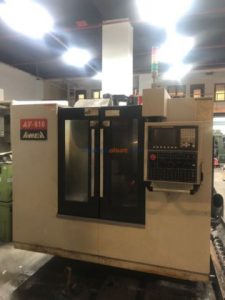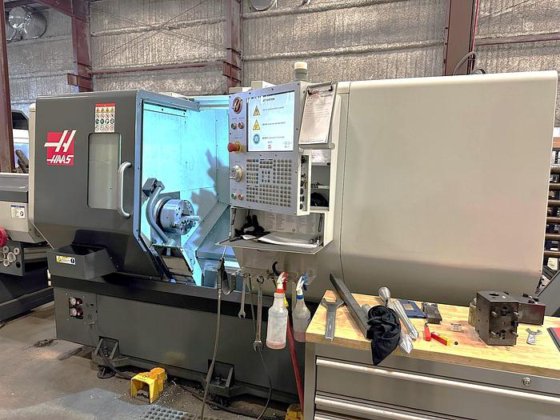
From Factory Floor to Your Workshop: Evaluating a Pre-Owned , Used , Secondhand, Surplus CNC Machines Before Purchase Haas DS-30Y CNC Turning Center made in USA
Here’s a detailed, structured guide you can use when evaluating a pre-owned / surplus Haas DS-30Y dual spindle / Y-axis turning center (made in the USA) — from factory floor to your shop floor. I also list reference specs and typical failure / wear points so you can benchmark what you see. You can adapt this to your particular inspection.
Reference Specs & What “Normal” Looks Like
Before inspection, have the Haas DS-30Y spec sheet handy so you know which claims to challenge. Some data:
From Haas official site:
- 10″ main spindle chuck size, 3.0″ bar capacity, up to 4,500 rpm, 30 hp main spindle.
- DS-30Y has dual spindles, Y-axis ±2.00″ (±50.8 mm), live tooling, C-axis, 12-station BMT65 turret.
- Capacities: max part swing ~21″ (533 mm), X = 9.4″ (239 mm), Z = 32.5″ (826 mm), etc.
- Example used spec: 30 hp, 4,500 rpm, chuck size 10″, 12-station turret, etc.
These give you baseline for acceptable tolerances. If someone claims wildly higher speeds, travel, or horsepower, ask for proof (test cuts, drive data, etc.)
Also, Haas offers a Lathe Level & Alignment Checklist (for ST / DS series) which gives alignment tolerances between spindle, turret, Z-axis, etc.
Use that to validate alignment if the seller allows.
Pre-Screening (Before Visiting)
Before heading to the site, collect as much documentation and evidence as possible:
- Photos of nameplates (mechanical & electrical), showing model, serial, build year.
- Specification sheet / brochure for that specific DS-30Y variant.
- Control / CNC version, software version, parameter backups, tool tables.
- Operating / runtime history (power-on hours, cutting hours, spindle hours).
- Maintenance / repair records (spindle rebuilds, turrets overhauled, major parts replaced).
- List of included tooling, fixtures, spare drive modules, electronics.
- Video / photos of the machine running: spindle motion, turret indexing, Y-axis moves, etc.
- Reason for sale (upgrade, failure, consolidation).
- Shop conditions (coolant type, cleanliness, chip control, environment).
- Layout / rigging data (weight, footprint, crane access, foundation).
If the seller is evasive or lacks many of these, be cautious.
On-Site Mechanical & Structural Inspection
Bring measurement tools (dial indicators, test bars, micrometers) and, if possible, a technician familiar with multi-spindle lathes. Proceed in this order: external → mechanical motion → electrical & control → operational testing.
1. Visual & Structural Checks
- Inspect castings, the base, column (if any), frame for any cracks, repair welds, distortions.
- Examine guideways / slides on all axes (X, Y, Z) for scoring, corrosion, pitting, wear.
- Check way covers, bellows, guards: torn, missing, or misaligned covers are bad signs.
- Inspect spindle noses, chucks, backplates for damage or wear.
- Inspect turret housing, tool stations, indexing face for wear, play, misalignment.
- Check for leaks: coolant, oil, hydraulic system (if present) around seals and sliding surfaces.
- Inspect cabling, conduits, junction boxes, wiring for patched wires, exposed insulation, strain issues.
- Inspect the Y-axis slide / carriage mechanism for looseness or damage.
Try to gently jog axes (in safe mode) to detect zones of binding or grit.
2. Kinematic / Motion / Backlash Tests
- Jog axes (X, Y, Z) slowly through their full ranges; feel for stiction, binding, “notchiness.”
- Use dial indicators to test backlash / lost motion in each axis (push-pull) at multiple positions.
- Reverse direction near limits to detect hysteresis / deadband.
- Check ball screws, nuts, couplings, bearing supports for axial / radial play.
- Jog slow feed moves; watch for smoothness (no jumps, hesitation).
- Cycle turret indexing many times and watch for mis-indexing, hesitation, or slop in tool seats.
3. Spindle / Tooling / Live Tooling / Y-Axis Checks
- Run each spindle (main and secondary) at multiple speeds; listen for bearing noise, vibration, roughness.
- Use a test bar + dial indicator to measure spindle runout at the nose and possibly further out.
- Check spindle acceleration / deceleration behavior.
- Test chuck closing / opening, jaw alignment, chuck seat, backplate fit.
- Operate live tooling / C-axis if installed; verify speeds, torque, backlash.
- Move Y-axis (±) direction, test milling / drilling off-center operations; observe accuracy, backlash in Y.
4. Control / Electrical / Electronics / Cabinet
- Open control / power cabinets; inspect wiring, fuses, relays, drives, interface boards.
- Look for signs of overheating: discolored insulation, melted wires, burnt connectors.
- Inspect servo / amplifier modules for damage, corrosion, signs of past faults.
- Check cable routing, shielding, strain reliefs, plug integrity.
- Power up: test control panel buttons, switches, emergency stops, limit switches, interlocks.
- Navigate CNC menus, check parameter memory, tool tables, macro programs, alarm log.
- Test safety interlocks: opening doors / guards should kill motion.
- If encoders / linear scales are installed, verify they respond and seem consistent.
Operational / Test-Cut & Live Running
If allowed, tests under load often reveal problems hidden by static inspection.
- Run a dry / air motion program to move all axes, tool changes, Y-axis moves, turret indexing.
- Perform a test cut (e.g. a known standard part) to evaluate surface finish, accuracy, chatter.
- Run an extended machining cycle (30-60 min) under moderate load; afterward re-measure key axes (backlash, runout) to detect thermal drift.
- After warm-up, re-check critical dimensions / backlash to detect shifts.
- Cycle turret many times; cycle Y-axis moves under load; assess consistency over repeated operations.
- Test operations that stress system: off-center milling, simultaneous multi-axis moves, heavy cuts.
Metrology & Accuracy / Alignment Checks
- Use calibrated gauges, test bars, master fixtures to check straightness, squareness, alignment.
- Test repeatability: move to point, retract, return, measure deviation.
- Check roundness, concentricity, taper errors on test parts.
- After prolonged running, re-check offsets, tool heights, backlash to detect drift.
- Compare measured tolerances with what your parts require, and with normal machine spec claims.
Also use the Haas Lathe Level & Alignment Checklist (ST / DS series) to check alignment tolerances—spindle to Z-axis, turret face, etc.
Infrastructure, Installation & Practical Considerations
- Confirm your shop floor load capacity is adequate (machine weight, dynamic loads).
- Ensure crane / rigging / path clearance for moving / installing the machine.
- Verify your power supply (voltage, phases, current) meets machine requirements (Haas DS has power spec, in its pre-install guide).
- Confirm coolant / chip removal / filtration / space for chip conveyors etc.
- Plan proper leveling, anchoring, foundation per Haas requirements.
- Ensure service access on all sides, control cabinet clearance, maintenance space.
- Confirm spare parts / support for Haas DS line in your region (modules, drives, parts, support).
Decision / Negotiation Criteria & Red Flags
Once you’ve done all measurement, observing, and test cuts, evaluate:
Good / acceptable signs:
- Measured travel, speeds, chuck size are close to the spec.
- Smooth motion, low backlash, no zones of stiction.
- Spindles run quiet, stable, low runout.
- Turret indexing is repeatable and accurate.
- Y-axis movement works as expected (if installed) with acceptable backlash.
- Control system is intact, no error logs or corrupted parameters.
- Test cuts show good surface finish and stable dimensions.
- Performance holds after warm-up (minimal drift).
- Spare parts / support for Haas DS line is accessible.
Red flags / deal-breakers:
- Major mismatch between claimed and actual specs (travel, rpm, torque).
- Severe wear on ways, banding, roughness.
- High backlash, zones of binding or motion jumps.
- Spindle noise, overheating, vibration, excessive runout.
- Turret mis-index, slop, tool seating issues.
- Y-axis error, nonfunctional, or excessive backlash.
- Control modules burnt, wiring damage, corrupted software or missing parts.
- Test cuts show drift, poor finish, chatter mid-cycle.
- Significant shift / drift after warm-up.
- Genuine parts no longer available or support too costly.
- Seller refuses live test, documentation, or warranty offer.
Use discovered defects as negotiation leverage — demand discount, spare parts, or short-term performance guarantees. Document all your findings rigorously (photos, measurements, videos) for your records.