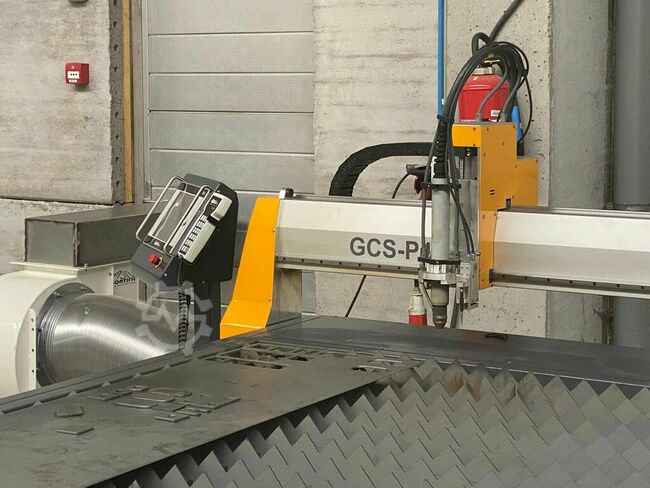
From Factory Floor to Your Workshop: Evaluating a Pre-Owned , Used , Secondhand, Surplus CNC Machines Before Purchase GEKA GCS-P 4020 – 125A Plasma Cutting Machine made in Spain
Here is a detailed, methodical evaluation guide you can bring with you when inspecting a GEKA GCS-P 4020 (125A) CNC plasma cutting table (made in Spain) — from preliminary documentation review through on-site mechanical, optical, and operational testing, to final decision criteria. I also include known specs for this model so you have benchmarks to compare against seller claims.
1. Reference Specs & Benchmark Data
Before visiting, arm yourself with the published specifications of the GCS-P4020 so that you know what to expect (and what claims to challenge). Some key data:
| Parameter | Published / Typical Value | Source / Notes |
|---|---|---|
| Table / working area (X × Y) | 4,000 × 2,000 mm | GEKA product listing shows P 4020 = 4000 × 2000 mm |
| Motion (rapids / travel speed) | 40 m/min | GEKA states “movement speed 40 meters/min” |
| Resolution | 0.01 mm | GEKA specs for GCS-P series: resolution 0.01 mm |
| Z-axis (gantry height) | 100 mm | GEKA spec: bridge height Z = 100 mm |
| Plasma source / power | Hypertherm 125A | Many used listings note the unit includes Hypertherm 125A source |
| Cutting capacities (approx) | Steel 25 mm; Stainless 20 mm; Aluminium 12 mm | In used listing: these are the claimed capacities of the GCS-P4020-125A unit |
| Structure & drive design features | Linear guides (self-lubricated, sealed), rack & pinion drives, torch height control (THC), anti-collision, laser pointer for zeroing, sectorized fume extraction | GEKA’s spec sheet indicates these as features of the GCS-P series |
| Optionals / features | Automatic lubrication, separate suction chambers, rack & pinion gearboxes, enclosed cable drag, safety head, laser pointer, anti-collision, CNC touch panel control | The used listing includes many of these optional features as included on that machine |
These serve as your benchmark envelope. If the seller claims travel of 6,000 mm or 100 m/min rapids, etc., you should ask for proof.
2. Pre-Visit / Document Request
Before going on site, request the following so you can pre-screen and plan your inspection:
- Clear photos of the machine nameplate(s) — mechanical and electrical (model, serial, manufacture date)
- The original specification / datasheet / user manual for the exact GCS-P4020 / 125A variant
- CNC control system details: model, software version, parameter backups, fault / alarm logs
- Usage history: hours of operation, cutting hours vs idle, types of parts/materials processed
- Maintenance / service records: torch repairs, motion axis rebuilds, linear guide service, electronics replacement
- List of included accessories / spare parts: torches, consumables, control modules, spare cables
- Photo / video of the machine in operation (motion, torch, cutting, table behavior)
- Reason for sale
- Environmental / shop conditions (dust, humidity, factory cleanliness)
- Layout / rigging / foundation information (weight, footprint, how the machine is mounted)
If the seller cannot provide many of these, proceed with heightened caution.
3. On-Site Mechanical & Structural Inspection
Bring measurement tools and a checklist; proceed from outside → mechanical components → motion → optical / plasma path → electrical / control.
3.1 Structural & External Checks
- Inspect the machine frame / gantry / base for cracks, repairs, distortions, warped structure
- Examine the guide rails / beams (X & Y) for pitting, wear, corrosion, gouges
- Check way covers, seals, covers for damage or missing parts
- Inspect torch mounting head, Z slide, supports for looseness, wear, misalignment
- Check the table (slats or grid) for damage, warpage, replacement parts
- Inspect welded joints, base reinforcements, rigidity elements
- Examine the cable drag chains, hoses, protective conduits for damage or wear
- Inspect for leaks of coolant / water / plasma gas / lubrication lines
If possible, gently move the gantry or stage (with motors off / in manual / safe mode) to sense binding, stiffness, or rough zones.
4. Motion, Kinematics & Backlash Tests
- Jog the X and Y axes slowly through full travel; observe for smooth, consistent motion or “stick-slip” zones
- Place a dial indicator at several positions and perform backlash / lost motion tests (push-pull in opposite directions)
- Reverse direction near travel limits to detect hysteresis / deadband
- Check rack & pinion meshes, gear backlash, backlash in coupling or gearbox
- Use micro-movements (small increments) to test motion linearity and responsiveness
- Test Z (torch vertical) motion similarly for smooth travel, backlash, focus axis stability
5. Plasma / Torch & Optical Path Inspection
- Inspect the torch head / nozzle / consumable parts — look for wear, erosion, damage
- Check torch alignment / mount — is it perpendicular, solid, well fixed
- Inspect gas delivery lines, hoses, fittings for leaks or damage
- Check that the Torch Height Control (THC) mechanism is working and has travel capability
- Inspect optics (if used), mirror or lens (if present) for damage or misalignment
- Do a purge test: flow gas through the system and see whether contaminants, moisture, or leaks are present (e.g. hold paper under purge)
- Inspect gain / arc initiation — test whether arc establishes cleanly
- Test anti-collision system (if present) by small controlled offset or protection test
6. Electrical, Control & CNC Inspection
- Open the control cabinet; inspect wiring, terminal blocks, fuses, contactors, power supply boards
- Look for signs of heat damage: burned insulation, discolored wiring, scorched PCB boards
- Check servo / drive modules, interface boards, control logic boards, connectors for damage or wear
- Verify cable routing, shielding, strain reliefs, connector integrity
- Power up the CNC control: verify screen, input, status, axes readiness, emergency stop, interlocks
- Examine offsets, parameter memory, alarm / fault logs
- Test limit switches, home / reference moves, soft limits
- If available, test diagnostic functions (movement feedback, error logs)
7. Operational / Test Cutting & Performance Verification
If the seller allows:
- Run a dry / no-cut motion program that moves the gantry, axes, THC, and torch positioning (without arc)
- Execute a test cut on known sheet material, moderate thickness, and evaluate cut quality (edge, dross, kerf consistency)
- Observe arc stability, material ignition, pierce behavior
- Run extended cutting (e.g. nested pattern) to stress torch, motion, thermal effects
- After warm-up, remeasure motions, backlash, accuracy to detect drift
- Cycle torch height changes, rapid head movement, arc off / on commands
- If fume extraction / suction chambers are present, verify extraction performance while cutting
Evaluate whether cut quality and dimensional accuracy are within your acceptable tolerances over the work area.
8. Metrology & Accuracy / Drift Checks
- Use a precision straightedge or test artifact to check geometric alignment (squareness, flatness, orthogonality)
- Check that cuts near edges of table vs center maintain dimensional consistency
- Repeat cuts on the same shape multiple times to test repeatability
- Measure positional accuracy: given commanded offsets, actual offsets should be within a small error band
- After prolonged operation, re-measure to see drift in accuracy
- Inspect if the CNC system can compensate for error (e.g. using part program offsets)
9. Infrastructure & Installation Considerations
- Ensure your facility can provide the appropriate power, gas supply, cooling, ventilation, and exhaust systems
- Check that your shop floor can support the machine (machine base, foundation, load)
- Verify that you have or can install adequate fume extraction, dust / smoke removal, and filtration
- Plan for crane / rigging / movement paths, access to all sides for maintenance
- Confirm access to spare consumables (nozzles, electrodes, torch parts) and control spares in your region
- Consider the availability of service / support for GEKA / GCS-P series in your country
10. Decision Criteria, Red Flags & Negotiation Strategies
After performing all tests, classify the machine’s condition and make your decision.
Good / Acceptable Indicators:
- Motion is smooth, backlash is low, axes response is consistent
- Torch ignites cleanly, arc is stable, THC works, no misfires
- Cut quality is good: clean edges, minimal dross, kerf consistency
- Accuracy holds across travel and after warm-up (low drift)
- CNC / control system is healthy, no error logs, parameters intact
- Structural integrity (frame, rails, beams) appears solid with no major repairs
- Consumables, spares, and documentation included or available
- Extraction / suction works, torch anti-collision works, safety features functional
Red Flags / Deal-Breakers:
- Severe wear or damage on guide rails, frames, or gantry
- Motion binding, jumps, inconsistent movement, excessive backlash
- Torch / consumables heavily worn or damaged, alignment issues
- Arc instability, misfires, THC malfunction
- Cut quality poor or inconsistent
- Drift or accuracy loss after warm-up
- Corrupted control module, burnt electronics, error logs, failed boards
- Missing critical spare parts (torch consumables, drives, control modules)
- Seller refuses operational testing, diagnostics, or documentation
Use observed faults as negotiation tools—ask for repair/ refurbishment, spare modules, discount, or acceptance test before final payment.