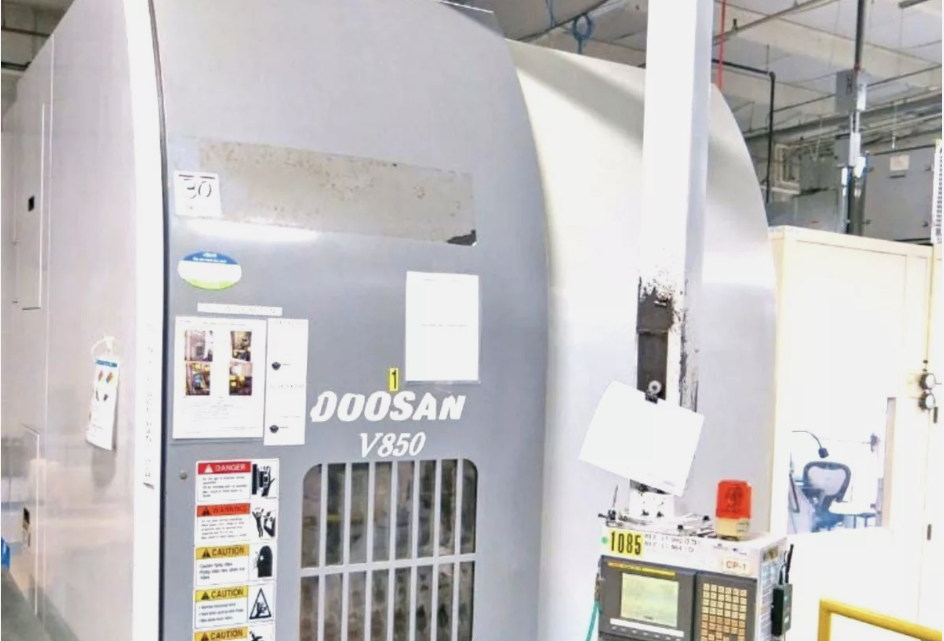
From Factory Floor to Your Workshop: Evaluating a Pre-Owned , Used , Secondhand, Surplus CNC Machines Before Purchase DOOSAN V850 CNC Vertical Lathe made in South of Korea
Here’s a detailed guide you can use when evaluating a pre-owned / surplus Doosan V850 vertical lathe (CNC vertical turning lathe, made in South Korea) — from pre-screening all the way through on-site testing, measurement, and decision making. I also include known reference specifications (from used machine listings) so you can flag mismatches or exaggerations.
Reference Specs & “What to Expect” for Doosan V850
Before walking onto the shop floor, it helps to know typical specs and features of the V850 so you can spot claim overstatements or issues. Below are data gathered from used machine listings. (These are guidelines, not guarantees.)
| Parameter | Typical / Published Value | Notes / Source |
|---|---|---|
| Max Swing (over tool / centerline) | ~ 39.46″ (≈ 1,002 mm) | Doosan listing shows “Max Swing: 39.46 Inches” |
| Max Cutting Height | ~ 33.3″ (≈ 846 mm) | Same listing: “Max Cutting Height 33.3 Inches” |
| Max Cutting / Turning Diameter | ~ 33.46″ (≈ 850 mm) | “Max Cutting Diameter: 33.46 Inches” |
| Spindle Speed Range | 5 – 1,800 rpm | The listing states “Spindle Speeds, 5-1800 RPM” |
| Chuck Diameter | ~ 24″ (≈ 610 mm) | The listing shows “24 Inch Hydraulic Chuck” |
| Control | Fanuc 21i-TB (common in listings) | Example: Doosan V850 with Fanuc 21i-TB is mentioned |
| X / Z Travel / Axial Movement | X ~ 18.50″ (≈ 470 mm) ; Z ~ 33.46″ (≈ 850 mm) | In one used listing: “X-Axis Travel: 18.50 Inches, Z-Axis Travel: 33.46 Inches” |
| Max Torque / Power | ~ 1,796 ft·lb torque; head power ~ 50 / 40 HP AC in some listings | The used listing mentions “Max Torque: 1,796 ft/lbs” and “Table Horse Power: 50/40 HP AC” |
| Turret & Tooling | 12-station turret is listed in used machines | The listing shows “Turret: 12 Station” |
| Machine Weight / Size | ~ 12,500+ kg in some listings | The listing shows “Approximate weight 12500 Kg” |
These specs give you a benchmark. If the seller claims, for example, a swing of 60″ or spindle speeds of 5,000 rpm, demand documented proof or test data.
Pre-Screening / Documentation Review (Before Visiting)
Before you physically go, gather all possible documentation, photos, and history. This helps weed out bad deals early.
Ask or request:
- Nameplate & identification photos
– Mechanical nameplate (model, serial, year)
– Electrical / control cabinet nameplate (voltage, phases, ratings) - Original spec sheets, operating / user manuals, parts books
– Helps you confirm stock spec and variant options
– Wiring diagrams, hydraulic / pneumatic plans, parts lists - Control / CNC details
– Which control is installed (e.g. Fanuc 21i-TB or variant)
– Software version, parameter backups, tool tables, macros - Usage / runtime / cutting hours log
– Power-on hours vs actual cutting (load) hours
– Nature of work: heavy boring, finishing, interrupted cuts, etc. - Maintenance / repair history
– Spindle rebuilds, bearing replacements, slide / guideway work
– Turret repairs, control board replacements, electrical faults - List of accessories / tooling / spare parts included
– Chuck(s), jaws, collets, faceplates
– Spare electronics (drives, boards, power supplies)
– Tooling mounted on the turret, live tooling (if any) - Photos / videos of the machine in operation
– Spindle running, control panel display, axis motion, tool changes, chip removal
– Close-up images of slideways, spindle nose, wiring - Reason for sale & condition disclaimers
– Is it being replaced, decommissioned, or failing?
– Any known defects or issues? - Shop / environmental context
– Was it in a clean environment or a production floor with heavy dust, coolant sludge, chip accumulation?
– Exposure to corrosion, coolant splash, humidity, etc. - Logistics / installation info
– Machine weight, footprint, crane / rigging plan, floor load rating
If the seller is evasive or cannot provide many of these, consider that a red flag.
On-Site Mechanical & Structural Inspection
Once you’re at the machine’s location, proceed methodically from external to internal, from static inspection to dynamic tests. Bring measurement instruments (dial indicators, test bars, etc.) and ideally a machinist or technician.
1. Visual / Structural / Exterior Checks
- Inspect the base / bed / frame / column for cracks, repairs, welds, distortion
- Check guideways / box ways / slideways across axes for pitting, scoring, corrosion, uneven wear
- Inspect way covers, guards, bellows: any damage, patches, missing parts
- Examine spindle housing / nose, chuck area, turret face for nicks, damage, misalignment
- Check wiring, cable carriers, conduit, junction boxes for patched wires, exposed insulation, poor routing
- Look for oil / coolant leaks or seepage along seals, slides, base troughs
- Inspect turret / tool magazine units for wear, play, mis-alignment
If possible, move slides manually (with drive off) to detect binding or uneven motion.
2. Motion / Kinematics / Backlash Checks
- Jog or move axes slowly (X, Z) and feel for smoothness or “notchiness”
- Use a dial indicator to test backlash or lost motion in both axes (push-pull test) at multiple positions
- Reverse direction near the limits to detect hysteresis / deadband
- Examine ball screws / coupling / nuts for looseness, side play, wear
- Jog at slow feed and see if motion is consistent, no jumps or stutters
- Cycle turret indexing several times to check for mis-index or hesitation
3. Spindle / Chuck / Turret / Tooling Tests
- Power up spindle and run at multiple speeds; listen / feel for bearing hum, vibration, irregular noise
- Use a test bar + indicator to measure spindle runout at the nose (and ideally along length)
- Monitor for heating during runtime (if allowed)
- Test chuck clamping / jaw action / faceplate alignment
- Operate the turret / tool changer: indexing, tool pick / place, repeatability, slop, mis-seating
4. Control / Electrical / Cabinet Inspection
- Open the electrical / control cabinets; inspect wiring, relays, fuses, connectors, PCB boards
- Look for signs of overheating: discoloration, burnt connectors, melted insulation
- Inspect servo drives, power modules, interface boards for damage or corrosion
- Check cable routing, shielding, strain reliefs
- Power up: test control panel, buttons, switches, emergency stops, limit switches
- Navigate control menus: check parameter backups, alarm logs, tool tables
- Test safety interlocks (doors / guards opening should kill motion)
Operational / Load Testing / Test Cuts
If the seller allows, performing live tests under motion and load is essential for verifying real-world performance.
- Execute a dry run (air move): a sample motion program involving axes, turret movement, tool changes, etc.
- Perform a test cut (on a moderate / known material) to assess surface finish, chatter, dimensional accuracy
- Run for an extended time (30–60 min) under load: after run, recheck critical measurements (backlash, runout, alignment) to detect thermal drift
- After warm-up, re-measure backlash, runout, alignment to see if dimensions changed
- Cycle turret / tool change many times to check for consistency, mis-indexing, wear
Watch for vibration, chatter, positional drift, or error messages mid run.
Precision / Metrology & Accuracy Checks
Because vertical lathes must deliver precise geometry, do the following:
- Use gauge blocks, master artifacts, or test bars to check alignment, straightness, squareness
- Test repeatability: move to a reference point, retract, return, and measure deviation
- Check concentricity, circularity, radial runout on test blanks
- After extended run, re-check offsets, backlash, tool height stability
- Compare measured results to your part tolerances and vs the reference spec values
Infrastructure / Installation / Practical Considerations
- Confirm that your workshop floor can support the weight and dynamic loads of the V850
- Ensure crane / rigging / clearance / doorways are adequate for moving, installing, leveling
- Confirm your power system (voltage, phase, current capacity) meets the machine’s requirements
- Check coolant systems, chip removal / conveyor, chip flushing, coolant filtration
- Plan for proper leveling, foundation, anchoring
- Ensure maintenance access, service clearance around the machine
- Verify availability of Doosan spare parts (bearings, drives, control modules, etc.) in your region
Post-Inspection Decision Criteria & Red Flags
Once you have all your observations, measurements, test results, and photos, use this decision matrix to evaluate whether to proceed, negotiate, or walk away:
| Category | Acceptable / Positive | Warning / Red Flag |
|---|---|---|
| Spec compliance | Machine travel, swing, spindle rpm close to reference spec | Big mismatches (e.g. exaggerated swing, rpm, missing features) |
| Mechanical condition | Smooth motion, light wear, low backlash | Heavy wear, rough spots, binding, inconsistent backlash |
| Spindle / chuck health | Quiet, low runout, stable under load | Bearing noise, high vibration, excessive runout |
| Turret / tooling | Reliable indexing, precise tool seating | Mis-index, slop, tool drop, alignment drift |
| Control / electronics | Clean wiring, functional control, no error logs | Burnt boards, fried modules, corrupted parameters |
| Operational cuts | Good surface finish, dimensional accuracy, no drift or chatter | Poor finish, deviations during cycle, thermal drift |
| Thermal / drift stability | Minimal dimension shift after warm-up | Significant drift or instability after running |
| Repair cost / parts availability | Most worn parts replaceable, parts available | Obsolete parts, very expensive refurbishment |
| Warranty / guarantee | Seller offers test-cut guarantee or warranty clause | “Sold as is,” no recourse for hidden defects |
| Support & service | Doosan support or third-party service available locally | Long lead times, lack of parts, remote support only |
Use the defects you find as bargaining chips—ask for spare parts, discount, or a short-term performance guarantee. Document everything (measurements, photos, videos) so you have evidence to fall back on.