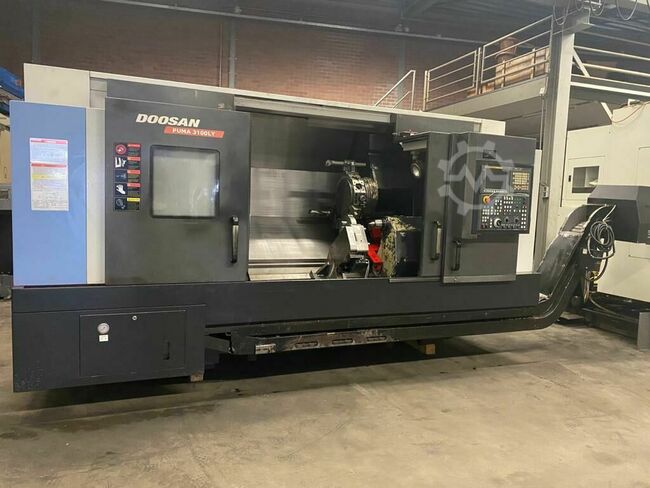
From Factory Floor to Your Workshop: Evaluating a Pre-Owned , Used , Secondhand, Surplus CNC Machines Before Purchase Doosan Puma 3100 LY CNC Turning Center made in South Korea
Here’s a detailed, structured evaluation framework tailored to a Doosan Puma 3100 LY CNC turning center (or variants thereof) — what to look for, pitfalls, and how to “stress test” things. I start with known reference specs, then go through pre-visit prep, inspection, testing, evaluation, and negotiation.
0. Reference: What is the Doosan Puma 3100 LY?
Before evaluating, it helps to know the nominal/”as new” specs so you have baselines to check against. Some key published specs:
| Parameter | Typical Spec / Range | Notes / Source |
|---|---|---|
| Chuck size / max turning diameter | ~ 12″ (≈ 420 mm) | For the 3100 series / LY variant |
| Travel in X-axis | ~ 293 mm | (often ± some) |
| Travel in Z-axis | ~ 1350 mm (length) (for longer bed / “L” variants) | For “L” bed variants, Z travel increases. |
| Y-axis travel | ~ 130 mm (±65 mm) | For “Y / LY” variants, there is sideways offset capability. |
| Spindle speed | ~ 2800 rpm (belt type) | Standard spindle speed for many 3100 models |
| Spindle power / torque | ~ 22 kW / ~ 1123 N·m | For many 3100 models |
| Machine dimensions & weight | ~ 4500 mm length × ~ 2100 mm width × ~ 2300 mm height; ~ 7,500 kg | Rough estimate published in some listings |
These numbers are your benchmarks to verify whether the used machine is close, or if “nominal capacity” has been compromised (e.g. due to wear or modifications).
Also note: the “LY” variant implies the presence of a Y-axis (i.e. lateral movement) in addition to the usual X/Z axes. This adds complexity and more potential failure modes (ways, guides, motors) to check.
1. Pre-Visit / Documentation to Request
Before you even travel to see the machine, ask the seller for:
- Service / maintenance / repair logs
- Dates and details of overhauls, spindle rebuilds, drive replacements
- Bearing swaps, linear guide maintenance, lubrication system history
- Control / electronics documentation
- Type and model of CNC control (e.g. Fanuc, Doosan’s proprietary, Siemens, etc.)
- Wiring diagrams, I/O maps, backup parameter files, firmware version
- Spare cards / modules available
- Operating / run hours / utilization history
- Approximate total hours, how many in cutting vs idle
- Duty cycles, load factors
- Parts and tooling inventory
- Whether the chuck, Y-axis tooling, driven tools, sub-spindle, steady rest, etc. are included
- Spare parts (belts, encoders, modules, motor spares)
- Photos / video (in operation)
- Machine while moving axes, spindle running, Y-axis sliding
- Close-ups of guideways, belts, motors, cables
- Alignment / calibration records
- Last time the machine was aligned, leveled, calibrated
- Reports for axis accuracy, backlash measurements
- Machine configuration details
- Which options are installed (sub-spindle, live tooling, steady rests, U-axis, etc.)
- Whether any modifications or retrofits were done
- Manufacturer / OEM references
- Serial number, build year, any upgrade history
- Logistics plan & responsibility
- How disassembly, transport, reassembly, alignment will be handled
- Whether they’ll assist or provide rigging instructions
Having this ahead of time lets you tailor what to inspect more tightly and avoid surprises.
2. On-Site Inspection Checklist
When you arrive, carry appropriate tools (dial indicators, test bars, feeler gauges, straightedges, vibration probe if possible). Work methodically through mechanical, control/electrical, and operational tests.
A. Mechanical / Structural
- Base, bed, and casting
- Inspect for cracks, structural weld repairs, distortion, corrosion
- Check whether the machine has been “patched up” or modified
- Guideways / linear ways / slideways / dovetails
- Look for scratches, wear bands, grooves, pitting
- At the ends and middle of travel, move carriage and feel for binding or “stiction”
- Use a straightedge / precision reference to check flatness if possible
- Ballscrews / lead screws / feeds
- Remove covers and inspect threads for wear
- Check backlash / play in each axis
- Move axis slowly and feel for jumps or gritty motion
- Spindle & front bearing / rotor
- Run spindle (if possible) at low and intermediate speeds
- Listen for noise, check for vibration, feel for heat
- Check radial and axial play
- See how the spindle is mounted (belt drive or built-in) and whether belts are in good shape
- Y-axis parts
- Because this machine has a Y axis (i.e. lateral offset movement), inspect those guideways, motors, feedback, and whether the movement is smooth, without binding
- Check for squareness and alignment of Y relative to X/Z axes
- Chuck / workholding / tailstock / sub-spindle (if present)
- Inspect chuck jaws, wear, runout
- Tailstock quill, centers, live tooling if any
- If sub-spindle is present: check its alignment, bearings, drive, and concentricity
- Turret / toolchanger / tool holders
- Check turret indexing, repeatability, backlash, wear in the tool pockets
- Ensure driven tooling, if present, is working and has low runout
- Coolant / lubrication / hydraulic / pneumatic systems
- Cleanliness of the coolant tank, condition of hoses, leaks
- Lubrication pumps, oil lines, autorelube systems
- Hydraulic clamping circuits, pneumatics if used
- Covers, guards, panels
- Are they intact, properly closing, no missing parts
- Check wiring harnesses for chafing, damage
B. Control / Electrical / Electronics
- Power-up & control panel
- Boot the CNC, monitor for errors or fault codes
- Test all buttons, jog mode, emergency stop, panel keys
- Check control responsiveness (no delay, no freezes)
- Drives / amplifiers / servo motors
- Inspect physical condition (dust, heat damage, discoloration)
- Look for burned connectors, bulging capacitors, signs of overheating
- Feedback devices / encoders / resolvers
- Check signal quality, noise, whether the axes lose counts or glitch
- If possible, monitor the feedback while moving axes
- Wiring / harnesses / connectors
- Look for brittle insulation, corrosion, loose connectors
- Ensure proper shielding and grounding
- Backup systems / memory / battery / parameter retention
- Check whether parameters are being stored correctly
- Ensure battery backups or memory retention systems are functional
- Safety / interlocks / limit switches
- Test E-stop, mechanical and electrical interlocks
- Move axes to the limits and confirm that limits are respected and safe
C. Functional / Operational Tests
If the seller allows, run the machine under motion and cutting (if possible). Some key tests:
- Axis movement & smoothness
- Move X, Y, Z axes through full travel, at slow and faster feed rates
- Listen/feel for binding, friction, roughness
- Backlash test
- Move an axis a known distance in one direction, then reverse and see how much “dead motion” occurs
- Spindle run / vibration
- Run spindle at different RPMs, monitor for vibration, heat, noise
- Use a dial indicator or vibration meter (if you have one)
- Test cut / turning operation
- Mount a test bar or sample, perform a turning operation, measure final diameter, roundness, surface finish
- Use your own workpiece material if possible (i.e. what you expect to run in your shop)
- Y-axis function test
- Command Y-axis offsets (if functionality exists) and verify lateral motion and accuracy
- Combine Y motion with X/Z motion, and check interpolation, smoothness
- Turret / tool change timing / repeatability
- Cycle the turret, check indexing, tool change time, repeatability
- If driven tooling, test tool spin, reverse, under load
- Cooling & chip removal under load
- Run coolant, check pump pressure, flow, filtering
- If chip conveyor / ejection system present, test that it works under chip load
- Thermal behavior
- Let the machine run for some time, see how temperatures stabilize, measure if there is drift
3. Measurement / Comparison & Analytics
Once tests are done, quantify what you observed and compare with benchmarks / tolerances:
- Deviation from nominal specs
- Compare measured travels, speeds, power, accuracy with published ones
- If X or Z travel is significantly reduced (e.g. due to worn covers or modifications), factor that in
- Wear margin and residual life
- Based on wear on guideways, screws, spindle bearings, estimate how much “life” remains
- Especially for the Y-axis, which is an extra load-bearing axis
- Error budgets / precision loss
- Backlash, lost motion, repeatability errors: evaluate whether acceptable for your machining tolerances
- Repair / refurbishment cost estimates
- Identify items that will need replacement or overhaul (spindle, ball screws, drives, encoders)
- Acquire quotes or parts availability
- Risk / downtime estimation
- The time to re-align, recalibrate after relocation
- Cost for shipping, rigging, installation, leveling
- Upgrade / retrofit potential
- If control electronics are obsolete, how easy is it to retrofit a modern control
- Whether the machine is “open” enough to accept new modules, or overly customized
4. Red Flags & Deal-Breakers
Some conditions are so severe they may not be worth negotiating. Watch out for:
- Cracked or severely repaired casting / base damage
- Spindle in poor shape or unknown condition (e.g. heavy noise, axial play) with no reliable data
- Guideways or screws with deep wear or damage beyond cost-effective repair
- Y-axis mechanism excessively worn or nonfunctional
- Control electronics obsolete, missing, or unsupportable (no spare parts, no backups)
- Missing critical components (turret, driven tools, chuck, tailstock, encoders)
- Unwillingness to allow full testing or movement of axes
- Severe environmental damage (corrosion, flooding, harsh chemical exposure)
- Transport / alignment risk too high (e.g. machine not rigid, misaligned, not easily disassembled or set up)
5. Negotiation & Purchase Strategy
- Use the findings from your inspections to structure contingencies: e.g. “If the spindle requires regrinding or bearings replaced, we deduct X from price.”
- Ask for a trial period or acceptance test window after installation (if possible)
- Factor in total cost of ownership: purchase price + transport + rebuild + calibration + downtime
- If a major refurbishment is needed, compare that cost vs buying a newer / better machine
- If possible, bring an expert machinist or service technician with you for inspection
- Consider asking for spare parts or warranty on critical systems as part of the deal