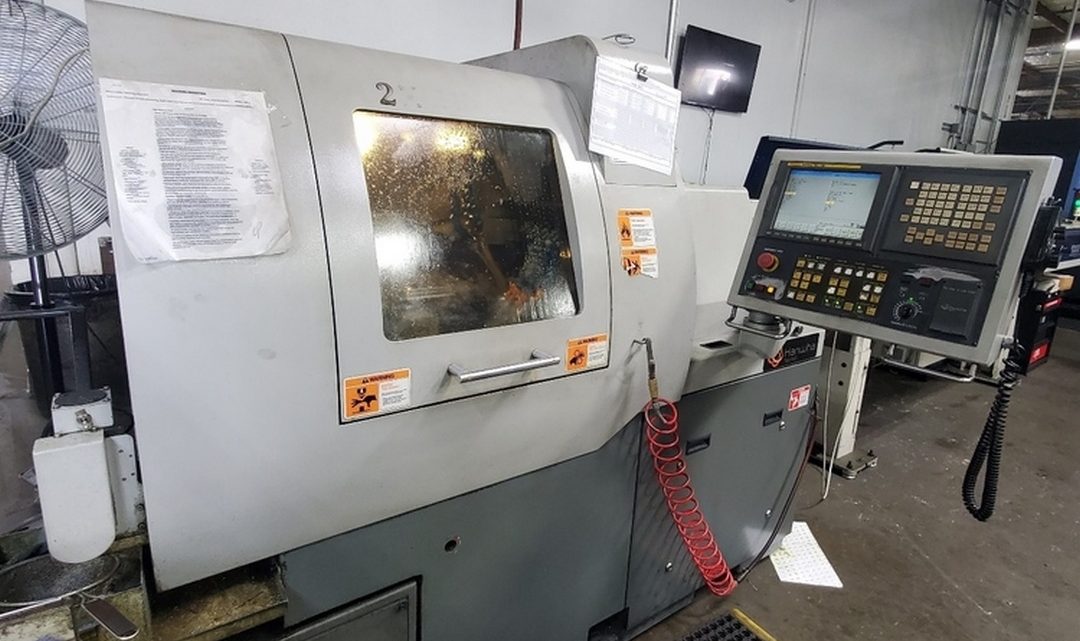
From Factory Floor to Your Workshop: Evaluating a Pre-Owned, Used, Secondhand, Surplus CNC Machine Before Purchase Hanwha XD20H CNC Swiss Lathe made in South Korea
When evaluating a pre-owned/factory-floor used CNC Swiss lathe such as the Hanwha XD20H (made in South Korea) prior to purchase — especially for your second-hand machinery portal and potential import into your country — it’s wise to adopt a structured checklist and deeply vet condition, tooling, service history, and suitability. Below I provide (1) a quick glance at the machine’s specification context, and then (2) a detailed evaluation checklist (with items specific to your scenario: import, used machine, second‐hand portal). You can use this as a comprehensive due-diligence framework.
Machine Background & Specification Highlights
Here are some known specs and background for the XD20H to anchor your evaluation:
- The XD Series from Hanwha includes Swiss-type sliding headstock (guide-bush or non-guide-bush) turning machines, in diameters from Ø10mm up to Ø42mm.
- For the XD20H in a used listing (2007 model) the listed specs: bar capacity ~0.75″ (≈19 mm) ; main spindle ≈10,000 rpm ; sub-spindle ≈8,000 rpm.
- Example dimensions: 79″ x 47″ x 69″ (≈ 2000 mm × 1190 mm × 1750 mm) ; weight ~5,700 lbs (≈2,585 kg) in one listing.
- Control system in that example: Fanuc 18iTB.
- Hanwha’s machine tool division states that their Swiss turning machines are high-rigidity, multi-axis, and intended for high precision.
Implication for you: Because this is a relatively complex Swiss-type lathe (sliding head/guide-bush or possibly convertible) with high spindle speeds and possibly multi-axis tooling (live tooling, sub spindle, back tooling), you’ll need to ensure that the used machine still meets the precision, cycle time, tooling flexibility and reliability you intend for your second-hand machine portal (both for your own purchase/usage and reselling).
Evaluation Checklist Before Purchase
Here is a detailed checklist (split into categories) of what to inspect / ask / verify. Since you are operating a second-hand machinery portal (for example importing from elsewhere, installing in your country, reselling), many of these items will overlap. I will also add notes specific to your scenario.
1. Machine Condition & Environment
- Physical inspection: Look for wear, corrosion, damage, alignment of slideways, ball screws, belts, pulleys. Does the machine look like it has been well-maintained or left in a heavy production environment with a lot of abuse?
- Slideway and guide bush condition: For Swiss-type machines the lead-guide bush (if present) is key. If it’s worn, the precision and surface finish will suffer. Confirm whether it’s guide-bush (G/B) type or non-guide-bush (N) type.
- Spindle condition: Ask for vibration analysis, run-out (main & sub spindles). Check spindle bearings (noise, heat) and that speeds (10,000/8,000 rpm) are still achieved smoothly.
- Tooling units: The cross/T/Y/back tooling, live tooling, sub-spindle, bar-feed interface. Are these units in place? Are they original? Have any been replaced?
- Electrical cabinet and wiring: Are cables labelled? Are there signs of overheating, water ingress, rust? Is the control panel clean and original?
- Coolant, lubrication systems: Are coolant tanks clean? Are pumps in working order? Any leaks? Are the lubrication systems for slideways intact? These are often neglected in used machines.
- Bar-feeder / automation interface: If the machine has a bar-feeder (common for Swiss machines) check the interface, feeds, alignment, setup, and spare parts availability. For example one listing of the XD20H included an Edge Minute Man 320SE magazine bar-feed.
- Parts conveyor / chip management / mist collector: Check presence and condition of parts conveyor (if words like “parts conveyor” listed) and mist/oil-mist collector. One listing mentions LNS Fox WS330 Mist Collector.
- Cycle-time / Performance verification: If possible inspect a test run with actual bar material, record cycle times, part quality (repeatability, finish) and compare with expected for the diameter and part geometry you intend.
- Service & maintenance history: Request logbooks, records of major repairs (spindle bearings, ball‐screw replacements, guide bush replacements). Ask for how many hours or bars have been run.
- Age and usage: Machine might be from ~2007 (as one listing). That’s ~18 years old (as of 2025). Ask for actual hours or number of parts produced, downtime, any modifications.
- Original specification verification: Confirm that the machine you are inspecting matches the spec of the model (spindle speeds, max diameter, tooling count). Example: capacity 0.75″ (19 mm) bar diameter listed in used spec.
2. Suitability for Your Needs
- Does bar diameter meet your parts? For your portal (you deal in second-hand machinery for industrial clients) ensure the XD20H capacity (Ø19 mm bar) is appropriate for the parts you or your clients intend to make. If larger parts are needed you may need a bigger machine.
- Tooling flexibility: Swiss machines are often used for high-precision small parts. Confirm that the tooling configuration (number of live cross tools, sub‐spindle, back tooling, Y-axis if any) suits the parts you will or will resell to clients.
- Control system & parts availability: If the control is Fanuc 18iTB (as in one listing) make sure spare parts are available in your country or via import, software version is okay, and you or your clients can service it.
- Spare parts & support for Hanwha in your region: Even if you purchase, you’ll need local or regional support. Investigate whether Hanwha has local representation or a parts supply chain in your country or nearby countries.
- Installation & foot-print: Check machine dimensions, weight (approx 2.5 t in one listing) and ensure your workshop in your country (or client location) has the space, crane/hoist capacity, electrical supply, bar‐feeder space, chip conveyor disposal. Example dimensions: 79″ × 47″ × 69″ for one listing.
- Electrical supply compatibility: Verify voltage, phases, frequency of the machine (Korea/USA listing may have 220/460V 60Hz, but in your country you likely have 50 Hz 400V 3-phase standard). Confirm motor compatibility or conversion cost.
- Automation / bar feeding / chip removal for your target usage: Since your portal focuses on second‐hand machinery, you might need machines that are easy to integrate and service. Assess how complex the bar feeding/chip removal setup is and whether it’s robust.
- Resale value / market demand: Since you resell second-hand machines, check how marketable a Hanwha XD20H is in your region (your country + Europe + UK) — are there many buyers of Swiss-type sliding head machines? Is there a demand for Ø20mm bar Swiss machines or does the market lean larger?
- Transport, import, and duty cost: As you may be importing into your country (or UK), consider cost of crating, transport, customs/duty, dismantling, re-assembly. If the machine is heavy (~2.5t), and has bar-feeder, you will need significant logistic budget.
3. After Purchase / Installation Considerations
- Alignment & assembly: After shipping, verify machine levelness, spindle alignment, guide bush alignment, etc. If moved, vibrations or settling may misalign slideways.
- Bar-feeder setup & first-article run: Run sample parts with your intended material to verify capability and quality (surface finish, dimensional stability).
- Tool offsets & calibration: For Swiss machines precision tooling matters. You may need to recalibrate tool offsets, check spindle run-out again after shipping.
- Maintenance plan for used machine: Draft a plan for your usage: change spindle bearings (if nearing life end), check ball-screws, ensure coolant filters, chip conveyor, lubrication systems are serviced.
- Documentation & training: Ensure you have operator manuals, wiring diagrams, tooling diagrams (live tooling, back tooling), and consider training your staff or your clients on the specifics of the machine.
- Resale or brokerage prepping: Since you’re running a portal, if you plan to resell, keep full documentation, service records, cleaning/painting, and maybe refurbish minor items to obtain better resale value.
4. Risk/Red-Flag Checklist
Be vigilant for these warning signs:
- Machine has heavy wear, large hours, but no service records.
- Spindle run-out, bearings or guide bush show excessive wear (you might detect by listening to bearings, measuring run-out, etc).
- Control panel or electrical cabinet is dirty, has been exposed to coolant, or wiring is modified/damaged.
- Bar-feeder or automation interface missing or in poor condition (can be costly to replace).
- Parts/consumables for the specific model are hard to source locally (especially if Hanwha parts are not local to your country).
- Machine has been used in a particularly abusive environment (for example high‐volume production) and possibly neglected maintenance.
- There is misalignment, damaged slideways, or major repairs needed (which may affect cost-effectiveness).
- The machine’s capacity or tooling configuration does not match your or your clients’ parts and will require major modifications.
- Important option units (live tooling, sub spindle, bar-feeder) are missing or broken — for a Swiss lathe these are integral to value.
Summary & Recommendation
If you’re considering purchasing the Hanwha XD20H (or similar model) for use or resale, the machine can be a solid choice if the condition is good, the service records are solid, the tooling/automation is intact, and it aligns with your bar-diameter/part mix. Given its complexity (Swiss sliding-head, high-rpm, live tooling/back tooling) it requires deeper inspection than simpler lathes.
Since you run a second-hand machinery portal, I recommend you:
- Schedule a factory floor inspection (video or on-site) including test cuts to verify performance.
- Request measurements of spindle run-out, guide bush wear, tooling unit condition.
- Confirm local parts/support availability in your country (or Europe) for Hanwha brand.
- Factor in transport + import + installation cost into your acquisition price.
- And build into your listing the machine’s service history, hours, condition, tooling configuration — as these will influence its resale value on your portal.