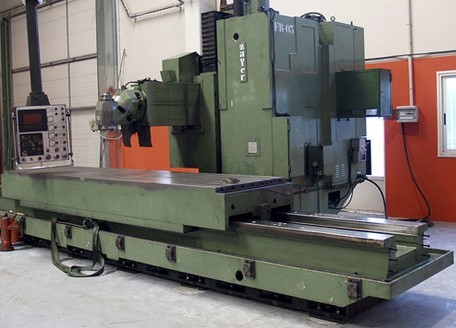
From Factory Floor to Your Workshop: Evaluating a Pre-Owned, Used, Secondhand, Surplus CNC Machine Before Purchase Zayer KF 4000 CNC Bed Type Milling made in Spain
If you’re evaluating a used machine like the Zayer KF 4000 (bed-type CNC milling machine made in Spain) for purchase, here’s a detailed checklist and guidance — from factory floor to your workshop — tailored to what to look out for, what to verify, and what questions to ask.
1. Understand the basic machine specs
Before you visit or inspect, know what the machine should offer, so you can compare what you see with expectations.
From listings for the Zayer KF 4000 (also shown as Zayer 30 KF 4000) you’ll find specs such as:
- Table size circa 4 000 × 1 000 mm.
- Axes travel approximately: X ~ 3 700–4 000 mm, Y ~ 1 200–1 300 mm, Z ~ 1 000–1 500 mm depending on version.
- Maximum table load ~ 10 000 kg.
- Spindle taper ISO 50, spindle motor 37 kW in some versions.
- Rapid feedrates up to ~15 000 mm/min and working feed up to ~5 000 mm/min.
Knowing these gives you a baseline: if the machine you inspect deviates significantly, that may affect its value or suitability.
2. Key inspection checklist for a second-hand machine
When evaluating the machine in person (or via remote photos/video), go through these areas carefully:
A. Condition of bed, table & ways
- Check for wear, gouges, pitting on the bed surface and the table top.
- Verify flatness and planarity of table surface: when loaded with a heavy fixture, is it still flat?
- Examine the T-slots: are they worn, chipped, or out of tolerance?
- Inspect the X/Y/Z ways (linear guideways or box-ways): is there uneven wear, or evidence of “rocking” or “slop”?
B. Spindle, head and tool system
- Confirm the spindle taper (ISO 50) and check for run-out or excessive vibration.
- Inspect the head (universal/swivelling if applicable): is the swivel mechanism intact, and are there signs of heavy repairs or damage?
- Tool clamping system: hydraulic tool holder condition, look for leaks or maintenance issues.
- Review spindle speed: is the motor power as spec’d? Listen and feel for unusual noise or heat when running.
C. CNC control, drives & electronics
- What CNC controller is fitted (e.g., HEIDENHAIN TNC series in many Zayer machines) — verify that the software is operational and that training is available.
- Check servo drives, cabling, limit switches, encoder feedback on axes — signs of replacement, rework or vendor changes.
- Ask for usage data: operating hours, history of major repairs or retrofits, how many shifts/days the machine has been working.
- Evaluate condition of electrical cabinets: cleanliness, cooling, corrosion, dust accumulation, signs of water ingress.
D. Alignment, accuracy & backlash
- Perform a test or ask for results of accuracy checks: e.g., positioning accuracy of ±0.010 mm over 4 000 mm (some listings mention this).
- Check for backlash or looseness in each axis by jogging the machine manually (if possible) and feeling for play.
- Inspect ball screws, guides for lubrication condition and maintenance logs.
E. Hydraulics, cooling, lubrication and infrastructure
- Verify hydraulic system condition: pressure levels, oil quality, leak checks around the tool clamping system and head swivelling system.
- Check coolant system: condition of coolant tank, cleanliness, pump health, presence of chips/swarf in coolant (which indicates past maintenance habits).
- Central lubrication: ensure it works, check if guides and ways have been maintained properly.
- Infrastructure: does the machine require strong foundations, does it have vibration isolation, what is the floor loading requirement? Especially important with heavy bed-type machines (~30+ t).
F. Transport, installation & spare parts availability
- Ask about dismantling & transport history: how many times moved, whether the level/anchor bolts have been disturbed, whether releveling/calibration has been done after transport.
- Spare parts: are parts for this model (Zayer KF 4000) still readily available? How many years back are parts stocked, any known “dead” components?
- Retrofitting/upgrades: has the machine been retrofitted (e.g., newer CNC, drives, head) or are the original components still in place? A retrofit is often a plus.
3. Usage fit-check for your workshop
Before committing, ensure the machine will fit your workshop and be a good fit for your production.
- Floor space & access: given table and bed size (4 000 × 1 000 mm or larger), you’ll need large floor footprint, crane access, space for loading heavy parts, clearance for the Z-travel.
- Foundation & weight support: bed-type machines are heavy (some listings indicate ~27–30 t). Your workshop floor must be rated and you must consider whether a pit is needed, or whether machine sits on surface with anchor bolts.
- Load handling: can you load up to 10 000 kg on the table? Do you have hoists or fixtures to handle that?
- Production match: Is the machine’s travel, spindle power, head configuration suitable for your range of parts? For example, if you do smaller parts, such a large bed may be overkill; if you do heavy large parts, you may need full capacity.
- Utilities: power (e.g., 72 kVA for one version) is a consideration. Also consider coolant, compressed air, extraction of swarf.
- Future flexibility: what is the machine’s remaining lifecycle? If you buy now, will you need major maintenance soon (e.g., ball screw replacement, way refurbishment, spindle rebuild)? Build that into purchase cost.
4. Pricing, negotiation & hidden costs
Buying a second-hand large CNC machine is not just the purchase price. Consider:
- Travel & dismantle cost, transport to your site, re-installation, calibration/leveling.
- Foundation or floor reinforcement if needed.
- Re‐certification (if required in your region) of safety systems, guard compliance.
- Spare parts inventory: you may want to purchase key spares ahead (e.g., bearings, seals) if the machine is older.
- Opportunity cost: machine downtime for removal, shipping, installation, commissioning — how soon will it be productive?
- Resale potential: is this model still widely supported? Can you expect to resell if you later upgrade?
- Condition adjustment: If during inspection you find issues (e.g., way wear, spindle run-out, missing parts), deduct cost of repair/maintenance from your offer.
- Warranty & liability: many used machines are sold “as seen, no warranty”. Ensure you understand exactly what is included, what is excluded, and what you accept. One listing states “Items are sold as seen with no warranty.”
5. Decision-making matrix
Here’s a quick decision matrix you can use when comparing the machine to your requirements:
| Criteria | Must-have / Good to have | Assessment of this machine | Risk / Impact if deficient |
|---|---|---|---|
| Table size & load capacity | Must-have | Too small table/load means your parts won’t fit or throughput suffers. | |
| Axes travel (X/Y/Z) | Must-have | Parts may not be processable or need multiple setups, reducing accuracy. | |
| Spindle taper & power | Must-have | Incorrect taper/power may limit tooling options or force slow cutting. | |
| Accuracy & condition of ways | Must-have | Poor accuracy leads to scrap or rework, undermines ROI. | |
| CNC control – support & training | Good to have | Obsolete controls increase risk of downtime, harder to maintain. | |
| Spare parts availability | Good to have | Limited spares means longer downtime, higher maintenance cost. | |
| Foundation/facility fit | Must-have | If your facility can’t support machine, cost becomes much higher. | |
| Transport & install cost | Good to evaluate | If costs too high, they may eat up your margin or push ROI out. |
If a machine meets most “Must-have” criteria and the “Good to have” ones aren’t deal-breakers, then it becomes a viable purchase. Otherwise, the risk may be too high.
6. Final pre-purchase actions
Before you sign anything, do the following:
- Request and review machine history: year of manufacture, number of shifts worked, maintenance log, major repairs or retrofits, any incidents (e.g., crashes, floods).
- Visit in person (or send a trusted inspector) and watch the machine under power: full cycle, idle, axis movement, tool change, spindle warm-up.
- Ask for live demo with load if possible: pick a part representative of your work and simulate setup.
- Confirm machine meets your safety and regulatory requirements in your region (e.g., CE-marking, electrical compliance).
- Agree on what is included: tooling, fixtures, documentation (manuals, CNC program backups), test reports, alignment certificates.
- Negotiate the final price by factoring in: condition, remaining useful life, cost to bring machine up to your standard, transport & install cost, downtime until it is productive.
- Include in your contract: machine condition at hand-over, acceptance testing criteria, what constitutes “delivery” (e.g., machine placed, leveled, operational), and any warranty or service period if available.
- Plan for commissioning: budget for installation, leveling, calibration, test pieces, program migration (if applicable), operator training.
Summary
Buying a used large machine like the Zayer KF 4000 can be a smart way to get high capacity at lower cost — but the risks are real. To make it successful:
- Know the baseline specs and make sure the machine fits your application and facility.
- Use a rigorous inspection checklist covering mechanical, electrical, control, infrastructure and logistic aspects.
- Factor in all the hidden costs (transport, install, calibration, spares, downtime).
- Negotiate with full awareness of condition and lifecycle.
- Do your due diligence with documentation, demo, acceptance testing and contract terms.