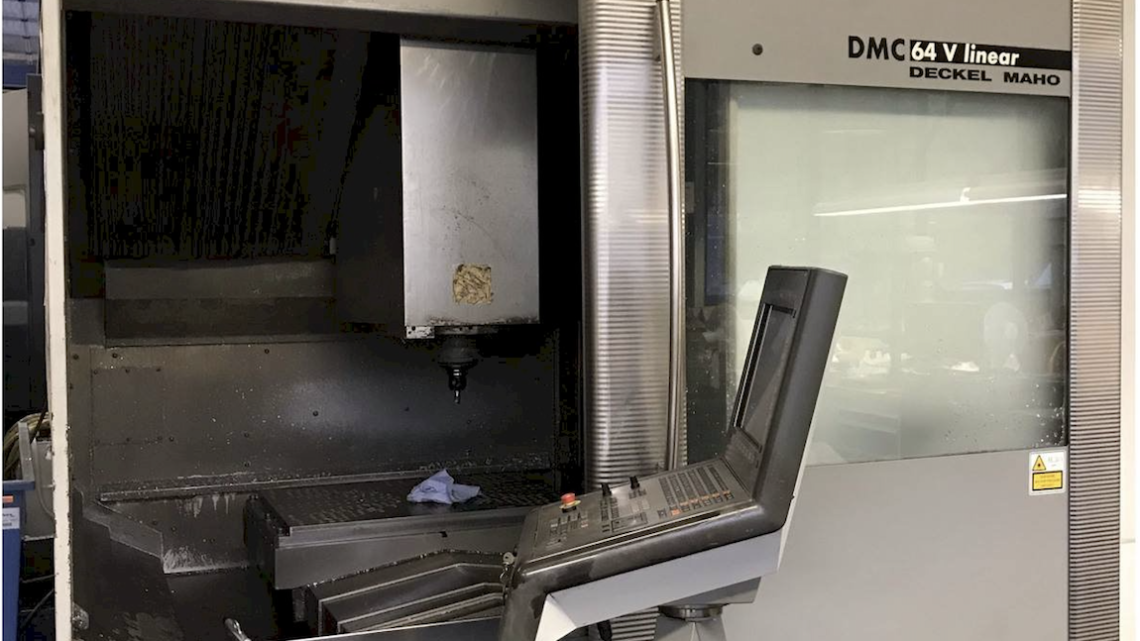
CNC Specialist’s Guide: Selecting the Right Used, Surplus, Secondhand, Pre-Owned DMG Deckel Maho 64V CNC Vertical Machining Center made in Germany
1. Background & What to Expect from a DMC 64V
1.1 Brand & Origin Context
- Deckel Maho / DMG (now under DMG MORI umbrella) is a German machine tool brand, and the DMC 64V series is manufactured in Germany (or formerly so).
- The “64V Linear” variant often denotes machines with linear guides (in X-axis or multiple axes) rather than box-way or roller guide implementations.
- Common controls include Heidenhain iTNC 530, Siemens 810D / 840D, or older Siemens / Deckel electronics.
Given this, when you see a used unit claiming “made in Germany,” it’s credible. But you should still verify build documentation, serial numbers, and assembly location.
1.2 Typical Specifications & Benchmarks
Based on public listings and technical sources, here are typical specs you should verify:
| Parameter | Typical / Expected Value | Sources / Context |
|---|---|---|
| Travel (X × Y × Z) | ~ 640 mm × 600 mm × 500 mm | Many listings for “DMC 64V Linear” cite exactly this travel. |
| Table size / Max load | ~ 850 × 600 mm, 600 kg | Standard dimension in used listings. |
| Spindle speed / power | Up to ~ 12,000 rpm; motors ~19 kW (peak) | Many used specs show 12,000 rpm. |
| Tool magazine | ~ 30 stations, often SK40 taper tools | A standard small tool capacity fits many use cases. |
| Rapid traverse & feed rates | Rapid: ~ 60 m/min (X) / 40 m/min (Y/Z); Working feed rates up to 40 m/min | Confirm the feed and rapid specs with seller. |
| Machine footprint / weight | Several tons (6,000+ kg range) with footprint ~3.4 × 2.5+ m | The machine is heavy; transport and foundation critical. |
Use these benchmarks as reference when assessing any used DMC 64V offer.
2. Pre-Purchase Inspection & Testing Checklist
Below is a specialist-level checklist to inspect and test a used DMC 64V (or similar “64V Linear”) machine. Use it during on-site visits.
2.1 Mechanical / Structural Integrity
- Frame, casting & bed
- Inspect for cracks, weld repairs, distortions, or signs of dropping or shock.
- Check verticality and flatness of the bed surface with a straightedge or granite slab.
- Linear / guideways & slides
- Check for wear, scratches, pitting, or corrosion on guide rails and carriage.
- Inspect lubricant systems: are oil / grease channels intact, blocked, or starved?
- Ball screws / drives
- Measure backlash or “lash” in each axis using a dial indicator.
- Listen for noise or binding when moving axes slowly.
- Spindle & bearings
- Mount a test tool or the original spindle tool and spin up. Check for vibration, runout, unusual noise.
- Run spindle at various speeds, measure temperature rise over 30 minutes.
- Tool magazine & changer
- Cycle all tool stations, check tool change speed and repeatability.
- Inspect grippers, pneumatics or hydraulics (if used), and mechanical condition.
- Enclosures, covers, seals, and guarding
- Ensure splash guards, covers, chip shields, coolant curtains, door seals are intact.
- Check for signs of coolant or chip ingress into areas where sensitive components are located.
- Chip extraction & coolant system
- Test chip conveyor, swarf removal, coolant pump, filtration, coolant piping, leaks.
- Check for coolant contamination, clogging, and pressure consistency.
2.2 Electrical, Control & Software
- Control / CNC unit
- Boot up the control (Heidenhain, Siemens, or whatever is installed).
- Check HMI, displays, navigation, memory, parameter access.
- Look into alarm logs, error history, and event records.
- Servo drives / motor amplifiers
- Open the electrical cabinet; inspect for overheating, dust, burnt wires, aging capacitors.
- Check cooling fans, card connectors, drive module health (no burn smells, bulging caps).
- Wiring, signal cables, connectors
- Inspect all power cabling, signal cables, limit switch wiring.
- Look for poor splices, frayed insulation, or tampering.
- Safety interlocks & limit switches
- Test door interlocks, emergency stops, limit switches on axes.
- Confirm that gates, covers, doors halt motions when opened or activated.
- Backups, firmware, parameter files
- Ask for backups of the CNC / parameter file sets, macros, programs.
- Inspect whether any modules or functionalities are locked or missing.
2.3 Performance & Functional Tests
- Dry motion / no-cut runs
- Run all axes through full strokes without cutting. Observe motion smoothness, uniform acceleration, sounds.
- Cut test using representative material
- Use a material you typically will machine (e.g. steel or aluminum).
- Perform simple contour cuts, pockets, holes, facing—test at varying feed and spindle speeds.
- Measure surface finish, dimensional accuracy, runout, chatter, and burrs.
- Speed / feed consistency under load
- Program a cycle that ramps from low to high feed / speed and observe behavior under load.
- Check for control lag, torque drop, thermal drift.
- Repeatability / accuracy checks
- Mill the same feature multiple times; measure deviations.
- Test tool change offsets, calibration, and interpolation consistency.
- Thermal stability test
- Run for extended periods (1–2 hours) with varied cutting to see if the machine’s accuracy shifts with heating.
2.4 Documentation & History
- Build records, serial numbers, control versions
- Confirm the machine’s build date, serial numbers, and matching documentation with factory or distributor records.
- Service & maintenance history
- Ask for logs of maintenance, parts replaced, rebuilds, retrofits, alignments, spindle overhauls.
- Parts & tooling availability
- Check whether spare drive modules, sensors, guides, tool changer parts, electronics are still available.
- If specialized or obsolete parts are needed, estimate lead times and costs.
- Warranty / support & contracts
- If any remaining warranty or service contract exists, see if it is transferable.
- Ask if the DMG MORI (or DMG / Deckel Maho support network) will service or calibrate the unit.
3. Risk Factors, Red Flags & What to Watch For
When evaluating used high-end machining centers like the DMC 64V, there are several critical warning signs:
- Hidden or unreported damage / repairs (cracks, dropped machines, re-welded frames)
- Severe wear on guideways or screws — sometimes beyond economical repair
- Corrosion, coolant leaks, chip ingress into sensitive areas
- Control / firmware corruption, missing modules or locked functionality
- Original parts replaced with incompatible, lower quality or “cheap” substitutes
- No spare parts or obsolescence of key components in your region
- Cooling or hydraulic failure history — if the coolant or hydraulic systems were compromised, hidden damage may result
- Relocation damage — transporting large machines often induces misalignment, frame stress, or subtle distortions
- Incomplete documentation, missing manuals, parameter files, or build records
- No acceptance test offered by seller / refusal to run full performance trial
Any one or more of these red flags should trigger caution and deep negotiation or rejection.
4. Decision Criteria & Acceptance Rules
Before committing to purchase, you should set measurable acceptance criteria. Examples:
- Achieve at least 90–95 % of nominal benchmarks (travel speeds, feed rates, rapid moves) during tests.
- Axial backlash and repeatability should be within your tolerance thresholds (e.g. a few microns on linear, arc-seconds on rotary if rotary).
- Tool changer must work reliably for all slots, without misfeeds or errors.
- Over a test run (1–2 hours), there should be no drift in accuracy, and thermal behavior should remain stable.
- All safety interlocks, limit switches, emergency stops must function correctly.
- Receive all software, parameter backups, parts lists, manuals, and the right to access configuration.
- Price must leave sufficient margin to refurbish or replace worn components if needed.
- Seller must permit a conditional acceptance period or hold-back payment until successful post-installation testing.
5. Workflow for Evaluating & Acquiring (Step by Step)
Here’s a practical sequence you can follow to minimize risk when purchasing a used DMC 64V:
- Remote Pre-Screening
- Request full spec sheet, photos (interior, axes, control cabinets).
- Ask serial number, build date, control type, motors, drive modules.
- Ask for video of machine running, axis motions, tool changes.
- On-Site Mechanical & Visual Inspection
- Use the mechanical checklist above (frame, guideways, screws, spindle, tool changer).
- Bring measurement tools (dial indicators, test bars, etc.).
- Electrical & Control Inspection
- Examine control cabinet, drives, cables, wiring, connectors.
- Boot up control, navigate menus, check for errors and logs.
- Functional & Performance Testing
- Dry motions, test cuts with known material, speed/torque ramp tests, repeatability trials.
- Extended thermal test runs.
- Measurement & Verification
- Measure actual versus programmed results.
- Use precision instruments to verify tolerances.
- Evaluation, Negotiation, & Contractual Safeguards
- Document all deviations or issues and quantify repair or refurbishment costs.
- Negotiate price adjustments or repairs.
- Insert performance guarantee / acceptance clause and hold-back payment.
- Ensure full transfer of documentation, software, parameter files, spare parts data.
- Logistics, Installation & Commissioning
- Plan safe transport, offloading, rigging.
- After installation, perform alignment, calibration, test cuts.
- Engage a local service provider with experience in DMG / Deckel Maho for commissioning support.