17/10/2025
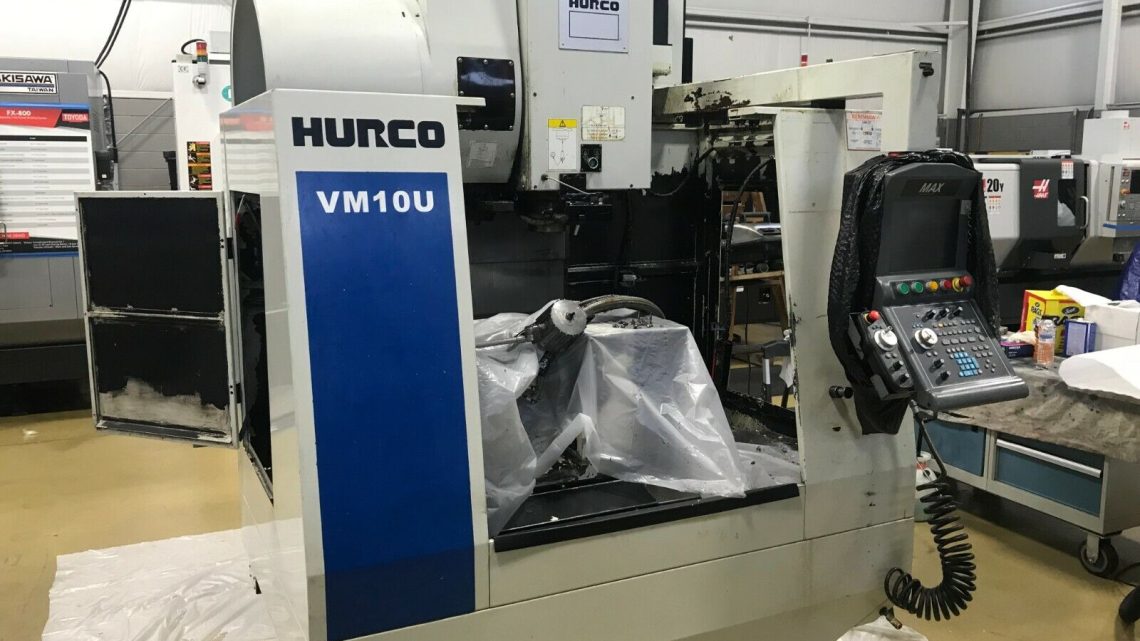
CNC Specialist’s Guide: Selecting the Right Used, Surplus, Secondhand, Pre-Owned Hurco VM10U CNC 5-Axis Vertical Machining Center made in Germany
1.2 Typical Spec Expectations
Here are parameters (from published Hurco VM10Ui and VM10U data) you should expect or use as benchmarks:
| Parameter | Typical Value / Range | Sources / Notes |
|---|---|---|
| X × Y × Z travel | ~ 533 × 406 × 483 mm | From Hurco’s VM10Ui spec sheet |
| A / C axes | A: +30° / –110° ; C: full 360° | Hurco VM10Ui specs |
| Table / workpiece load | ~150 kg on table | From Hurco spec |
| Spindle speed / power / taper | Up to 12,000 rpm, several kW, BT / CAT 40 taper | VM10Ui spec shows 12,000 rpm max |
| Rapid traverse / feed rates | ~28 m/min on linear axes, 25 rpm on rotary axes | From Hurco spec sheet |
| Tool magazine / tool capacity | 24 tools, tool lengths and diameters as per spec | In VM10Ui spec sheet |
| Weight & footprint | ~3,300+ kg | Hurco spec: 3,360 kg |
Any candidate machine that falls significantly short of these (say 50% less performance) is suspect.
2. Technical Inspection & Site Test Checklist
Use this as a detailed on-site evaluation guide.
2.1 Mechanical & Structural
- Frame & rigidity inspection
- Look for cracks, weld repairs, or distortion in the machine bed, column, saddle.
- Check whether someone moved or dropped it—look for misalignment signs.
- Axis motion & backlash
- Use a dial indicator or displacement sensor to check backlash on linear axes (X, Y, Z).
- Move each axis and check for binding, noise, “dead spots,” or loose slideways.
- For rotary axes (A & C), test indexing accuracy and repeatability.
- Trunnion / Rotary table integrity
- Inspect bearings, lubrication paths, seals, gear meshing or direct drive components.
- Wiggle test or slight torque to detect play.
- Guideways, slides, ball screws / lead screws
- Check for wear marks, scoring, pitting, or corrosion.
- Confirm lubrication systems are functional and have been maintained.
- Spindle & spindle bearings
- Mount a test tool or dummy arbor, spin at high rpm, check for runout, vibration, and noise.
- Temperature stability test: run for 30+ minutes, measure temperature rise.
- Tool changer & magazine
- Cycle through full magazine, tool changes, tool in/out times, reliability.
- Check for worn grippers, pneumatic/hydraulic actuators, misfeeds.
- Enclosure, covers, seals, safety guards
- Ensure guards, doors, chips shields, flexible bellows are intact.
- Check seals for coolant or chip ingress.
2.2 Control, Electronics & Software
- Controller / PLC / HMI
- Boot up the CNC control, check interface, menu navigation, parameter access.
- Review fault logs, alarms, maintenance logs stored in control.
- Servo drives / amplifiers
- Check drive boards, cooling fans, clean inside electrical cabinet.
- Verify voltage, current settings, module health, drive faults.
- Wiring, connectors, signal cables
- Check for overheating, burnt connectors, cable insulation damage, or splices.
- Confirm that wiring is routed neatly, shielded, and labeled.
- Power supplies, transformers, distribution
- Inspect main supply, fuses, wiring to motors, control, and auxiliary systems.
- Confirm proper grounding and shielding.
- Interlocks / safety circuits / E-stop
- Test emergency stop, door interlocks, safety switches, limit switches.
- Confirm the machine halts as expected with safety triggers.
- Software licensing, configurations, backups
- Request backups of all control parameters, tool tables, user programs, macro files.
- Ensure there is no proprietary or locked-out firmware that prevents function.
2.3 Performance & Functional Testing
- Dry runs without workpiece
- Run axis motions, tool change operations, rotary motion, full cycle motion without cutting.
- Listen for abnormal noise, vibration, or irregular motion.
- Test cuts on sample material
- Use a known material (e.g. aluminum alloy, steel) to make cuts.
- Test simple geometry, 5-axis moves, contouring, pocketing.
- Inspect surface finish, dimensional accuracy, burrs, and check deviation tolerance.
- Speed / feed validation
- Compare achieved feed rates vs programmed ones; check for loss under load.
- Test rapid traverse in axes and rotary motion—see if the machine can reach spec speeds.
- Repeatability & consistency
- Repeatedly machine the same feature (hole, pocket) and measure deviation.
- Thermal stability: run for extended periods, see if accuracy drifts.
- Tool offset & calibration checks
- Verify tool length compensation, tool radius compensation.
- Use calibration artifacts to check that the machine’s offsets are within spec.
2.4 Auxiliary Systems & Supports
- Coolant / chip removal / washdown / flood systems
- Check coolant pump, filtration, coolant plumbing, leaks, spray, pressure.
- Chip conveyor, chip augers, washdown nozzles, evacuation paths.
- Lubrication / centralized grease / oil systems
- Ensure auto-lubrication is functioning, oil levels, and correct lubrication intervals.
- Confirm there are no dry slides or lubrication starvation.
- Air, pneumatics, hydraulics (if applicable)
- Inspect air lines, valves, pressure, regulators.
- Hydraulic actuation (if used) should be stable, leak-free, correctly pressure-adjusted.
- Machine environmental conditions
- Check for dust, humidity, inadequate ventilation in original location.
- Inspect for corrosive atmosphere damage to electronics or mechanical parts.
2.5 Documentation & Traceability
- Serial numbers, build records, factory documentation
- Match machine model, serial number, and build date with the manufacturer or authorized distributor records.
- Service & maintenance history
- Request logs of preventive maintenance, parts replaced, refurbishments.
- Ask for calibration certificates or alignment adjustments.
- Spare parts, consumables, and compatibility
- Confirm which parts have been replaced, availability of spares (bearings, servo drives, guides, rotary table bearings).
- Confirm that the machine uses standard components or proprietary ones (which may be harder to source).
- Warranty / repair agreements / service contracts
- See whether any balance of warranty exists or whether Hurco (or regional service) will support refurbishing or alignment.
3. Risk Factors & Red Flags
When dealing with used high-precision 5-axis machinery, beware:
- Unverifiable history or missing logs — suggests hidden wear or neglect.
- High operating hours or near end-of-life for components (bearings, drive modules, spindle).
- Control / firmware corruption or locked modules — you might end up with a “brick.”
- Modified or non-original parts — may degrade performance or require nonstandard spares.
- Severe wear on guides, slides, or rotary table — may be irreparable or expensive.
- Cooling, lubrication, or hydraulic failures — damaging to mechanics if undetected.
- Cracks or structural damage hidden by paint or cosmetic repair.
- Misalignment from relocation or shock — particularly on 5-axis machines, alignment is critical.
- No spare parts or obsolete components in your region.
- No acceptance test or performance guarantee from the seller.
4. Acceptance Criteria & Decision Rules
Before firming up your purchase, define metrics and thresholds you will accept. Some suggestions:
- The machine must deliver at least 90–95 % of its nominal spec in speed, feed, and accuracy under test conditions.
- All axes (linear & rotary) must have minimal backlash within spec and stable repeatability (e.g. ±2–5 µm for linear, small arc seconds for rotary).
- Show that the machine can run a full test cycle using your materials with no drift, abnormal noise, or error over time.
- The tool changer must reliably change all tools in the magazine.
- All safety circuits, interlocks, and control features must operate correctly.
- The price you pay, plus estimated refurbishment / parts costs, must leave enough margin relative to a new or lightly used alternative.
- You must receive the complete control, parameter, program backups, spare parts list, and original manuals.
- The seller must allow a hold-back or conditional acceptance period (e.g. pay partial, full payment after acceptance).
- If any module is failing or near failure (electrical drive, spindle, etc.), the seller should reduce the price accordingly or replace it.
5. Recommended Evaluation / Purchase Workflow
Here’s a stepwise approach you can follow to minimize risk:
- Pre-qualification (Remote)
- Collect photos, video, machine spec sheet, serial number, build date, service history.
- Ask whether it is VM10U or VM10Ui (integrated trunnion version) and whether true 5-axis or 5-sided.
- Compare in writing the spec sheet vs what the seller claims.
- Site visit & mechanical inspection
- Use the checklist above to inspect structural, mechanical, alignment, guides, screws, rotaries.
- Bring precision measurement tools (dial indicators, laser alignment tools, micrometers).
- Control & electronics inspection
- Open control cabinet, inspect wiring, drives, connectors, modules.
- Load up programs, view configuration, log error history.
- Check software versions, backups, and licensing.
- Performance testing & cut trials
- Run dry cycles, then actual cuts of your typical workpieces.
- Check achieved feed, speed, surface finish, accuracy.
- Run sustained operations to observe thermal drift or load behavior.
- Evaluation & negotiation
- List all defects, component wear, parts to replace, calibration needed.
- Ask for cost estimates for those repairs.
- Deduct from your offer price or require seller to fix major issues.
- Contractual safeguards
- Insist on a performance guarantee clause (e.g. “must meet 90 % spec over 30-day test”).
- Retain a hold-back payment until post-installation acceptance.
- Get full transfer of all documentation, software, backup files, parts lists, spare modules.
- Transport, installation & alignment
- Plan safe transport, unloading, rigging.
- After installation, perform alignment, calibration, test cuts.
- Retain a local service provider to assist commissioning.