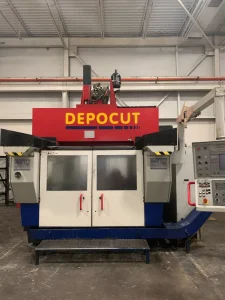
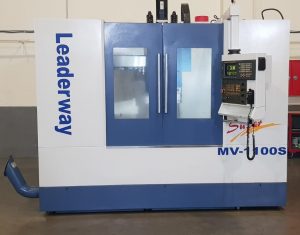
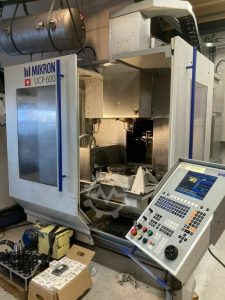
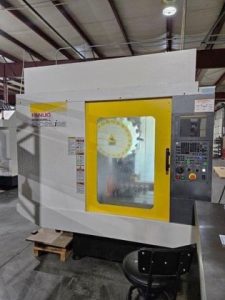
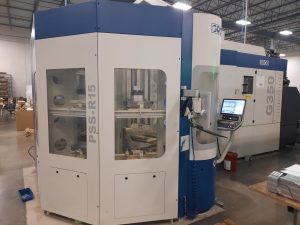
Before You Buy: Essential Criteria for Evaluating a Used, Second-Hand, Pre-Owned, Surplus XYZ 1010 VMC CNC Vertical Machining Center made in UK
If you’re considering buying a used / second-hand / surplus “XYZ 1010 VMC” (Vertical Machining Center) made in the UK, there are many traps and hidden costs. Below is a structured checklist and guideline of essential criteria you should insist upon. Use this to protect your investment and negotiate from a position of knowledge.
1. Define Your Requirements First
Before even inspecting machines, clarify what you need. This helps you reject unsuitable ones immediately.
- Work envelope / travel distances (X, Y, Z) — must cover your largest part
- Spindle speed, power & torque (for the materials you’ll cut)
- Tool changer capacity and speed
- Precision, repeatability, surface finish requirements
- Control system compatibility (CNC brand, retrofits)
- Rigidity / stiffness required for your work (e.g. heavy milling vs light finishing)
- Utility constraints: floor space, power, compressed air, foundation, chip removal
- Budget for not just the purchase, but mobilization, repair, tooling, support
With that in mind, you can more critically assess candidate machines.
2. Seller & Documentation
- Provenance: Who originally built or sold it? Do they still support parts or documentation?
- Maintenance / Service History: Ask to see logs, repair invoices, calibration records. A machine with a detailed history is far more valuable and safer to buy.
- Original Manuals, Schematics & Wiring Diagrams: Without these, future troubleshooting and repair become much harder. Many forum users emphasize that missing these can “cut the machine’s value in half.”
- Spare Parts Availability: Check whether key spares (bearings, encoders, drives, control modules) are still manufactured or can be sourced through third-party vendors.
- Control / CNC backups: Ensure the parameter files, program backups, ladder logic (PLC), and software are available.
3. Visual & Structural Inspection
Start with a careful walk-around and visual check. Many serious defects show themselves before power-up.
- Check for corrosion, rust, cracks, or weld repairs on the machine frame, column, base etc.
- Inspect way covers, guards, bellows — missing or damaged covers often point to neglect.
- Look for oil leaks, coolant leaks, or signs of fluid seepage.
- Check for physical damage: dents, scrapes, broken panels, wiring hanging out.
- Examine sliding surfaces: scratches, pitting, wear marks.
- Ensure all covers, doors, windows, safety interlocks are present and functioning.
- Take extensive photos / video (especially of suspect areas) as reference later.
4. Electrical & Control Inspection
- Open the electrical cabinet: inspect wiring, cable dress, cleanliness, terminal condition, burnt or overheated components.
- Verify proper cable management and shielding; look for wires cut or modified.
- Check for fuses, breakers, power supplies for obvious signs of stress.
- Ensure the CNC control powers up cleanly (no error codes) and the operator interface (screen, buttons, keys) is responsive.
- Test network / communications ports, USB, DNC, etc.
- Confirm safety circuits (emergency stops, interlocks) are intact.
5. Motion System & Mechanics
This is where a lot of latent wear shows up.
- Ball screws, linear guides / ways / box ways: inspect for backlash, smoothness, binding, wear marks, scratches
- Move each axis manually (if possible) and under powered movement; listen for abnormal noises, feel for stick-slip or rough zones
- Check for excessive play / backlash in all axes
- If the machine has positioning scales / encoders, verify their health and alignment
- Check lubrication (grease/oil) delivery lines, check oil reservoirs, filters, pump operation
- Inspect spindle bearings: power up the spindle, listen for hums, growls, or noises that change with RPM. Excess vibration at high RPM is a red flag.
- Inspect the spindle taper: damage or wear here can mean degraded accuracy and high repair cost
- Tool changer (ATC): run several tool changes, check for misfeeds, jerky motion, missing pockets, or misalignment
Many guides stress that the spindle and bearings tend to fail and be costly to replace.
6. Performance & Accuracy Testing
You need to see how the machine actually performs, not just move. If possible:
- Run a test cut on a part representative of what you will produce
- Measure accuracy and repeatability (e.g. via dial indicators, gauges, or better, a CMM)
- Check thermal drift: run the machine for several hours at moderate load and re-measure critical dimensions
- Test rapid traverse, feed rates under load (not just “air-cut”)
- Verify repeatability and that motion is consistent across full travel ranges
- Check for chatter, vibration during cutting
- If the machine has adaptive features (compensation, thermal compensation, backlash compensation), test their behavior
7. Utility, Foundation & Facility Compatibility
Even a perfect used machine is useless if your shop can’t support it.
- Power requirements: voltage, phase, current draw (startup vs running), frequency
- Compressed air: pressure, volume (CFM)
- Cooling / coolant system: whether chiller or coolant pump is working, coolant condition, filtration
- Chip removal / conveyor or auger systems: verify working condition
- Floor / foundation: ensure your floor can bear the weight / dynamic loads
- Shop layout: access doors, crane capacity, rigging access, ceiling height
- Ambient environment: temperature stability, humidity, vibrations from nearby machines
Many inspection checklists warn that buyers “often forget to inspect your shop” i.e. check that your facility is ready to host the machine.
8. Hidden & “Soft” Risks / Costs
- Downtime & repair risk: a used machine often has unknown weak points; what is the risk of a breakdown early on?
- Obsolete control / parts: if the CNC or drives are out of support, you may be forced to retrofit.
- Integration with your workflow: will the machine need retrofits, communication retrofit, new tooling, fixturing, software updates?
- Opportunity cost: time lost while fixing, calibrating, adapting the machine
- Transportation, rigging, installation, leveling, alignment, calibration — these costs may approach 10–20% or more of the purchase price
- Spare parts package: negotiate inclusion of a spare parts kit
- Warranty or return clause: demand a short acceptance/inspection window or conditional guarantee
- Resale value: how well-known/maintained is the brand? How likely it is to retain value?
- Support base: trained service engineers in your region, parts network, community of users
In forums, many users warn that a board or module failure on an old control can cost more than the machine is worth—and the longer repair lead times can kill productivity.
9. Pricing & Negotiation
- Use all your inspection findings as negotiation leverage
- Compare with comparable machines (age, hours, features, brand)
- Deduct repair/upgrade costs you’ll incur (e.g. new bearings, control retrofits)
- Ask seller to include tooling, fixtures, tooling holders, probes if applicable
- Consider incremental payments or retention until acceptance
10. Final Acceptance / Delivery Checklist
- Before you pay final settlement, do a final inspection after delivery and setup
- Re-check zeroing, alignment, axes motion, test cuts
- Validate promised performance
- Confirm that any included spares, manuals, software, cables have arrived
- Get final documentation signed off