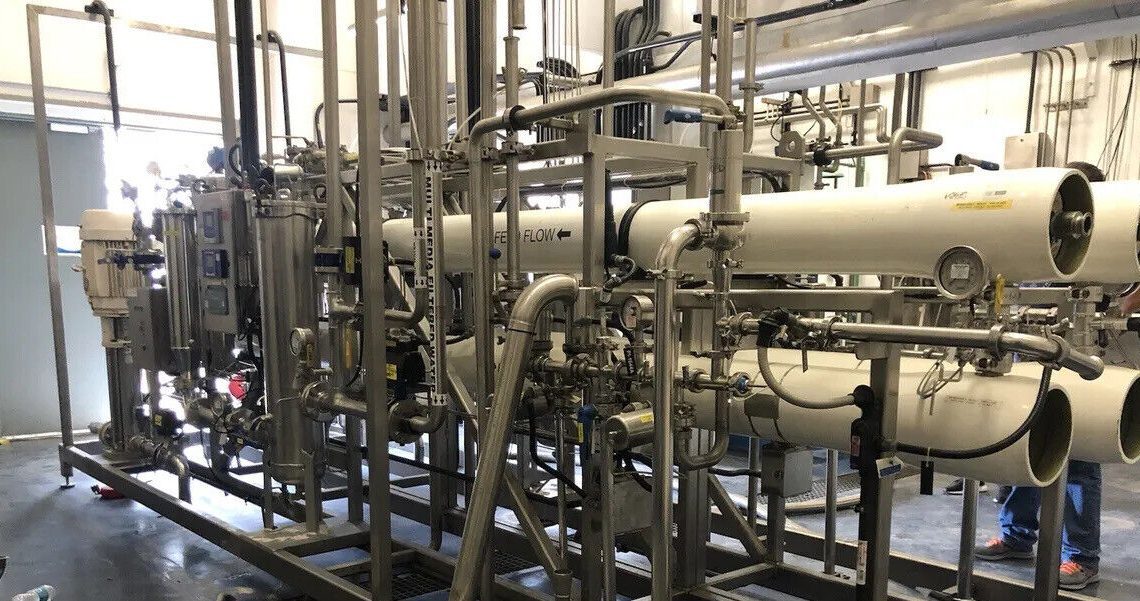
Before You Buy: Essential Criteria for Evaluating a Used, Second-Hand, Pre-Owned, Surplus Sterling Berkefeld DUAL PASS Industrial Reverse Osmosis System 60 GPM
Here’s a detailed due-diligence / inspection checklist you can use when evaluating a Sterling Berkefeld DUAL PASS (two-pass) Industrial Reverse Osmosis system, 60 GPM (used / surplus). This is designed to help you uncover hidden issues, estimate rehabilitation cost, and negotiate more confidently.
Because RO systems involve fluid dynamics, membranes, instrumentation, high pressures, and chemical compatibility, your inspection must include both mechanical and process verification, not just a superficial look.
Key Preliminaries & Baseline Info to Gather First
Before you even physically inspect the system, try to collect as much of this information from the seller as possible:
- Original design / specification sheet / datasheet
Flow ratings (feed, permeate, reject), recovery rate, pressure, temperature limits, membrane type, piping materials, instrumentation, etc. - Operating history / usage profile
How many hours/days of use? What feedwater quality (TDS, hardness, organics) was it treating? Was it run continuously or intermittently? - Membrane history & condition
When were the membranes last replaced or cleaned? What is the age / model / manufacturer of membranes? Any known damage? - Chemicals / pretreatment / cleaning (CIP) history
Record of cleaning, chemical exposure, fouling, scaling issues, prior repairs. - Utility & site context
What was the feedwater source, temperature, pressure, pretreatment (sand filters, carbon, water softeners, etc.)? What power supply, piping, drainage, product water use or storage was in place? - Spare parts, documentation, instrumentation, control systems
Are original drawings, P&IDs, control logic, spare pumps, valves, sensors included or available? - Manufacturer / brand trace & nameplate
Confirm the brand (Sterling Berkefeld), model (Dual Pass 60 GPM), country of origin (if on nameplate), serial / build number, manufacturing year, materials of construction.
Having that data upfront helps you benchmark what to expect and flag deviations.
Inspection & Testing Checklist
The checklist below is organized by subsystem; for each, test and verify both mechanical robustness and fluid / process performance.
| Subsystem | What to Inspect / Test | Why It Matters / Risk | Suggested Acceptable / Target Conditions |
|---|---|---|---|
| Frame, Skid & Structural Integrity | • Visual inspection of frame, skid, supports, welds, fasteners, mounting points, piping supports • Signs of corrosion, cracks, deformation, misalignment • Check for proper anchoring, mounting pads, and leveling jacks | The structure must remain rigid and plumb; distortions can cause piping stresses, leaks, misalignment | No cracks or structural repairs beyond cosmetic ones. Skid is flat and stable. |
| Piping, Valves, Fittings & Seals | • Inspect all piping (feed, reject, permeate, recirculation, interstage) for corrosion, pitting, mechanical damage, thinning • Check welds, flanges, gaskets, O-rings, compression fittings, union joints • Check for leakage during static pressure test (if possible) • Verify valve operation (full open / closed, partial) works smoothly • Check tri-clamp or sanitary connections (if present) for seat damage | Leaks, weak joints, or incompatible materials (e.g. galvanic corrosion) can kill RO system performance or cause catastrophic failures | No visible leaks under static test. Valves turn freely, no binding or leaks. Piping material matches spec (stainless steel, PVC, FRP, etc.). |
| High Pressure Feed Pump(s) | • Check pump motor integrity: bearings, vibration, noise, temperature • Inspect mechanical seals, packing, leak paths • Run pump at low speed if possible, see whether it draws correct current • Check for cavitation, unusual pulsation, vibration • Check pump alignment, coupling, base bolts | The feed pump is critical. If the pump is worn, misaligned or sealing poorly, you may not be able to generate required RO pressure, or risk damage | Pump runs smoothly, vibration within acceptable limits, no seal leaks, current draw stable and within nameplate ratings. |
| Membrane Pressure Vessels & Membrane Modules | • Open pressure vessels (if safe) and inspect internal tubes / housings • Inspect end caps, brine seals, permeate tube connections for damage • Check for delamination, cracks, fouling or scaling • Confirm number of membrane elements, arrangement (first pass, second pass) • Check age / date codes on membranes (if present) | Membrane vessel damage or aging membranes dramatically reduce performance or cause failure | Vessels free of cracks / deformities. Membrane elements show no catastrophic damage or delamination. |
| Membranes & Permeate Performance | • Operate feed water and measure permeate flow, conductivity / TDS, salt rejection, recovery • Test both first pass and second pass (dual pass) performance • Check for pressure drop across membrane stages, fouling indicators, bypass • Monitor trends over time (declining flow or rejection) • For dual pass, verify that the second pass stage is treating first pass permeate and boosting quality appropriately | Membrane performance is the heart of RO. Weak or aged membranes degrade product water quality and throughput. | Membranes perform close to design spec (or within expected decline). Salt rejection meets your requirement. Recovery factor acceptable. |
| Instrumentation, Sensors & Control System | • Inspect sensors (pressure, flow, conductivity / TDS, pH, temperature) for calibration, drift, damage • Check signal wiring, calibration history, instrumentation quality • Test control logic, PLC / DCS panels, alarms, interlocks • Check human-machine interface (HMI), display readouts, logging • Verify that safety / shutdown protocols operate properly | A broken or miscalibrated instrument can mislead, allow damage or insufficient quality water | Sensors read close to reference instruments. Control logic responds correctly. Alarms & interlocks functional. |
| Valves, Bypass, Recirculation, CIP / Cleaning System | • Verify valves that direct flow to recirculation or bypass streams work properly • Test Clean-In-Place (CIP) plumbing (if present) — chemical injection, isolation valves, flush lines • Check whether provisions exist for backwash or flush lines • Inspect whether recirculation / concentrate recycle lines are intact • Ensure valves are clean, actuators function, no stuck valves | Inadequate ability to flush, clean or bypass can shorten membrane life or prevent troubleshooting | Valves actuate properly. CIP system is intact and operable (if installed). Recirculation lines are connected and leak-free. |
| Electrical & Motor Systems | • Inspect motor control centers (MCC), drives, starters, breakers, wiring, enclosures • Check motor insulation, terminations, connections, overloads • Inspect control cabinet cleanliness, fans, cooling, grounding • Run motors (pumps, recirculation, CIP) and monitor for overheating, unusual vibration, current draw | Electrical faults can cause major downtime or damage sensors, motors or control electronics | All motors operate within nameplate current/voltage and temperature limits. Wiring is clean, intact, and no evidence of overheating or burnt insulation. |
| Leak / Pressure Testing & Integrity | • With system dry or partially dry, perform low pressure leak tests on vessels, piping, joints • With feedwater, gradually increase to operating pressure, observe leaks, deformation, pressure hold • Monitor pressure profiles across stages and compare to design values • Observe any pressure drops (blockage, fouling, leaks) | A system leaking under pressure will fail performance expectations and may damage membranes or sensors | No visible leaks. Pressure readings are stable. Pressure drops are within acceptable ranges. |
| Water Quality & Analytical Verification | • Independently verify feed water TDS, hardness, pH, turbidity, conductivity, organics before system • Independently measure permeate TDS, conductivity or resistivity • Verify second pass product meets required purity • Confirm that rejection percentages match or approach design | You must validate that product water meets your specifications; system claims are only useful if real | Permeate TDS / conductivity within tolerance. Salt rejection consistent. Second pass significantly improves purity. |
| Performance Under Load / Extended Run | • Run the system for a duration (e.g. hours to full day) under normal operating conditions • Monitor trends: flow decline, pressure increase, temperature drift, sensor drift • Look for signs of fouling, scaling, or clogging • Observe whether membranes or sensors degrade over time • Check for pump stress, heating, vibration changes | Some problems (fouling, drift, leaks) only appear after some time in operation | Stable performance over extended run, minimal drift. No catastrophic decline. |
| Chemical / Pretreatment & Fouling Mitigation | • Check pretreatment upstream (sediment filters, activated carbon, softeners, anti-scaling dosing) • Inspect chemical dosing lines, antiscalant or pH control system • Check for past scaling, fouling marks, deposits, cleaning logs • Verify compatibility of system materials with feedwater chemistry (e.g. corrosion from chlorides, acids) | Without good pretreatment, RO membranes degrade quickly, scaling can kill performance | Pretreatment is intact and operational. Chemical dosing lines work. No heavy scaling deposits. |
| Maintenance History, Documentation & Spare Parts | • Ask for maintenance logs, cleaning history, membrane replacements, pump rebuilds • Request original P&IDs, drawings, schematics, control logic, parts lists • Ask if spare membranes, pumps, valves, sensors, seals are available • Check if manufacturer (Sterling or Berkefeld) or third-party support is still active | The ability to maintain, repair, and replace parts determines the long-term viability | Complete documentation is available. Spare parts can be sourced. |
| Safety, Compliance & Environmental | • Ensure pressure vessels are certified (ASME or appropriate local code) and stamped • Check safety relief valves, pressure safety instrumentation • Confirm that waste / concentrate disposal is permitted and feasible at your site • Confirm that piping, electrical, chemical systems comply with local codes • Ensure operator safety: covers, guards, emergency stops, chemical safety | You cannot install or use a system that violates safety or environmental rules, or that puts operators at risk | Safety valves function. Certification plates intact. Waste discharge route acceptable. |
| Site Fit, Transport & Installation Considerations | • Confirm system footprint, weight, dimensions (with skid) • Confirm access, rigging, clearance, overhead, piping routing • Check utilities needed (power, drainage, feedwater, brine discharge, chemical feed) • Plan for leveling, anchoring, vibration damping • Check whether dismantling / reassembly is required to move the system | Underestimating installation cost or site mismatch is a frequent hidden cost | The system can be installed within your facility’s constraints. Utility connections are feasible. |
| Warranty / Acceptance Terms & Risk Mitigation | • Negotiate an acceptance period (e.g. 30-90 days) during which you can test performance • Tie final acceptance / payment to passing performance criteria • Require seller to disclose known issues or defects • Possibly require supply of spare membranes or essential components • Document system condition (photos, test results) before acceptance | Since it’s used, you want contractual protection against latent defects. | A usable acceptance period helps protect you from hidden failures. |
| Price Adjustment / Repair Reserve | • Based on your findings (membrane decline, instrumentation issues, pump wear, leaks, fouling) estimate the cost to refurbish or replace parts • Leave a negotiation margin to absorb surprise defects • Use measurement or test deviations as leverage in price discussions | Even a well-inspected used system often needs “refresh work” | As a rule, budget 10-30 % of system value for commissioning, membrane replacement, calibration, and surprise repairs. |
Special Considerations for Dual-Pass RO Systems
Because this is a dual pass (two-pass, permeate-staged) RO system, additional nuances apply:
- The second pass system will treat the output of the first pass, so quality of membranes in the first pass directly affects second pass behavior. If first-pass membranes are fouled or aged, they may hamstring the second pass performance.
- The membrane pressure vessel design must handle backpressure and appropriate feed pressures to the second pass. According to membrane theory (e.g. DuPont / FilmTec), the second pass often runs at moderate flux and may recirculate some concentrate back to first pass feed to maintain stable operation.
- The system layout, piping, valves, and pressure instrumentation must allow interstage bypass / flow control between first and second pass.
- The control logic should include second pass controls, alarms, and interlocks for quality monitoring.
- Fouling or scaling in the first pass will propagate issues to the second pass; design for adequate clean-in-place (CIP) provisions for both passes.
- Membrane compatibility and cross-contamination: ensure that membranes used in both passes, their material, pH tolerance, and chemical cleaning regimes are matched and documented.
Useful Checklists & References
- A published Reverse Osmosis Maintenance Checklist (by Aqua-Chem) outlines vital periodic inspections like checking tubing, filters, sensors, pumps, fittings, and calibration.
- A downloadable “Reverse Osmosis System Checklist” document (from savingwater.org) gives a general form of what to inspect.
- The “Ultimate Buyer’s Guide: Reverse Osmosis” from Puretec covers what to verify in industrial RO selection, operating conditions, pretreatment, and maintenance.