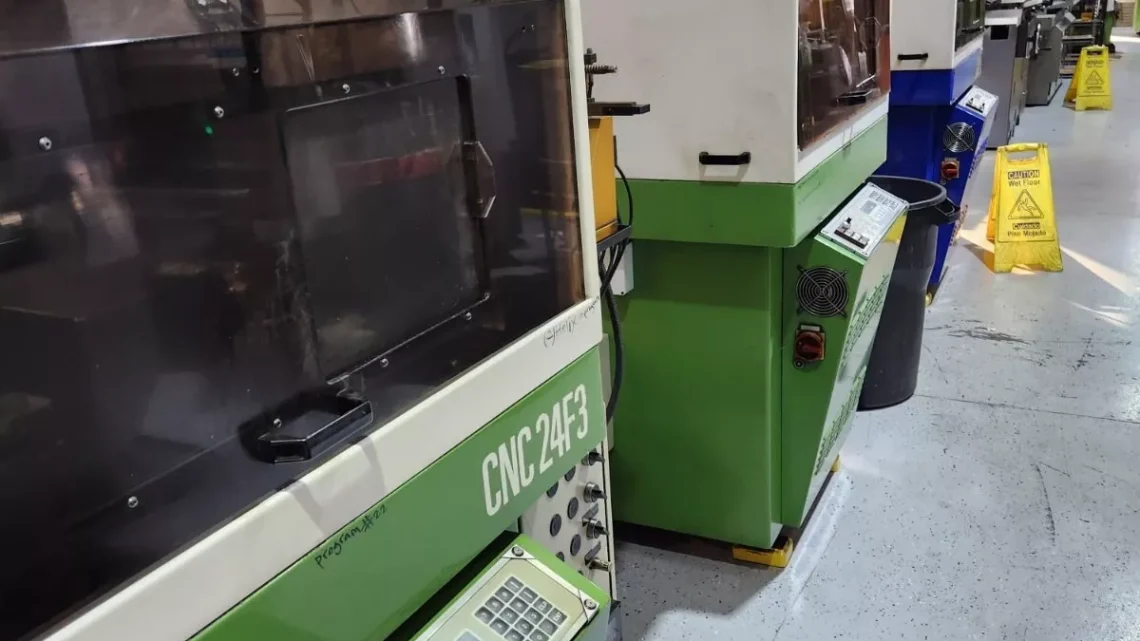
Before You Buy: Essential Criteria for Evaluating a Used, Second-Hand, Pre-Owned, Surplus Rollomatic CNC 24 F3VR 3 Axis Tool & Cutter Grinder made in Switzerland
If you are considering buying a used / surplus / pre-owned Rollomatic CNC 24 F3VR (or similar 3-axis Rollomatic tool & cutter grinder) from Switzerland, it’s absolutely essential to perform a disciplined, thorough inspection. These machines are precision grinders, and their value & utility come from tight tolerances, good kinematics, and subtle mechanical/electrical integrity. Below is a detailed checklist of criteria, with commentary tailored to this kind of machine, things to watch out for, and how to interpret findings.
0. Know the “Baseline” / Spec Sheet in Advance
Before you go on site, collect all available documentation or spec sheets for the exact model (CNC 24 F3VR) so you have a reference to compare. Here are some baseline data from listings / known specs for Rollomatic CNC 24 series:
- The Rollomatic CNC 24 is used for twist drill / cylindrical flute grinding.
- Spec sheet (from a used listing) shows:
• Capacity: min ~ 2.0 mm, max ~ 6.35 mm (Ø) for drills / tools
• Grind wheel diameters: Ø 80 mm or 150 mm, width ~ 31.75 mm
• Machine weight: ~ 900 kg
• Dimensions: ~ 1,750 × 1,200 × 1,777 mm (L × W × H)
• Power: 3-phase 380 V (50 Hz) - The “F3VR” suffix likely indicates some variant (e.g. “Flute 3 VR” or version with some third axis or variant). (Be sure to ask exactly what “F3VR” means in that vendor’s nomenclature.)
Use these as reference points. When on site, verify whether the machine you see matches the published spec (or if there are deviations due to rebuilds or modifications).
Also ask the seller: what was this machine used for (micro tools? drills? regrinding)? How many hours has it operated (grinding hours, axes motions)? Any rebuilds or major services?
1. Structural & Mechanical Integrity
Because tool & cutter grinders depend on rigid, vibration-free motion, inspect all structural and mechanical parts with care.
a. Base, Frame & Castings
- Inspect the machine’s base, column, and supports for cracks, weld repairs, filler material, patch plates, or misaligned parts. Even small cracks or repairs around mounting or high-stress zones may degrade performance.
- Look for corrosion, pitting, or deeply etched rust, particularly in areas that may have held coolant or chips.
- Check if any external brackets, covers, or supports have been added or modified (which could hint at past problems).
b. Linear Motion / Guideways / Slides / Bearings
- On each axis (X, Y, Z or whatever the machine offers), examine the slideways / linear guides / dovetail surfaces for scratches, scoring, chatter lines, rust, or dents.
- Manually move the axes (if possible) with handwheel or jog mode, and feel for binding, stiction, uneven motion, gritty feel, or jerkiness.
- Use a dial indicator to test for backlash, play or wobble between motions. Any appreciable backlash is a red flag.
- Check the condition of gibs, adjustment screws, lubrication points, wipers/seals, and verify whether the axis covers or bellows are intact.
c. Spindle / Grinding Head / Wheel Spindles
- Inspect the spindle(s) (grinding wheel spindles, work-holding spindle) for smooth rotation. Rotate slowly (manually or via slow jog) and listen/feel for roughness, noise, or uneven drag.
- Use a test bar or indicator to measure radial and axial runout (i.e. how much wobble or play). For a tool grinder, tolerances must be tight (micron-level).
- Check the spindle bearings: ask when they were last replaced; see if there are records. Worn bearings can degrade surface finish and cause vibration.
- Inspect any spindle seals, lubrication lines, coolant-through systems (if present) to ensure no leakage or contamination.
- For the grinding wheel spindle(s), check wheel holders, adapters, locking mechanisms, and whether they sit true and hold tight.
d. Wheel Magazines, Wheel Change Mechanisms & Dressers
- If the machine has an automatic wheel changer or wheel magazine, inspect the magazine mechanism, indexing, locks, servo drives, and alignment. Malfunctioning wheel changes will cause lost time or errors.
- Examine the dressing / truing / stick-off devices: ensure they are functional, precise, and not overly worn. A worn dresser can ruin grinding performance.
- Inspect the wheel clamping / motor coupling assemblies for play, wear, or misalignment.
e. Tool Holding / Workholding Fixture Mechanisms
- Check the mechanics of any collet or workholding spindles, tailstocks, axial supports, or fixture devices used to hold the tool to be ground.
- Inspect whether any misalignment, play, or looseness exists in the workholding axis.
- If there is any third axis (e.g. “F3” variant, possibly a flute or rotary axis), verify its bearing smoothness, angular accuracy and backlash.
2. Motion Accuracy, Kinematics, Metrology & Test Verification
Because tool grinding requires high precision, it is not enough for axes to move — they must move accurately and reliably. Bring your measuring tools (dial indicators, test bars, gauge blocks, reference standards) to run tests.
- Backlash / Reversal Error: For each axis, approach a reference point from both directions and measure how much “dead zone” exists.
- Straightness / Flatness / Linearity: For linear axes, check straightness over travel using a precision straightedge or laser if you have access.
- Repeatability / Return Accuracy: Move to a point, return, and come back; measure how close you get repeatedly.
- Combined Axis Moves (CNC interpolation): Because CNC grinders often execute combined motions (e.g. move X+Y while rotating tool, or do helical interpolation), test a few realistic motion paths or sample programs. Check for deviations or lag.
- Thermal Drift / Stability: Let the machine run for a while, allow temperatures to stabilize, then re-check reference geometry. Some machines develop slight drift over time.
- Vibration / Noise under Load: If you can, run a light grinding cut (or dummy run) and feel for vibration, chatter, or resonance. Surface finish deviations or chatter lines visible may be evidence.
- Wheel-to-tool concentricity: Check alignment between grinding wheel and tool axis, especially if multiple wheel axes are used.
If any axes or interpolations show misbehavior or larger than acceptable error, that is a critical defect in a machine meant for precision grinding.
3. Control System, Electronics, Software & CNC Components
A tool grinder is only as good as its electronics, controls, and logic. Even if the mechanics are excellent, bad control systems or software corruption can render it unusable or very expensive to repair.
- CNC Controller / Drives: Inspect the control unit (PLC / CNC brain), drives, servo amplifiers, HMIs, buttons, panels, displays, memory modules. Ensure functionality, no error codes, stable performance, and that the firmware/software is consistent.
- Test file transfer, parameter backup / restore, program memory, tool / wheel tables etc.
- Kinematic / geometry calibration data: Because grinding machines often use coordinate transformations (for flute grinding, helical interpolation, etc.), check whether calibration data is intact, whether any re-calibration logs exist, whether the seller can provide backup copies of calibration / machine geometry data.
- Feedback devices / encoders / resolvers: Check that all axis encoders or feedback devices operate correctly, do not drop signals, and have no intermittent faults.
- Safety / interlocks / limit switches: Test all limit switches, e-stops, door interlocks, safety covers, etc.
- Wiring / cabling / electrical cabinet health: Inspect for signs of overheating (brownish discoloration, melted insulation), dust buildup, corrosion, water intrusion, or past repairs. A messy or repurposed wiring job is a red flag.
- Cooling, lubrication and hydraulic / pneumatic systems: Many grinding machines have coolant, oil lubrication, mist systems, sealing, and filters. Check that pumps, valves, filters, coolant lines, reservoirs are intact, clean, and operate well.
4. Accessories, Tooling, Parts & Documentation
What comes with the machine can make or break the deal. Even a perfect machine without the proper tooling may not be useful.
- Grinding wheels, wheel holders, adapters, collets, extenders — are they included? Are they in serviceable condition?
- Probes, touch-off sensors, measuring / calibration tools — these are especially valuable for grinders.
- Workholding fixtures, tailstocks, supports, collet chucks — ensure whatever holding arrangement is present is adequate for your parts.
- Spare parts — extra motors, encoders, belts, couplings, sensors, electronics modules, gibs, etc. If the seller has a spare parts kit or inventory, that is a major bonus.
- Dressing tools / diamond dressers / stick-off devices — check health and alignment.
- Original manuals, electrical schematics, wiring diagrams, machine calibration sheets, maintenance logs — these are extremely valuable for later service.
- Software / backup disks / source code / parameter sheets / license keys — ensure you are not left without required software or missing configuration files.
- Safety covers, guards, splash guards — check whether all necessary protective covers are present and in good condition.
If important accessories are missing, the cost to reproduce or source them might be high or sometimes practically impossible.
5. Demonstration, Test Runs & Sample Grinding
Seeing the machine actually operate is one of the best ways to detect hidden faults.
- Request the seller to run the axes, initiate tool / wheel motion, and execute a sample grinding program (light cut) if possible.
- Watch / listen for unexpected vibrations, jerks, skipping, hesitation, or unusual sounds.
- After warm-up, recheck reference alignment or critical geometry to see if any drift occurs.
- Perform a grinding pass on a representative tool (if the seller consents). Examine the result: surface finish, dimensional accuracy, repeatability, and runout.
- Attempt tool change / wheel change / dressing sequences to see if they operate reliably.
- Test interpolation moves (if the machine supports helical or multi-axis interpolation). See whether performance is consistent across full envelope.
- If possible, try corner or extreme positions (end of travel) to detect binding or misalignment under extremes.
6. Maintenance History, Provenance & Service Records
Understanding how the machine was used and maintained is vital in judging risk.
- Ask for hours of operation, ideally broken down into spindle hours, axes motion hours, and grinding cycles.
- Request maintenance logs, repair history, worn part replacement records, calibration records — especially relating to spindles, bearings, axes, and electronics.
- Ask whether the machine has ever had a crash, overheated, or been in a harsh environment (e.g. strong coolant contamination, flood, dust, corrosive environment).
- Ask why the seller is disposing of it (upgrade, redundancy, breakdown) — motive may hint at hidden issues.
- If possible, get references or see other grinders the seller has sold, to gauge their reputation.
- Ask whether the machine ever underwent major rebuilds (e.g. spindle rebuild, axis refurbishment, control renewals) and when.
A well-documented machine with a service history is worth a premium. Absence of documentation adds risk.
7. Practical / Logistical Considerations & After-Sales Support
Even if the machine checks out mechanically and electronically, there are practical and operational issues you must consider.
- Transport, rigging & installation cost: Tool grinders are delicate. Transport must control vibration, shock, leveling, and settling. Ensure your facility has appropriate floor loading, crane / lift capacity, door clearances, and alignment capability.
- Electrical & utility requirements: Verify voltage, phase, current, grounding, and whether your shop infrastructure supports the machine (coolant, compressed air, exhaust, chip disposal) without costly upgrades.
- Foundation / mounting / leveling: Even slight misleveling or inadequate foundation can degrade precision. Budget time and cost for leveling, anchoring or even machine base shim work.
- Spare parts availability & supplier support: Because Rollomatic is a niche high-precision brand, check whether parts (spindles, bearings, encoders, electronics modules) are still available or can be sourced locally (or internationally). If the machine variant is old, some parts may be obsolete.
- Calibration / commissioning / alignment cost: Once installed, you’ll likely need to recalibrate, align axes, verify geometry, and possibly re-run kinematics, which may require external metrology or technician support.
- Software / upgrade / compatibility: Be sure the software version is current, or that you can upgrade if needed. Some older CNC systems may have limitations or be difficult to maintain or interface with modern tool programming systems.
- Residual life and depreciation: Be realistic about the machine’s remaining useful life, especially for wear components. If a key spindle bearing or axis requires replacement soon, factor that into your offer price.
- Resale / trade-in potential: Consider how easy or difficult it may be to resell or upgrade later; niche tool grinders often have small markets.
8. Red Flags & Warning Signals
While inspecting, watch for these warning signs. Each one may reduce the machine’s value significantly or even make it unusable:
- Excessive play, backlash, or slop in any axis or rotary mechanism.
- Rough, gritty feel when moving axes or spindle — especially in linear motion.
- Poor or missing documentation (manuals, wiring, calibration data).
- Spindle wobble or high runout beyond acceptable tolerances.
- Noise, binding, or vibration during operation or test runs.
- Wheel change / magazine mechanism faults, stalls, or misalignment.
- Control errors, software glitches, corrupted memory, missing backups.
- Mishandled wiring, ad hoc repairs, overheated or burnt electrical cabinet parts.
- Missing or broken accessories, especially critical ones like dressers, collets, probes.
- Insufficient or non-functional coolant / lubrication systems (clogged pipes, leaks, contamination).
- Evidence the machine has been used in extreme or harsh conditions (dust, coolant contamination, flood, corrosion).
- Seller unwilling to allow full testing, back-back inspection, or refusal to run sample programs.
If many red flags are present, the cost and risk of making the machine usable may exceed the purchase savings.
9. Go / No-Go Decision Checklist (On-Site Summary)
Take this condensed decision checklist when you visit:
| Check | Acceptable / Desired Condition | Action or Concern if Failing |
|---|---|---|
| Spec match | Travels, spindle, wheel sizes, axes match published spec (or within tolerance) | Reject or demand evidence of modification |
| Axis motion | Smooth, no binding, minimal backlash | Back off deal or negotiate heavy discount |
| Spindle runout & play | Micron-level radial & axial play | Unusable for precision grinding |
| Combined interpolation / CNC moves | Accurate, stable, no lag or distortion | 5-axis CNC capability compromised |
| Wheel change / dressing systems | Function reliably and precisely | Limited utility or high repair cost |
| Control & electronics | Clean, error-free, functional, with backup | Software or control failure risk |
| Accessories / tooling / documentation | Included and usable | Missing costs may kill ROI |
| Sample grinding test | Good results (surface finish, repeatability) | Signal of poor performance |
| Service history & parts availability | Documented, parts accessible | High risk / uncertain life |
| Logistics & installation | Fit your space, utilities, rigging is feasible | Unexpected costs may negate deal |
If the machine passes most checks and the deficiencies are minor or repairable within your budget, it may be worth proceeding. If several critical failures show up, walk away or demand a very steep discount to absorb risk.