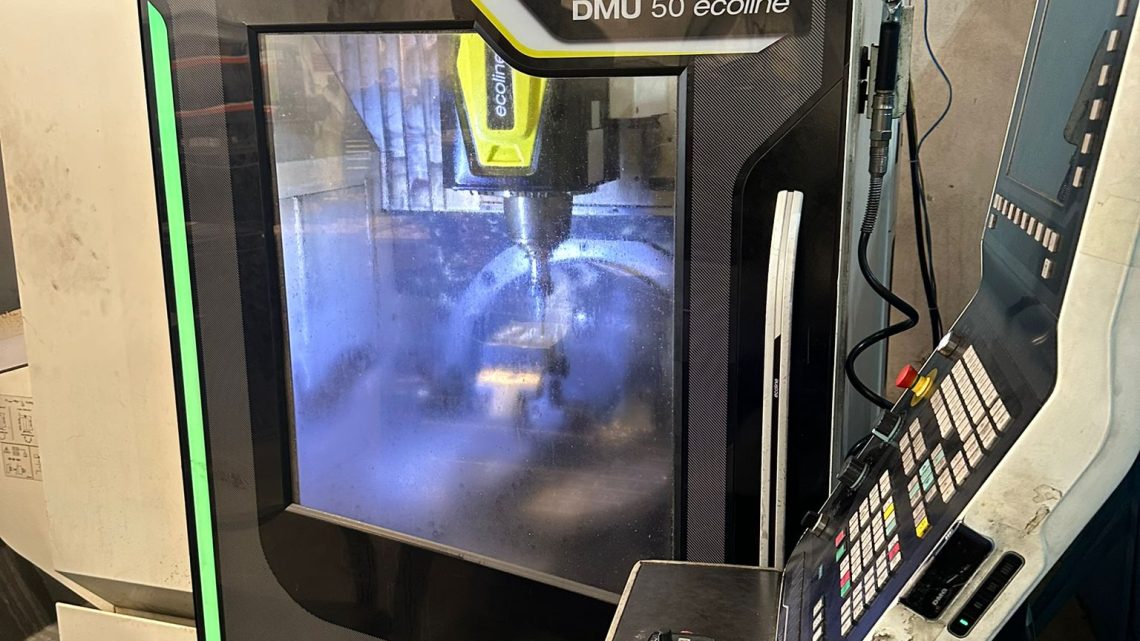
Before You Buy: Essential Criteria for Evaluating a Used, Second-Hand, Pre-Owned, Surplus DMG DMU 50 ECO CNC Vertical Machining Center 5 Axes made in Germany
Here is a detailed, structured checklist (and commentary) for evaluating a used / surplus / second-hand DMG DMU 50 ECO (5-axis vertical machining center) before you commit to purchase. A 5-axis machine is complex and any defects or wear can be expensive to repair, so due diligence is essential.
0. Know the “Target” / Baseline Specs
Before you inspect, you should gather the published (or ideal) specs for the DMU 50 ECO (or equivalent generation) so you have a baseline to judge deviations. Here are typical / reference figures and features:
| Feature | Typical / Reference Value / Range | Notes / sources |
|---|---|---|
| X / Y / Z travels | ~ 500 mm (X) × 450 mm (Y) × 400 mm (Z) | Many used listings of DMU 50 models list these values |
| B-axis tilt | –5° to +110° | (some 5-axis “3+2” models) |
| C-axis rotation | 360° | Common for 5-axis / index table setups |
| Spindle speed / power | Up to ~ 10,000 rpm (or higher, depending on model / upgrade) | Some used machines list 10,000 rpm heads |
| Table / rotary table size & load capacity | e.g. 630 × 500 mm table, workpiece load ~200 kg (varies) | In listings: “Table: 630 × 500 mm, load 200 kg” |
| Tool changer / magazine | ~ 16 to 30 tool capacity, HSK / SK / ISO-40 interfaces depending on variant | Many used listings mention 16 tool changers on DMU 50s |
| Control systems | Siemens (810D, SINUMERIK), Heidenhain (iTNC) or DMG Mori’s newer controls | Many used DMU 50 ECO units use Siemens 810D or Heidenhain. |
Some newer DMG models (e.g. DMU 50 “3rd generation”) boast higher spindle speeds (e.g. up to 20,000 rpm) and more advanced cooling, path measuring, etc.
Before visiting, ask the seller for the machine’s exact variant, control, and any upgrades or modifications. That helps you tailor your inspection and avoid surprises.
1. Structural & Mechanical Frame Inspection
Since rigidity, alignment, and structural integrity are fundamental for precision, start with a top-down inspection of the physical frame, castings, and slideways.
a. Castings, Column, Base & Structural Integrity
- Cracks, welds, repairs — inspect all cast surfaces, especially around stress-prone areas (column base, intersections, rib fillets). Look for signs of weld patches, filler material, or reinforcement plates.
- Corrosion / pitting — heavy rust or pitting may degrade the effective cross section of structural members.
- Flatness & mating surfaces — check the surfaces where ancillary components mount (covers, supports) for warpage or damage.
- Deformation or distortion — long service or misuse could bend or warp structural parts.
b. Slideways, Guides & Gibs
- Inspect linear guides, dovetail or box ways for wear, scoring, scratches, corrosion. Especially on axes that see heavy load (X, Y, Z).
- Manually move axes (if possible) and check for play, backlash, or free motion. Use a dial indicator to measure deflection or wobble.
- Examine gibs, shims, adjustment surfaces — uneven wear or sloppy gib adjustment can reveal prior misuse or sloppy repairs.
c. Spindle Housing & Head Assembly
- Check the spindle housing for signs of impacts, evidence of rework, misalignment.
- Inspect how the head (if tilting or swiveling) moves. The B-axis (tilt) in a 5-axis machine is a pivoting mechanism that can suffer wear; look for play or slop in its bearings or pivots.
- Check lubrication ports, seals, and passages for damage or blockage. Leaking seals or missing covers are red flags.
d. Rotary / Swivel Table & B / C Axes Mechanism
- The B (tilt) and C (rotation) axes (or the table if it’s integrated) are additional mechanical systems that can degrade. Check for backlash, slop, and alignment in both axes.
- If the table is mounted on bearings or trunnion supports, inspect the bearings, housing, preload, and seals.
- Ensure that indexing locks or brakes are functional and have good clamping force.
2. Motion Accuracy, Kinematics & Geometric Testing
A used 5-axis CNC is only as good as its accuracy across all axes, including when axes are combined (tilt + rotate + linear). You must test geometry, kinematics, repeatability, and alignment.
- Straightness / flatness / squareness: Use indicators or test bars to check straightness on each axis, and ensure the axes remain orthogonal (X vs Y, X vs Z, Y vs Z).
- Backlash / reversal error: Test each axis for backlash by reversing direction and measuring the “dead band.”
- Simultaneous axis behavior / kinematic errors: Since 5-axis machining often requires interpolated motion, test combined motions (e.g. tilt + rotate + linear) and check positional accuracy, especially near corners or extremes of travel. Users report that kinematics (i.e. the transformation model of the machine) may drift over time or need re-calibration.
- Repeatability: Move to a reference point repeatedly, return, and check if the machine returns to within tolerance.
- Spindle runout / taper accuracy: Use precision test bars and measure radial and axial runout to ensure the spindle is still within acceptable tolerance. Any abnormal runout indicates spindle bearing wear or damage.
- Thermal stability / drift: Let the machine run or sit for a while, then re-check critical alignment to see if thermal expansion or structural creep affect accuracy.
A user in forums remarked that they had to re-adjust the kinematics for their DMU 50 because the programmed coordinate transformations were off.
3. Spindle, Tooling & Drive Systems
Because cutting precision comes down to how well the spindle and tooling behave, give careful attention to these systems.
a. Spindle & Bearings
- Rotate the spindle (slowly) and listen for noise, roughness, or unusual friction. It should spin smoothly.
- Use test bars or dial indicators to check radial and axial play / runout.
- Ask for maintenance history: whether bearings were ever replaced, and with what quality. Bearing failures in 5-axis spindles (especially at tilt angles) can propagate into expensive repairs.
b. Tool Interface & Tool Changer
- Check the interface (HSK, SK40, ISO) for wear, damage, or improper fitting.
- Inspect the tool changer arms, grippers, and magazine for wear, play, alignment, and reliability.
- Perform a few tool-change cycles (if possible) to see for misfeeds, slow cycles, or misalignment.
- Check if there is a coolant-through spindle feature (if the machine has this option), and test it.
c. Drive Systems, Gears & Motors
- Inspect the drive motors, belts, couplings, gearboxes, and servo systems for signs of wear, overheating, slippage, or misalignment.
- In a 5-axis machine, additional gearing or transmission for tilt/rotate may be present — check these carefully.
- Listen for gear noise, backlash, or binding during movement.
- Check encoders, feedback systems, and wiring for integrity.
4. Control, Electronics, CNC Systems & Software
A 5-axis machine’s control and electronics are arguably as important as its mechanical condition.
- Control unit condition: Inspect the CNC control (Siemens, Heidenhain, or other) for screen integrity, button wear, error logs, alarms, and history. Confirm firmware or software versions.
- Kinematic parameters / calibration: Because 5-axis requires a kinematic transformation (mapping machine geometry to tool motion), check whether the machine has saved or verified kinematic calibration, and whether the seller can provide that record. Some users report the kinematics going off over time on DMU 50s. Practical Machinist
- Data interface & memory: Test file transfers (USB, network, etc), check whether offsets, tool tables, programs, and user data remain intact.
- Safety & interlocks: Verify that all safety channels, interlocks, e-stops, limit switches, door sensors, and cover protections are working.
- Electrical wiring & components: Inspect wiring harnesses, control cabinet, power supplies, relays, fuses, cooling in electronics compartments, and cleanliness. Signs of overheating, burns, or ad hoc rewiring are red flags.
- Probing, measurement & feedback systems: Many DMU 50 machines have probes, touch-off systems, linear scales, and position feedback. Test these systems for accuracy, repeatability, and drift.
- Cooling / chip / lubrication systems: The CNC system often controls coolant, hydraulic systems, lubrication, and pumps. Test these systems (pumps run, valves open, no clogging or leaks).
5. Accessories, Tooling, Spare Parts & Documentation
The value of what comes with the machine is significant, especially for 5-axis machines where replacements can be costly.
- Rotary tables, fixtures, clamps, trunnion tables — Are they included? What is their condition?
- Tooling — Are collets, holders, adapters, probes, tool presetters, etc. included? Are they all compatible with the machine’s spindle interface?
- Probes, tool setters, calibration devices — These are particularly valuable for 5-axis accuracy.
- Spare parts — Any extra motors, switches, belts, bearings, gibs, or replacement parts are a big plus.
- Manuals, wiring diagrams, kinematic calibration data, maintenance logs — Having original documentation is very helpful for servicing later.
- Safety guards, covers, enclosures — Ensure all required protective devices are intact.
If you find missing critical parts (e.g., toolchanger arm, B-axis motor, probe), the cost to replace or retrofit them can be substantial.
6. Operating Demonstration & Test Cuts
Seeing the machine actually running (ideally under light load) is one of the best ways to detect hidden issues.
- Request the seller to run the machine through various axes, tool changes, kinematic moves (tilt + rotate + linear) while you observe for noise, vibration, binding, skipping, or delays.
- Make a test cut with a representative material and tool (if possible) and examine the surface finish, stability, chatter, and tool behavior.
- Observe or measure positional errors during simultaneous motion (e.g. move in 5-axis mode along a known path and check deviation).
- Run the machine for a while and let it warm up; then check for thermal drift in alignment or reference geometry.
7. Maintenance History, Use & Provenance
- Ask for the machine’s hours of operation (spindle hours, axes hours), shift patterns, and utilization history.
- Request maintenance logs, service records, bearing changes, calibration check certificates, kinematics calibration history, and any rework or repairs done.
- Ask for the reason the seller is disposing of it (e.g. is it obsolete, had a failure, or being upgraded).
- If the seller is open, ask for references from prior users or technicians who serviced it.
8. Logistics, Cost, Installation & After-Sales Considerations
Even if the machine is mechanically sound, there are important practical and financial considerations:
- Transport & rigging: A 5-axis VMC like DMU 50 is heavy, bulky, and delicate; account for proper packing, transportation, guarding, cranes, alignment on site, and leveling.
- Foundation / floor load: Ensure your shop floor can support the machine’s weight and that proper foundation (grouting, leveling) is possible.
- Installation utilities: Confirm electrical supply (voltage, phase, amperage, grounding), cooling water, chip disposal, compressed air, etc.
- After-sale support & spare parts availability: Because 5-axis machines use premium components (tilt/rotate bearings, encoders, kinematic calibration, advanced motors), you must verify that you can source spare parts (motors, bearings, control modules, encoders) in your region.
- Calibration, alignment, and commissioning cost: Once installed, expect costs for alignment, geometric verification, kinematic calibration, and testing.
- Upgradability: Check whether the machine is compatible with upgrades (e.g. higher-speed spindle, better control, new toolchanger) and whether such upgrades have been applied.
- Depreciation / resale potential: 5-axis machines are expensive to maintain. Consider how easily you may sell it later or trade it in.
9. Red Flags & Warning Signs
While doing the inspection, watch out for:
- Excessive maintenance modifications (patches, non-original parts, sloppy welds).
- Loose bearings, sloppiness or play in any axis or tilt/rotate mechanism.
- Unwillingness to demonstrate complex motion or test cuts.
- Missing or non-functional accessories (toolchanger, probes, rotary table, encoders).
- Poor or missing documentation, no calibration records.
- Control issues, software errors, corrupted parameter files, missing kinematic data.
- Evidence of coolant leaks into electrical compartments, rust in cabinets, overheating components.
- Strange noises, binding, or delayed motion in axes during movement.
- Lack of parts availability or support for the specific variant.
If enough of these red flags appear, the cost to bring the machine up to reliable service may outweigh the purchase savings.
10. Summary “Go / No-Go” Checklist before Purchase
Here’s a quick decision list you can carry to the site:
- Are the travels (X, Y, Z) as promised (or within acceptable tolerance)?
- Do the linear axes move freely, with acceptable backlash and no binding?
- Does the spindle rotate smoothly, with low runout, no noise, minimal axial/radial play?
- Are the B / C axes (tilt / rotate) functional, with tight motion, no excessive play, and proper locking / brakes?
- Do tool changes proceed reliably, without misfeeds, hesitation, or misalignment?
- Is the control system intact, responsive, error-free, and capable of file transfer / backup?
- Does the kinematic calibration / transformation work, or is there evidence it is off or drifting?
- Do test cuts show stable operation, good surface finish, and no abnormal behavior?
- Are critical accessories (rotary table, fixtures, probes, tool holders) included and in usable condition?
- Are maintenance records, documentation, and spare parts support sufficient?
- Can you afford installation, alignment, calibration, and ongoing maintenance costs?
- Is the seller willing to allow testing, inspection under load, and some warranty or acceptance period?
If the machine passes most of these, it’s a viable candidate. If many criteria fail or are uncertain, walk away (or demand a heavy price discount to cover risk).