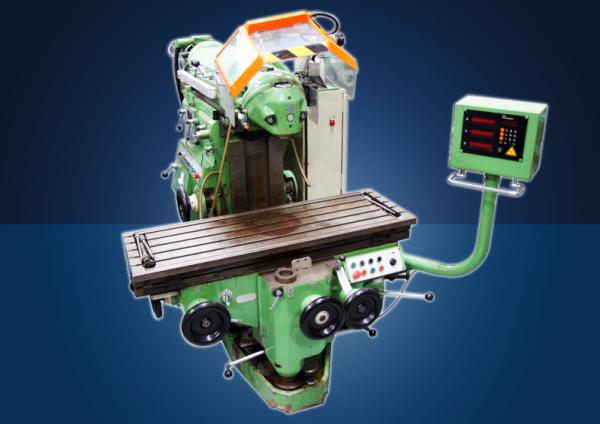
Before You Buy: Essential Criteria for Evaluating a Used, Second-Hand, Pre-Owned, Surplus Huron NU4 Universal Milling Machine made in France
If you’re considering buying a used / second-hand / surplus Huron NU4 universal milling machine (France-made), doing a careful inspection and evaluation is vital. Here’s a structured checklist and guidance to help you decide whether the machine is worth buying (and what to negotiate or budget for).
Because the NU4 is a relatively heavy, precision machine, even small defects or wear can lead to high repair or refurbishment costs. Below are the key criteria, with commentary specific to the Huron NU4 where possible.
1. Understand the Baseline Specifications & What You Need
Before you inspect the machine, you should know what the “normal” specs are (so you can spot deviations) and match them against your intended work. For the NU4 model, typical published parameters are:
| Parameter | Typical / Published Value | Notes & Sources |
|---|---|---|
| X (longitudinal) travel | ~ 1,100 mm | |
| Y (cross) travel | ~ 700 mm | |
| Z (vertical) travel | ~ 500 mm | |
| Table size (L × W) | ~ 1,435 × 460 mm | |
| Distance spindle-to-table (min / max) | ~ 9 mm to ~ 509 mm | |
| Spindle taper / interface | SK / ISO 40 (SA 40) | |
| Spindle speed range (steps) | ~ 30 to ~ 2,066 rpm (27 speed steps) | |
| Feed rate range / number of feed speeds | ~ 1.6 to 820 mm/min over 27 steps | |
| Rapid traverse (X, Y) | ~ 2.8 m/min | |
| Rapid traverse (Z) | ~ 1.4 m/min | |
| Machine weight / footprint | ~ 3,100 kg; ~2.36 × 1.65 × 1.45 m |
You should confirm with the seller the specific version, any modifications, and which of these specs are guaranteed (or “as is”).
Why this matters: If the machine’s travel, spindle interface, table size, etc. are reduced by wear, damage, or modification, it may no longer suit your workpieces or tooling.
Before going on-site, prepare a “target spec sheet” of what you need — both your minimum acceptable and good-to-have values (for travel, spindle rpm, rigidity, etc). Use that to filter machines you’re willing to bid on.
2. Condition of Structural & Wear Parts
Because the universal milling machine relies heavily on the rigidity of its castings, slideways, gibs, and mounting surfaces, assessing the structural condition is critical.
a. Castings, Frame & Base
- Look for cracks, repairs, or welds in the base, column, saddle, knees, and ram. Pay special attention to fillets and junctions where stress concentrates.
- Check if repair plates or patches have been added (these may indicate past damage).
- Check flatness and alignment of mating surfaces (e.g. where attachments or support brackets would mount).
- Inspect for corrosion, pitting, or deep rust that could have penetrated into the cast metal.
b. Slideways, Gibs, and Guides
- Worn or smashed slideways reduce precision. Check for signs of scratches, gouges, scoring or rust pitting on the dovetail surfaces and linear guides.
- Check for play or backlash when moving the table, saddle, and knee manually. Use a dial indicator to check for movement perpendicular to direction of travel.
- Look at the condition of gibs, wedges, and adjusting surfaces — whether they have been modified, shimmed excessively, or show uneven wear.
- Check whether any surface reconditioning (e.g. scraping, re-grinding) has been done; if so, how well. Poor rework can degrade performance.
c. Spindle & Head Assembly / Universal Head
- Spin the spindle by hand (or power it slowly) and check for smoothness, noise, and runout. Use a test indicator on a precise tool (e.g. test bar) to measure radial runout and axial play.
- Check for wear of bearings, whether they have been replaced, and whether the spindle is still within spec.
- Inspect how the universal head swivels/tilts: look for wear or looseness in the pivot points and bearings. The universal head is a mechanically complex component and may have sustained wear from angular operations.
- Lubrication passages, seals, and oiling points on the spindle head should be intact and not clogged.
- Check the nut or drawbar mechanism (if applicable) for damage or excessive play.
d. Table & T-Slots
- Inspect the table’s surface for wear, pitting, dents, and flatness. Use a straightedge or precision test bar.
- Check T-slots for deformation, wear, or damage.
- Verify that fixtures, stops, and mounting points (if present) are intact and aligned.
- Verify that the table movement (X, Y) is free, with no binding or sag.
e. Lead Screws, Nuts & Feed Drives
- Lead screws (ball screws or Acme / plain screws) should be checked for wear, backlash, binding, or scoring.
- Nuts & half-nuts must be checked for looseness or play.
- The feed mechanism (gear train, belts, chains, clutches, shafts) should be inspected for wear, broken teeth, oil leaks, or misalignment.
- Check the condition of keys, splines, couplings in the drive train.
f. Gears, Gearboxes & Power-Trains
- The NU4 has multiple speed steps. Check all gearboxes, shafts, and engaging mechanisms for wear, broken teeth, noise, or misalignment.
- Shift mechanisms (levers, handles, locks) should engage cleanly without slop or binding.
- Listen for gear noise when the machine is run under no-load / low load.
- Inspect lubrication levels and signs of contamination in gearboxes (metallic chips, sludge, etc).
3. Accuracy, Alignment & Wear Testing
A used machine may look okay, but its geometric accuracy may be compromised. Try to perform the following tests (bring measuring tools, test bars, dials, etc.):
- Straightness / flatness checks: Lay precision straightedges or level across table or saddle and measure deviation with an indicator.
- Squareness between axes: Check that X–Y, X–Z, Y–Z are orthogonal within tolerance (e.g. 0.01–0.05 mm over full travel).
- Backlash / reversal error: Using a dial indicator, measure backlash or “deadband” when reversing each axis.
- Positional repeatability / stepping: Move to a point, return, move back, etc. Check if position goes back to within tolerance.
- Spindle runout / taper accuracy: Use a precision test bar with indicator to quantify runout. A good machine should not exceed small microns (e.g. ≤ 0.01 mm typical for a well-maintained machine).
- Thermal stability: Run the machine for a while, then re-check critical alignment to see if thermal expansion or play changes tolerances.
- Vibration / noise under load: If possible, run some test cuts (with minimal or moderate load) to detect chatter, vibration, or irregularities.
If you or an expert can bring a laser interferometer or more advanced metrology gear, that’s a big plus.
4. Electrical, Motors & Control Systems
- Check the spindle motor(s) — condition, power rating, insulation, wiring, thermal protection.
- Inspect control switches, safety interlocks, relays, wiring harnesses, and control panels for signs of overheating, burning, or prior repair.
- Check voltage compatibility (the machine may require three-phase electrical supply), breaker panels, earth grounding, and phase balance.
- Inspect the lubrication / pump / coolant system: check pump operation, lines, filters, lubrication distribution, whether there are clogged or broken pipes.
- If the machine has any digital scales / DROs / position encoders / electronic feedback systems, verify they function, read consistent values, and are well-calibrated.
- Check the quality of the machine’s wiring: are original cables intact, or have there been ad hoc repairs or rewiring?
5. Accessories, Attachments & Spare Parts
The value of the machine also depends on what else is included (or missing), because replacing missing parts or adapters may be expensive or impossible.
- Auxiliary heads, milling heads, dividing heads, angular heads — are they included? Are they in good condition?
- Collets, chucks, arbors, tool holders — what is the included tooling, and is it compatible with the spindle (e.g. ISO 40)? If adapters (e.g. ISO 50 to 40) are installed, check their condition or wear.
- Vices, fixtures, bolts, clamps, stops — are they present and in usable condition?
- Coolant / chip conveyors / filters / mist systems — are these included, functioning, and clean?
- Manuals, schematics, lubrication diagrams, parts lists — these are invaluable. Ask if the original documentation is available.
- Spare parts: any spare belts, gibs, nuts etc can be a bonus.
- Safety guards, covers, enclosures — check for missing protective elements that may be required by local regulations.
6. History, Maintenance & Documentation
- Ask the seller for maintenance logs, repair history, overhaul records, and any modifications done. A well-maintained machine with documented history is much more trustworthy.
- Ask about the number of operating hours, shifts, duty cycles, and past workloads. A machine used lightly will have less wear.
- Inquire about why it’s being sold and whether there were known issues (e.g. crash history, accidents, misuse).
- Request to see the machine in operation (if possible). Watching it run gives clues about noise, vibration, performance, and any signs of trouble.
- Ask about the date and quality of the last calibration, alignment, or service.
- If possible, get references from prior buyers or see other used Huron machines sold by the same seller to evaluate reliability.
7. Cost Factors, Transport & Installation
- Because the NU4 weighs over 3 tonnes and has a large footprint, you must account for transportation, rigging, foundations, leveling, and alignment costs.
- Check whether the machine foundation is adequate, or if it will need a reinforced base or pit.
- Ensure that your facility has sufficient overhead clearance, door size, cranes or gantries to move the machine in and position it.
- Budget for calibration, alignment, refurbishment, part replacement, lubrication, and any retrofitting (e.g. DRO, better motors) after purchase.
- Check local supplier availability for spare parts (bearings, gibs, lead screws, motor spares, gear teeth, etc) and cost. Some parts may require custom fabrication or import.
- Confirm whether any legal or regulatory constraints (electrical codes, safety rules, CE compliance) apply in your locale.
8. Risk / Red Flags & What to Negotiate
When inspecting, watch for these red flags:
- Significant structural cracks, weld repairs, or patchwork.
- Excessive play in slides, gibs, or bearings.
- Inconsistent or mismatched wear between axes (indicates misuse).
- No documentation, missing parts, or unknown modifications.
- Spindle runout / bearing play beyond acceptable tolerance.
- Gearbox noise or broken teeth.
- Damaged wiring, burned components, or uncertain electrical systems.
- Absence of key accessories or tooling, meaning you will need to source them.
- Lack of test or demonstration (seller unwilling to run it).
- Incomplete or poor maintenance history.
If you still want to proceed, negotiate a price that reflects the risk and expected repair or refurbishment cost. The seller should ideally include a guarantee or allow time for testing under load.
9. Summary Checklist — “Go/No-Go” Decision
Here’s a compact decision checklist you can use on-site:
- Are the measured travels and clearances (X, Y, Z, spindle-to-table) within acceptable tolerance relative to the datasheet (or your minimums)?
- Does the spindle rotate smoothly, with minimal runout, no noise, and no axial / radial play?
- Are slideways, guides, gibs, and lead screws in good condition (no deep wear, scoring, or excessive play)?
- Are gearboxes, shifting mechanisms, feed systems sound and functional, with minimal noise or binding?
- Does the machine hold or return to positions within your required accuracy (positional tests)?
- Are all electrical/motor systems, lubrication systems, etc functioning / safe / well maintained?
- Are essential accessories, tooling, documentation included (or available)?
- Does the price, including expected transport and refurbishment, remain viable compared to alternatives (rebuilt, newer, or competitor brands)?
- Can you secure sufficient time for testing, running, and inspection (under minimal load) before final acceptance?
- Are you prepared to assume risks of hidden defects, spare part challenges, and refinement work?
If all or most of these criteria are satisfied (or the deficiencies are acceptable and repairable within your budget), then this NU4 is a candidate. If not, walking away may save you a lot of headaches and expense.