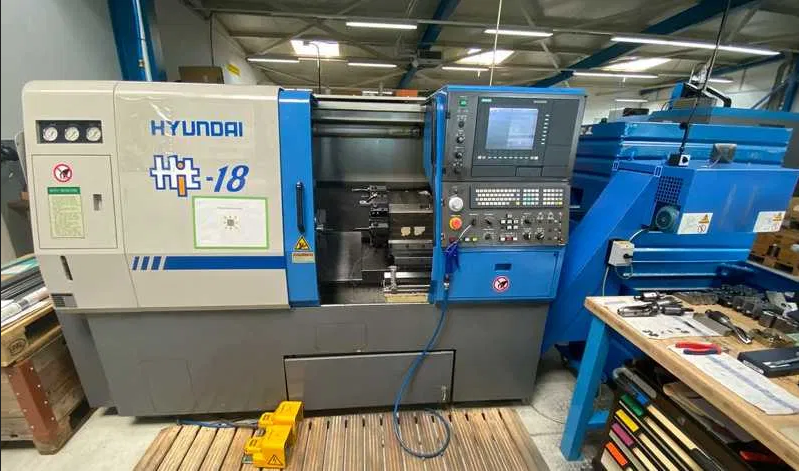
Before You Buy: Essential Criteria for Evaluating a Used, Second-Hand, Pre-Owned, Surplus Hyundai Hit 18 CNC Lathe made in South Korea
If you’re considering buying a used / surplus / second-hand Hyundai HIT 18 CNC lathe, you’ll want to scrutinize its mechanical, electrical, and control systems carefully. Below is a structured “due diligence” checklist and commentary tailored to the the HIT 18 (or HIT 18S / similar variants) to help you make an informed decision.
0. Gather Baseline Specs (so you know what to expect)
Before inspecting, collect the factory/ideal specs of the HIT 18 (or the specific variant). Many used-listing specs are available; here are some representative data points for the Hyundai HIT 18 / HIT 18S:
- Maximum turning diameter (over bed) ≈ 440 mm (17.32 in)
- Typical turning / cutting diameter ≈ 254 mm (10 in)
- X (cross) axis travel ≈ 180 mm
- Z (longitudinal) axis travel ≈ 510 mm
- Spindle speed range often from 36 to 3,600 rpm
- Spindle bore (bar capacity) ≈ 70 mm
- Turret tool stations: 8-station turret is common in HIT 18 variants
- Approximate machine weight / footprint: ~ 4,300 kg and floor dimensions ~ 2,600 × 1,650 × 1,830 mm (L × W × H)
- Rapid traverse (X, Z) is often ~ 30 m/min (or equivalent)
Use these as comparison anchors during inspection. Ask the seller for the exact variant (HIT 18, HIT 18S, control type, any special options or retrofits) and if there is any discrepancy from standard spec.
1. Structural & Mechanical Condition
a. Castings, Bed, Headstock & Frame
- Inspect the bed, bedways, base, headstock housing, tailstock housing for cracks, repairs, welds, patch plates, or visible distortions.
- Look for corrosion, pitting, or localized wear, especially near coolant zones or chip accumulation zones.
- Verify that all mounting surfaces, covers, and guards sit properly and are aligned (meaning that parts have not been bent or misaligned).
- Check whether the bed is straight and free of warpage or sag.
b. Slides, Ways, and Box / Dovetail Guides
- Visually inspect the guideways (in X and Z axes) for scoring, rust, nicks, chatter marks, or wear lines.
- Jog / manually move the axes and feel for binding, sticking, or rough movement. Motion should be smooth across full travel.
- Use a dial indicator to detect play, backlash, or side‐to‐side wiggle in the axes.
- Check gib or adjustment surfaces (if provided) for uneven wear or over-shimmed conditions.
- See whether protective scrapers, wipers, or covers are present and functional.
c. Spindle & Bearings
- Rotate the spindle (if possible, slowly) and listen/feel for rough spots, noise, uneven drag, or hesitation.
- Use a test bar or dial indicator to check radial runout and axial play (end‐play). Excessive wobble is a serious problem.
- Ask for maintenance / bearing replacement history. Bearing wear is costly to fix on used machines.
- Inspect spindle seals for leakage or damage. Ensure spindle lubrication lines, if any, are intact, and look for signs of coolant ingress.
- Check the spindle nose, the mating surfaces, threads, drawbars or locking mechanism (if applicable) for wear or damage.
d. Turret / Tooling & Tool Change Mechanism
- Ensure the turret (8-station or whatever number) locks solidly with minimal slop. Test indexing and locking under power if possible.
- Check for wear or play in the turret drive mechanism, indexing cams, or locking pins.
- Test a few tool change cycles (if allowed) to observe speed, repeatability, mis-indexing, or hesitation.
- Inspect tooling holders, collets, adapters, cam locks, or any sliding parts for wear, corrosion, or damage.
e. Tailstock & Quill (if present)
- If the machine has a tailstock, test the quill movement, lock, and alignment. Look for play or misalignment.
- Check taper surfaces (e.g. MT #4 quill taper) and measure if the tailstock center is aligned to the spindle centerline.
f. Lead Screws, Nuts & Feed Mechanism
- Examine the lead screws (if conventional) or ball screws (if upgraded) for wear, pitting, or damage.
- Check anti‐backlash nuts, half-nuts, or feed mechanisms for play, binding, or slop.
- Inspect gears, belts, couplings, and shafts in the feed drive chain for wear, broken teeth, alignment, or looseness.
2. Accuracy, Geometric & Kinematic Tests
A used lathe’s real value is in its alignment, repeatability, and ability to maintain tight tolerances. Bring gauges, test bars, and indicators to perform these tests.
- Backlash / reversal error: Reverse the axis direction into a reference point and measure the “dead zone.”
- Linearity / straightness: Use a precision straightedge or test bar to check for straightness in the travel.
- Repeatability / return accuracy: Cycle to a reference point, retract, and return; measure error in repeated moves.
- Squareness & alignment: Check that X vs Z axes remain orthogonal, and that the spindle axis is perpendicular to the bed within acceptable tolerances.
- Thermal drift: Let the machine warm up, then re-measure reference alignment to detect shifts.
- Turning test / cut test: If allowed, make a test turning pass on a known material and measure finishing errors (runout, taper, cylindricity).
If possible, perform test cuts on both heavy and light passes to observe chatter, stability, and consistency.
3. Control System, Electronics & CNC Components
Because the control and electronics govern precision, reliability, and ease of operation, scrutinize these carefully.
- Inspect the control unit (CNC cabinet, drives, servo amplifiers), HMI panel, screen, buttons, wiring, electronics fans, and overall cabinet cleanliness and integrity.
- Power up the machine (if seller allows) and check for error messages, alarms, or diagnostic logs.
- Verify that program memory, tool tables, offsets, parameter backups, and control files are intact and readable.
- Test communication ports (USB, RS-232, LAN, DNC) and see whether file transfers work reliably.
- Inspect wiring, harnesses, connectors, and cable carrier chains for wear, chafing, broken insulation, or ad hoc repairs.
- Test limit switches, home switches, safety interlocks, and emergency stops to ensure they function properly.
- Evaluate the lubrication / hydraulic / pneumatic systems (if present) that control tool clamping, tailstock, coolant, chip conveyor, etc.
Be vigilant for burnt wiring, overheated components, mismatched wires, or signs of repairs.
4. Accessories, Tooling & Spare Parts
What you get with the machine significantly affects its usability and overall cost.
- Chuck(s), collets, adapters, tooling holders — are they included? Check whether they are compatible and in good condition.
- Workholding fixtures, steady rests, follow rests — if included, check condition, alignment, and utility.
- Bar feeders / automatic feeding units — many HIT 18 listings include bar feeders (e.g. LNS Hydrobar).
- Tool presetter / tool‐eye / tool measuring devices — valuable items that reduce setup time.
- Probes / touch-off sensors — check if the machine has them and whether they work.
- Spare parts inventory — look for extra belts, gibs, bearings, motors, servo modules, couplings, etc.
- Manuals, electrical schematics, control parameter documentation, maintenance logs — absolutely essential for future troubleshooting.
- Safety guards, chip conveyor, coolant systems, enclosure doors, splash guards — these should all be present and functional.
Missing critical tooling or accessories can significantly reduce the machine’s usable value.
5. Demonstration, Testing & Sample Operation
Seeing the machine run is crucial to uncover issues invisible in static inspection.
- Ask the seller to jog all axes, cycle tool changes, move the turret, etc., while you listen for odd noises (grinding, knocking, binding).
- Run a program or test cut if permissible; observe spindle behavior, chatter, surface finish, vibration.
- After warmup, re-measure reference geometry or indicators to detect thermal drift.
- Test corner or end-of-travel positions (axes fully extended) to detect binding or alignment issues under extremes.
- Run repeated cycles to detect creeping errors or drift over time.
- Test the bar feeder (if installed), tool presetter, and any auxiliary systems (coolant, clamps, tailstock) for reliability.
6. Maintenance History, Usage & Provenance
Understanding how the machine has been used and maintained is key to estimating its remaining life and risk.
- Ask for the machine’s operating hours (spindle hours, axis motion hours, cycles) if available.
- Request maintenance logs, repair history, component replacements (especially bearings, motors, actuators, electrical modules).
- Ask if the machine ever had collisions, crashes, or misoperation events.
- Inquire why the seller is disposing of it (upgrade, failure, redundancy) — the reason might flag hidden issues.
- If possible, get references or see other machines sold by the same vendor to gauge reliability.
- Ask if there have been retrofits, control upgrades, or nonstandard modifications.
A well-documented machine with known history commands a premium and minimizes surprises.
7. Practical / Logistical Aspects & Post-Purchase Risks
Even a technically good lathe can become problematic if logistics, support, or upkeep are neglected.
- Transport & installation cost: A large lathe like HIT 18 will require crane / lift, careful packing, leveling, and alignment on site.
- Floor loading & foundation: Ensure your shop floor strength, levelness, and anchoring plan are adequate.
- Electrical / utility requirements: Confirm voltage, phase, current, grounding, required coolant, compressed air, ventilation, etc.
- Alignment / commissioning cost: You’ll likely need to re-level, align, calibrate axes, check geometry, and tune backlash after installation.
- Spare parts / supplier availability: Check if critical parts (motors, spindle bearings, electronic modules, control parts) are still obtainable locally or via import.
- Software / control upgrades: Some older control versions may lack features or be harder to maintain; upgrading can be costly.
- Remaining useful life & depreciation: Be realistic about how many more years the machine can reliably serve and factor in replacement/repair costs.
- Resale potential: Consider how easy it might be to sell or trade this machine later (especially in your locality).
8. Red Flags & Warning Signs
During inspection, these are serious red flags that should make you pause or renegotiate heavily:
- Significant play, backlash, or slop in axes or turret.
- Grinding, knocking, or irregular noise during movement or spindle rotation.
- High spindle runout or axial play beyond acceptable tolerances.
- Damaged, missing, or modified wiring, burnt components, or repair patches in control cabinet.
- Control errors, missing parameter files, or corrupted memory.
- Nonfunctional turret indexing, tool change failures, or mis-index conditions.
- Corrosion, pitting, or damage to critical surfaces (ways, beds, spindles).
- Absence of documentation, manuals, or wiring diagrams.
- Missing critical tooling (chucks, collets, fixtures, presetter).
- Seller refusing to permit test cuts or full axis demonstration.
- Evidence of neglect, poor maintenance, or environmental damage (flooding, coolant leaks, severe chip accumulation).
If multiple red flags exist, the cost of making the machine serviceable may exceed the value.
9. Go / No-Go On-Site Checklist
Here’s a condensed decision checklist to carry onsite:
- Spec validation: Are the key travels (X, Z), spindle bore, turning capacity etc. roughly within published spec?
- Axis motion: Are the axes smooth, free of binding, with minimal backlash?
- Spindle quality: Does the spindle rotate smoothly, with low runout and minimal play?
- Turret / tool change: Does the turret index reliably, lock solidly, and change tools accurately?
- Control & electronics: Is the control functional, free of errors, with intact program memory and reliable communication?
- Accessories & tooling: Are chucks, collets, fixtures, tool presetter, bar feeder, etc. included and usable?
- Test cuts / demonstration: Are test operations successful, without vibration, chatter or unexpected error?
- Service history & parts support: Is there a credible history and confirmation of spare part availability?
- Installation feasibility: Can your site handle transport, foundation, utilities, leveling, alignment?
- Risk tolerance: Are any deficiencies manageable or acceptable in your budget?
If the machine satisfies most of these and the risks are manageable, it may be worthwhile. If many critical checks fail, be prepared to walk away or insist on strong contingencies in the purchase agreement.