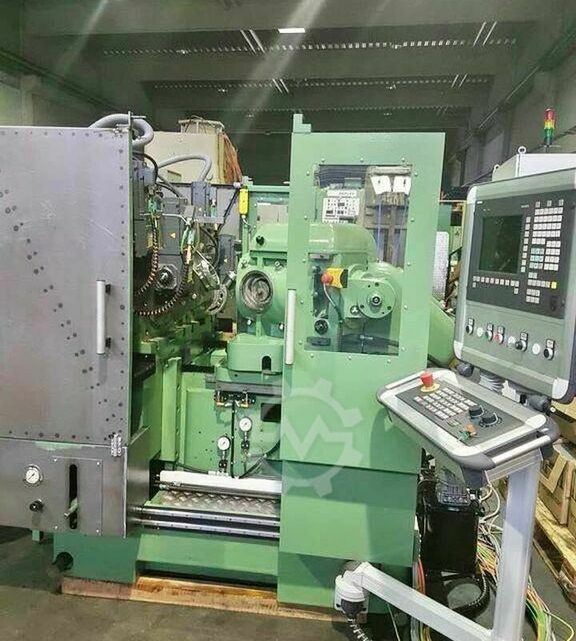
Before You Buy: Essential Criteria for Evaluating a Used, Second-Hand, Pre-Owned, Surplus KLINGELNBERG CNC BF CNC Bevel Gear Generators Straight Hobbing Machine made in Germany
Evaluating a used / surplus Klingelnberg (or similar) CNC BF bevel-gear generator / straight-hobbing / bevel-gear cutting machine is a demanding task. Gear machines require extremely precise mechanical, kinematic, and control integrity. Below is a detailed “before you buy” checklist plus commentary—things you must verify in person (or via remote video) to avoid expensive surprises.
What to Know in Advance / Baseline Data
Before you visit, compile the machine’s “passport” information (serial number, model, build year, original spec) and ideal benchmark specs so you have reference points. Ask the seller for:
- Exact model (e.g. BF CNC, BF, or a variant), build year, serial number
- Manufacturer’s spec sheet: gear diameter range, module range, tooth count, index table specs, spindle speeds, indexing system, feed axes, torque, control system, number of axes, tool heads
- What cutting modes it supports (straight bevel, spiral bevel, hobbing, indexing, etc.)
- Control system type (CNC brand & version), drive systems, feedback systems (encoders, resolvers)
- Any rebuilds, retrofits, or modifications (e.g. new control, new bearings, new motors)
- Maintenance and service history, usage hours, known issues
Having ideal specs and history helps you detect deviations or misrepresentation on site.
Also note: Klingelnberg is a leader in bevel gear technology; their machines are high-precision, and tolerances are tight.
Key Areas to Inspect & Test
Here’s a systematic checklist of subsystems and what to check. Bring measuring tools (dial indicators, straight edges, test bars, probes) and insist on live testing wherever possible.
| Subsystem / Area | What to Check / Test | Why It Matters / Warning Signs |
|---|---|---|
| Frame, Base & Castings / Structural Integrity | Check for cracks, welds, patch plates, repaired surfaces on the base, columns, supports, index table housing. Look for distortions or warpage on mating surfaces (mounting faces). Check for corrosion, pitting, coolant damage or erosion near chip / fluid paths. | The structural skeleton must remain rigid; distortion undermines gear accuracy and repeatability. |
| Guideways, Linear Slides, Transfer / Indexing Axes | Manually / via jog move each linear axis (feed axes, slide axes) over full travel. Feel for smooth motion, any binding, stick-slip, gritty zones. Use indicators to measure lateral play (perpendicular to motion) or vertical drift. Check backlash / reversal error. Inspect surfaces for scoring, wear lines, pits, scratches, chips, and verify lubrication / wipers / scrapers are intact. | Gear machines require smooth, precise motion control. Any irregular friction or play leads to periodic errors in the tooth profile. |
| Index / Rotary Table & Division Mechanism | Check the index table or rotary axis (if part of the machine) for backlash, runout, smooth rotation, locking mechanism integrity. Rotate manually (if safe) and check for mechanical looseness or uneven resistance. | Indexing errors will result in pitch errors or tooth spacing irregularities. |
| Spindle / Cutter Head / Hob Head | Slowly rotate the main cutter or hob spindle. Feel for smoothness, listen for noise, drag, or rough spots. Use test mandrels or dial indicators to measure radial runout and axial play. Inspect bearings, housings, seals, lubrication lines, and check for signs of leakage or contamination. Ask whether bearings have ever been replaced. | The cutter head must be rigid and precise. Even small play or runout degrades gear flank quality. |
| Tool / Cutter Mounting & Arbor / Support | Inspect the arbor or tool mounting mechanism, keyways, locking nuts, supports, and secondary bearings. Ensure the tool mounting is precise and that the arbor support is rigid. | If the tool is not held rigidly, machining error or chatter may result. |
| Drive Systems, Motors, Gearboxes, Couplings | Inspect servo motors, drive amplifiers, gearboxes, couplings, shafts, belts, and torque systems. Look for signs of overheating, discoloration, repair, or abnormal wear. Check alignment of couplings and shafts. | Drive system anomalies (misalignment, backlash, vibration) will degrade gear accuracy or break under load. |
| Control & CNC / Electronic Systems | Power on (if allowed). Read any diagnostics, error logs, control health. Check parameter memory, tool tables, offsets, indexing tables. Navigate the controller interface, command manual moves. Check feedback devices (encoders, resolvers) for signal stability. Inspect wiring, connectors, cable routing, cable carriers for wear or damage. | A machine with control or feedback failure is risky. If control modules are obsolete or unsupported, service becomes very expensive. |
| Metrology & Accuracy / Test Cuts | Perform geometric tests: backlash / reversal in feed axes; straightness over full travel; repeatability (move / retract / return). If possible, cut a bevel gear test piece and inspect profile, helix, pitch, tooth contact, flank quality. Measure deviations. Re-check after warm-up (thermal drift). | This is the ultimate test. If the machine cannot hold specs in a test, it is of limited use. |
| Accessories, Tooling, Fixtures & Spares | Confirm what is included: cutters / hobs, arbors, calibration tools, fixturing, chucks, balancing tools, spare parts (bearings, couplings, motors), tooling inventory, manuals, wiring diagrams. | Missing tooling or calibration parts can cost more than the machine to source or fabricate. |
| Maintenance History & Provenance | Request maintenance logs, rebuild records, repair events, operating hours, known failures, usage conditions (shocks, heavy duty, coolant quality). | A machine with unknown or bad history has higher risk. |
| Logistics, Installation & Suitability | Confirm that your shop can accommodate weight, footprint, floor load, electrical power, coolant / lubrication systems, foundation requirements, rigging / transport, safety requirements. | Even a perfect machine is useless if you cannot properly install or power it. |
Specific Gear / Bevel Gear Considerations
Because this is not a general milling or turning machine but a bevel gear generator / straight bevel gear hobbing / cutting machine, some additional checks are essential:
- Index Table / Differential Mechanisms
The gear generator may use differential gearing or indexing systems. Verify that the indexing gears, differential drives, and synchronization are intact and properly meshed. - Pitch Error, Tooth Spacing Uniformity
Test for periodic pitch errors (every nth tooth). Use gear measurement instrumentation (or a master gear) to detect pitch variation, composite error, or periodic error caused by drive or backlash issues. (See diagnostic methods for gear hobbing machines) - Cutter / Hob Runout and Balance
If the cutting hob or cutter is unbalanced or has runout, it will introduce vibration and profile errors. Check arbor support, balancing, and runout carefully. - Helix / Profile Deviation
For spiral or bevel gears with helix angles, errors in the helix direction are extremely sensitive to mechanical misalignment. Check profiling capability, helix error, and whether the CNC software supports proper compensation and interpolation. (Klingelnberg emphasizes integration of optimal cutting software and compensation) - Tool Path & Machine Kinematics
The machine’s interpolation of rotational movements (to index the cutter and rotate the gear blank) must be precise and synchronized. Any lag, slip, or control mismatch will distort the gear profile. - Rigidity & Chatter / Vibration under Load
Run under a moderate cutting load (if possible) and observe for chatter, vibration, or tool deflection. Gear cutting under low rigidity will degrade surface quality and dimensional precision. - Thermal Stability
Because gear machines often operate over long cycles, thermal drift can creep in. After warm-up, re-check geometry or test cuts to detect shifts.
Red Flags & Warning Signs
Be particularly wary if you see:
- Heavy repairs, welds, or structural modifications in the base, column, or table
- Excessive play, backlash, or slop in any axis
- Roughness, irregular friction, binding, or jumps in slide motion
- Spindle or cutter head noise, vibration, or high runout
- Failed or missing control / CNC modules or no access to parameter data
- Obsolete control electronics (no support or unavailable spare parts)
- Missing crucial tooling, arbors, calibration equipment
- The seller refusing full-motion testing, test cuts, or running gear cycles
- Pitch / profile errors in test gear cuts or inconsistent gear output
- Coolant or chip contamination in sensitive components
- Mismatched or repaired wiring, burned electrical parts or poor cable management
Onsite Decision / Acceptance Checklist
Here is a compact on-site checklist you can use (mark Pass / Marginal / Fail) to help decide whether to proceed:
- Specs match (gear size, module, tooth count, indexing, control)
- Frame integrity & absence of structural damage
- Smoothness of linear motion (no binding)
- Backlash / reversal errors acceptable
- Indexing table / division mechanism precise & solid
- Spindle / cutter head runout and play within tolerance
- Drive systems, motors, couplings in good condition
- CNC / control responsiveness and parameter integrity
- Test gear cut / profile / helix meets tolerance
- Thermal drift check after warm-up
- Tooling & fixture package included
- Maintenance history available
- Installation feasibility in your shop
- Risk vs price — deficiencies manageable
If the majority of items pass (or marginal ones are acceptable and fixable), it can be a good candidate. If many items fail, you must negotiate heavily or walk away.