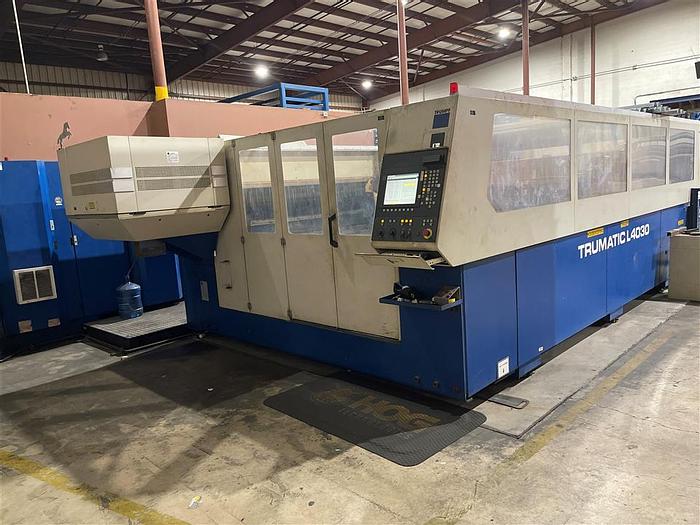
Avoid Costly Mistakes: Professional Tips for Purchasing a Pre-Owned / Surplus / Second-Hand / used Trumpf Trumatic L4030 made in Germany
Purchasing a used Trumpf Trumatic L4030 CNC laser cutter (made in Germany) can be a great deal — if you do your homework. But lasers are finicky, and many hidden problems can cost you dearly later. Below is a professional, detailed checklist (plus tips and red flags) to help you avoid expensive mistakes.
1. Baseline Specs & What You Should Expect
Before you get to the shop floor, arm yourself with the typical specs so you can spot exaggerated claims or mismatches.
From multiple listings, here are common parameters for the L4030:
| Parameter | Typical / Published Value |
|---|---|
| Laser type | CO₂ laser |
| Laser power | ~ 4,000 W (resonator) |
| Working area / table size | ~ 4,000 mm (X) × 2,000 mm (Y) |
| Z / focal travel | ~ 100–115 mm or so in many versions |
| Maximum cutting thickness (mild steel) | ~ 20 mm (some listings) |
| Control / CNC | Siemens 840D in certain models |
| Machine weight | ~ 16,000 kg |
| Year / build | Some units are from late 1990s / early 2000s |
Use these as reference “sanity checks.” If someone claims “10 kW CO₂ / 8,000 × 3,000 mm / 500 mm Z-travel,” you should demand proof.
2. Pre-visit Questions & Documentation Request
Before you even travel to see the machine, require certain documentation and answers. This allows you to screen out bad deals early.
Ask the seller to provide:
- Serial number, manufacturing year, and model revision
- Total laser hours / “beam on” hours / resonator run hours
- Maintenance / service logs (resonator, optics, alignment, gas systems)
- Any history of crashes, collisions, repairs, or retrofits
- Which resonator model (Trumpf TLF 4000, TLF series, etc.)
- Which control / CNC version (e.g. Siemens 840D) and whether software is original or modified
- Optical path / lens / mirror replacement history
- Power supply / machine electrical data
- Cooling / chiller system specs and health
- Photos of optics, cutting head, mirrors, beam path
- List of included accessories (sheet loaders, pallet changer, dust extraction, automation)
- Agreement that you can run a full functional test, including laser cuts if safe
- Confirmation that the machine will allow test of axis motion, resonator, gas flow, etc.
If the seller refuses basic transparency, that’s a red flag.
3. Visual & Structural Inspection (Cold / Before Powering)
Before firing it up, inspect the structural, mechanical, and optical subsystems visually. Many defects or wear signs show up without power.
a) Frame, bed, gantry & guideways
- Look for cracks, warps, missing welds, distortion in the frame or bed.
- Check the movement ways, guide rails, linear bearings: look for scoring, rust, pits.
- Inspect way covers, protective boots, scrapers — if they are heavily damaged, chips or dust may have invaded critical areas.
b) Gantry / axes drive systems
- Examine belts, pulleys, gearboxes, ball screws or rack & pinion systems (if used).
- Check backlash or looseness visually on couplers or joints.
- Check the condition of motors and servo systems for signs of overheating, discoloration, burnt wiring.
c) Laser head, optics path, mirrors, lens housing
- Inspect the cutting head: lens housing, window, nozzle, alignment marks.
- Check mirror mounts; are they solid or sloppy?
- Look for contamination (dust, soot) in optics path.
- Inspect lens / mirror holders for damage, burn marks, misalignment.
- Check whether protective windows or AR coatings are intact.
d) Resonator / laser source room
- Inspect the resonator (or laser tube) housing for leaks, cooling, corrosion, or electrical damage.
- Check cooling pipes, water lines, chiller interface, reservoir.
- Look for signs of past leaks, discolored spots, residue of coolant or cleaning fluids.
e) Cooling / chiller / auxiliary systems
- Chiller, heat exchangers, coolant pipes: condition of tubing, pumps, leaks.
- Gas supply lines (CO₂, assist gas, nitrogen, etc.): check piping, pressure gauges, leaks.
- Electrical cabinets: dust, wiring modifications, signs of heat damage or burnt insulation.
- Extraction / fume removal system or dust collector condition.
f) Accessories / automation
- Sheet loading systems, pallet changers, shuttle tables, conveyors: inspect mechanical condition, linear guides, cams.
- Inspection sensors, alignment fixtures, gas flow devices.
- Control panels, covers, wiring harnesses, connectors.
Document all visual defects with high-resolution photographs; when you get home, they help you argue discount or repairs.
4. Power-Up & Functional Testing
Once you have permission and it is safe, power it up and run through functional tests to validate mechanical, optical, and control subsystems.
a) Control system & startup
- Boot the CNC controller. Observe the alarm history, warnings, diagnostic logs.
- Verify all control keys, jog wheels, overrides, panels work.
- Let the system warm; confirm stable behavior over time.
b) Axis movement & dynamics
- Jog each axis (X, Y, Z) across full travel at slow, medium, high speeds. Feel for binding, jerkiness, or inconsistent friction.
- Reverse direction and watch for backlash or hysteresis.
- Run simultaneous / combined moves (if the control allows) to test motion coordination.
- Observe servo response, speed stability, deceleration overshoot.
c) Laser diagnostics & resonator
- Power up resonator (if allowed) in test / low power mode. Monitor how the beam becomes stable.
- Check gas pressures, flows, resonator cooling behavior.
- Examine beam path diagnostics (if control provides).
- Test mirror alignment adjustment functions (if available).
d) Optics / beam path / focal head tests
- Perform beam diagnostics (beam centering, focus consistency).
- If possible, do a “pierce” test with minimal material to see how the head behaves.
- Check focal height control, autofocus if installed, and the travel / movement of head in Z.
- Inspect movement or misalignment of mirrors during travel.
e) Cutting test (if safe and acceptable)
- Using noncritical metal (e.g. mild steel), perform a short cut or trial contour.
- Inspect cut quality, kerf, precision, edge finish, burrs.
- Vary feed / speed slightly to see behavior under small deviations.
- Observe whether quality degrades toward edges or corners (indicating alignment problems).
f) Thermal stability & drift test
- Run the laser active (or idle) over a period of time (e.g. 30–60 minutes).
- Check drift in beam quality, alignment, dimensional stability.
If any subsystem misbehaves (e.g. optics misalignment, poor cut quality, overheating, unexpected alarms), note it and quantify how much repair might cost.
5. Accuracy, Metrology & Acceptance Criteria
A used laser must not just run—it must cut accurately. Use precision measurement tests.
- Grid / alignment checks: cut a precise test grid or array of small holes, measure positional accuracy, squareness, repeatability.
- Edge-to-edge consistency: cuts near front, back, left, right — see whether accuracy holds over entire bed.
- Benchmark parts: cut geometrically demanding parts (holes, slots, radii) and measure in a CMM or precise tool.
- Corner quality & bevel checks: see if corners are clean and consistent.
- Thermal-drift repeat tests: after warm-up, re-cut and measure.
- Cycle repeatability: repeat the same pattern multiple times; measure consistency across cycles.
Define in writing what your tolerance threshold is (e.g. ± 0.05 mm, or better) before you do tests. If machine fails against your acceptance criteria, use that leverage.
6. Spare Parts, Serviceability & Obsolescence Risks
This is where many used laser deals go bad over time.
- Resonator / laser tube: Is the exact resonator still manufactured? Are there known spares or rebuilders?
- Optics / mirrors / lens elements: These get damaged or worn—confirm you can source replacements.
- Gas supply / plumbing parts / regulators: alignment parts, pressure regulators, valves—check availability.
- Chiller / pumps: coolant pump, piping, heat exchangers—these fail often.
- Servo drives, motors, controllers: older control modules or servo boards may be out of production.
- Control upgrades / software support: Make sure the CNC software version is supported and you can get backups or upgrades.
- Local service / support: In Türkiye / your region, check whether authorized Trumpf or third-party laser service houses exist.
- Documentation & schematics: Missing optical path diagrams, parts lists, alignment procedures make maintenance costly.
- Spare parts package: Negotiate inclusion of critical spares (optics, parts, consumables) in the sale.
If a single critical part (resonator, optics) is unobtainable or extremely costly, the machine becomes a high-risk investment.
7. Logistics, Installation & Hidden Costs
Even a “cheap” used laser can balloon in cost when you factor in installation, movement, and commissioning.
- Transport / rigging / disassembly: Heavy components (gantries, resonators) need careful handling.
- Foundation / floor: You’ll need a stable, level, low-vibration floor, possibly a dedicated foundation.
- Electrical infrastructure: Proper voltage, phase balance, clean power, grounding. Also UPS / surge protection.
- Cooling / chilled water / ventilation: Many lasers use chillers, deionized water, heat rejection, ventilation of exhaust fumes.
- Fume extraction / filtering / dust collection: Laser cutting produces gases and particulates; you’ll need extraction equipment.
- Commissioning & alignment: After installation, optical alignment, calibration, beam path setup, and tuning must be done.
- Operator training & programming adaptation: The laser control interface, cutting parameters, support gases, etc., have learning curves.
- Downtime & ramp-up period: Reserve time to debug, re-cut parts, optimize parameters.
- Permits, health & safety, laser safety systems: Ensure compliance with local laser safety, shielding, interlocks, and ventilation codes.
Include all these in your cost estimate—not just the “price of the machine.”
8. Contractual Safeguards & Acceptance Clauses
Because of the complexity and risk, your purchase contract must protect you.
- Conditional acceptance / provisional period: Don’t pay fully until the machine passes all your agreed qualitative and cutting tests.
- Holdback / escrow: Retain a portion of funds until the machine proves itself under load.
- Written acceptance criteria: Tolerances for cut quality, positional accuracy, repeatability, drift, etc.
- Short-term warranty: Even a few months warranty on optics, resonator, drive systems is valuable.
- Spare parts & documentation delivery: Require the seller to hand over all documentation, optical schematics, spare modules.
- Liability for hidden defects: If serious defects surface after installation, provisions for repair, replacement, or refund.
- Right of third-party inspection: Allow your expert or consultant to attend tests and sign off.
- Support assistance clause: Seller should assist in commissioning, alignment, or troubleshooting initial issues.
If the seller balks at these, it’s a strong warning.
9. Key Red Flags / Deal Killers
Watch out for multiple red flags; a few of these should make you pause or walk away.
- Seller refuses full axis / laser / cutting tests.
- No service history or vague “used” descriptions.
- Resonator older than listed, unknown runtime, or no maintenance record.
- Poor cut quality, misalignment, drifting beam, inconsistent focus.
- Optics path shows damage, soot, or misalignment.
- Cooling / chiller system in poor condition (leaks, corrosion).
- Control / CNC boards modified, missing, or with nonoriginal parts.
- Spare parts (resonator, optics) not available or extremely expensive.
- Price that’s too low relative to market without clear explanation.
- Nameplate / identification missing or defaced.
- Safety / laser interlocks missing or tampered with.
If you see a cluster of red flags, negotiate heavily or decline.
10. Post-Acceptance / Commissioning Checklist
Once you’ve accepted and installed the machine, do the following immediately:
- Clean & purge all optics, beam path, coolant lines.
- Replace consumables: lenses, mirrors, O-rings, seals, filters, gas lines.
- Precise alignment & calibration: align beam path, mirror positions, cutting head focus.
- Baseline test cuts & calibration check: cut grids, measure, adjust error maps.
- Set up parameter library / cutting database for your materials.
- Preventive maintenance schedule: optics cleaning, alignment checks, resonator monitoring, gas system checks.
- Stock critical spares: lenses, mirrors, parts of the optical path, seals, control modules.
- Train operators & technicians in laser operation, safety, maintenance.
- Monitor performance & drift: log alarms, drift over time, cutting quality trends.