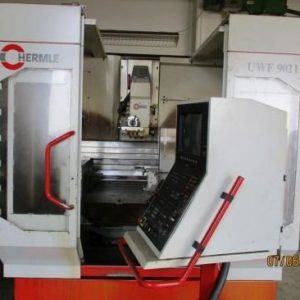
Avoid Costly Mistakes: Professional Tips for Purchasing a Pre-Owned / Surplus / Second-Hand / used Hermle UWF 902H made in Germany
Here’s a professional, detailed guide (checklist + pitfalls) for evaluating a used Hermle UWF 902H (Germany-made universal machining / milling center) to avoid costly mistakes. Many of the principles are general to CNC machining centers, but some points are tailored to the Hermle UWF 902H’s known specs and features.
Background & Reference Specs (for Benchmarking)
Before inspecting, know the typical published specs so you can judge whether the seller’s claims are realistic or exaggerated. Below are reference specs collected from several listings:
| Parameter | Typical / Published Value |
|---|---|
| Travels (X / Y / Z) | 600 mm / 450 mm / 500 mm |
| Table size | 900 × 520 mm |
| Spindle speed range | 20 – 6,300 rpm (stepless) |
| Spindle taper | ISO 40 (DIN 2079 / SK 40) |
| Tool magazine | 34 positions |
| Control / CNC type | Heidenhain TNC 426 / TNC 430 in some listings |
| Machine footprint / dimensions | ~ 2,935 × 2,980 × 2,400 mm |
| Weight | ~ 4,500 kg (or somewhat higher in some listings) |
| Quill stroke | ~ 75 mm (vertical head) |
| Head swivel / vertical head | ±90° vertical head in some versions |
Use these as a sanity check: if the vendor claims, e.g., 12,000 rpm spindle without documented upgrade, or vastly larger travel, be skeptical.
Pre-Inspection & Vendor Due Diligence
Before you visit the machine, request documentation and answers to critical questions:
- Serial numbers, manufacture date/year, and version
Ensure you get the exact model (UWF 902H) and its build year. - Service / maintenance history
- Lubrication logs
- Spindle rebuilds or overhauls
- Guideway alignments, leveling, scrapping repairs
- Past breakdowns or crashes, repairs
- Usage profile & material history
What materials were processed (e.g. castings, hardened steels)? Was it high-volume or occasional work? - Hours / cycles / axis motion counts
If possible, spindle hours, time under load, axis traversals. - Modifications / retrofits / upgrades
Has the spindle, drives, controls, or head been modified or replaced? Any conversions (e.g. higher speed spindle)? - Original documentation & spares
- Operator, maintenance, electrical schematics, parts lists
- Wiring diagrams, CNC parameter backups
- Spare boards, sensors, modules included?
- Accessories & tooling
Are fixtures, probes, rotary tables, tool holders included? Are these original or aftermarket? - Inspection / test acceptance permission
Confirm you will be allowed to power up, move axes, run test cuts, measure accuracy before final sale.
If a seller is evasive about any of these, that’s a red flag.
Visual / Structural Inspection (with machine cold or powered off)
Many issues show even before powering up. Bring a flashlight, camera, calipers, feeler gauges, and a straightedge.
- Base, castings, frame integrity
- Check welds, repair marks, crack lines
- Has the machine been re-leveled repeatedly (possible base settling)?
- Guideways, linear rails, slide surfaces
- Look for scoring, corrosion, pitting, rust
- Check whether way covers, scrapers, bellows are intact or damaged
- Ball screws / lead screws / nut wear
- Inspect for backlash, binding, wear zones
- If possible, manually traverse short distances (if safe) to feel friction or dead spots
- Spindle nose / taper / seating surface
- Nicks, scratches, uneven seating
- Test toolholder insertion: how tightly and uniformly it mates
- Vertical head / quill & swivel head
- Inspect vertical head mechanism, swivel joints, signs of play or looseness
- Quill travel mechanism and seals
- Tool magazine / tool changer
- Missing arms, worn components, damaged magazine mechanism
- Inspect grippers, rails, motors, linking rods
- Coolant & lubrication systems
- Tanks: sludge, rust, contaminants
- Piping, hoses, leaks, clogging
- Filters, sumps, chip removal
- Electrical cabinet & wiring
- Look for burned insulation, odd splices, non-OEM wiring
- Bad connectors, signs of high heat, dust accumulation
- Accessory components
- Rotary tables, indexing tables, fixtures, probes, sensors
- Check mounting and alignment of any attachments
Take many photos, note all suspicious areas, and compare symmetry or wear across axes.
Power-Up & Functional / Dynamic Testing
Once power is enabled and safe, run through comprehensive functional checks.
a. Control & Startup Behavior
- Boot control (Heidenhain, etc.), check for alarm history, diagnostic screens, memory warnings
- Ensure all control buttons, overrides, jog wheels, keys function
- Let the machine warm up; observe any instability or drift
b. Linear Axes Motion Tests (X, Y, Z)
- Move each axis over full travel at slow, medium, and rapid feed speeds
- Reverse direction to test for backlash, hysteresis, overshoot
- Check for dead zones, binding, rough patches
- Perform combined / simultaneous moves to stress axes
- Test acceleration / deceleration behavior
c. Spindle Testing
- Ramp through speed range (e.g., to 6,300 rpm) and listen for noise (whine, grinding)
- Run for sustained time to check for rising temperature or thermal drift
- If possible, measure radial & axial play or runout
- Inspect spindle lubrication system: check for contamination, oil flow, particle presence
d. Tool Changer / Magazine Cycles
- Cycle through all magazine positions, test random tool calls
- Watch for misfeeds, indexing errors, hesitation
- Inspect gripper throughput, tool insertion / removal quality
e. Head / Vertical / Swivel Head Tests
- Move vertical/quill strokes and test travel
- Swivel head (if present) through full angular range, check smoothness, backlash
- Verify that axis joints and bearings in the swivel head are solid, without play
f. Test Block / Dry Run
- Mount a test workpiece (non-critical) and run a dry (air) G-code program
- Observe motion paths, accelerations, any interference or unusual vibration
If any axes or subsystems fail or behave erratically, you should deduct cost for repair or reconsider.
Accuracy, Test Cuts & Acceptance Criteria
Running the machine and doing test cuts is the ultimate proof.
- Ballbar / circular interpolation test
Reveals servo errors, axis synchronization problems, dynamic deviations - Linear calibration / interferometry / straightness & pitch testing
Use laser interferometer or high-accuracy instrumentation to verify linear position accuracy and straightness - Test parts / benchmark cuts
Machine representative parts and measure key dimensions: flatness, parallelism, concentricity, surface finish, repeatability - Thermal drift / warm-up stability test
Run the machine over several hours, re-measure to see how dimensions drift due to heat - Load / production condition test
Run with feeds, speeds, depths you expect to use in production and verify stability, chatter, power draw - Repeatability / cycle variation
Run multiple cycles and check consistency of output across cycles
Make sure acceptance tolerances are documented in advance (e.g., “axis repeatability ≤ ± 0.01 mm,” “surface finish ≤ Ra 0.8,” etc.). The machine should meet these before final acceptance.
Risk, Spare Parts & Serviceability
Used machines often stumble on parts, support, and obsolescence.
- Spindle bearings, seals, taper sleeves
Are replacement parts still available? Are they expensive or rare? - Control / CNC modules, boards, memory
Older Heidenhain or electronics modules may be discontinued. Confirm replacement or compatible modules. - Drive motors, encoders, amplifiers
Check whether you can source equivalents or rebuilders in your region (Türkiye, Europe). - Linear guides, ball screws, couplings
Ensure wear parts can be sourced. - Swivel head / vertical head parts
Bearings, pivot joints, quill slides must be serviceable. - Local technical support & service network
Is there a Hermle service agent or knowledgeable repair house in your region? - Documentation & parts catalogs
Missing manuals, diagrams, and part lists make servicing costly. - Include spare parts in sale
Negotiate inclusion of essential spares (bearings, seals, modules, grippers) as part of the deal.
If a critical module is unobtainable or very expensive, your machine becomes a liability.
Installation, Logistics & Hidden Costs
When comparing used vs new, often the “hidden” costs kill the deal.
- Transport, rigging, disassembly / reassembly
Large precision machines need careful handling; damaged parts during move-in are costly. - Foundation & leveling
The machine may demand a rigid, vibration-controlled foundation, anchor bolts, grouting, precise leveling. - Electrical & power infrastructure
Confirm voltage, phase, clean power, grounding, UPS or filters if needed. - Cooling / coolant / filtration / chip removal
Ensure coolant pumps, lines, filtration, collectors, chip conveyors are functional or budget for renewal. - Commissioning, alignment & calibration
After install, you’ll need to align axes, zero offsets, compensate, verify performance. - Operator training / control familiarity
The control (Heidenhain TNC 426 etc.) may require specialized operator training. - Downtime / ramp-up buffer
Allow for debugging, adjustments, trial parts before production start. - Permits / site modifications
Floor reinforcement, crane access, ventilation, utilities—these sometimes surprise buyers.
Include all of these in your financial analysis, not just the machine’s sticker price.
Contract / Legal Protections & Acceptance Clauses
Because used precision machines carry risk, your contract must include protective clauses.
- Conditional / provisional acceptance
Final payment only after machine passes all acceptance tests and cuts. - Holdback / escrow
Retain a portion (10–20 %) until the machine proves itself under load during a test period. - Written acceptance criteria
Define tolerances, test protocols, allowable deviations, and rejection conditions. - Short-term warranty
Even for used machines, negotiate 30–90 day warranty on key components (spindle, drives, control). - Delivery of spares & documentation
Seller must hand over manuals, wiring diagrams, parts catalogs, parameter backups, and spare modules. - Liability for hidden defects
Clause to return, repair, or compensate if major defects surface soon after commissioning. - Right of third-party inspection
Permit your technician or independent expert to inspect and sign off before final acceptance. - Support / assistance clause
The seller should commit to help in commissioning or provide referrals.
If the seller resists any of these, consider the risk too high.
Red Flags & Deal Killers
Some signs indicate the machine may be too risky:
- Seller refuses to allow axis motion or test cuts.
- No maintenance logs, vague history, or missing documentation.
- Uneven wear, outstanding corrosion, or damaged structural parts.
- Spindle noise, vibration, or overheating during tests.
- Axes binding, stuttering, or excessive backlash.
- Tool magazine errors, misfeeds, or worn mechanism.
- Swivel or vertical head is loose or plays, joints sloppy.
- Control modules or boards missing, modified with nonoriginal parts.
- Parts that are custom, obsolete, or unavailable.
- Unrealistic price compared to market.
- Defaced or missing nameplate / serial / model identifiers.
If multiple red flags are present, don’t proceed—or push a very steep discount + warranty.
Post-Delivery / Commissioning Checklist
Once the machine is installed and accepted, you should immediately:
- Clean & flush coolant lines, tanks, filters
- Replace consumables — seals, filters, belts, fluids
- Level & align precisely the machine base
- Baseline calibration & verification tests — ballbar, test cuts, interferometry
- Set compensation & error corrections (e.g. pitch compensation, tool offsets)
- Preventive maintenance plan — schedule lubrication, inspections, vibration checks
- Stock essential spares — bearings, seals, electronic modules, grippers
- Operator training & process validation
- Performance logging & trend monitoring — track drift, alarm history, deviations over time