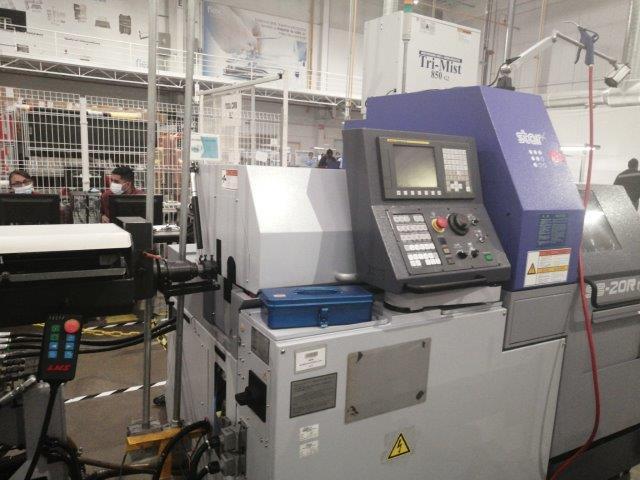
Avoid Costly Mistakes: Professional Tips for Purchasing a Pre-Owned / Surplus / Second-Hand / used STAR SB-20R TYPE G made in Japan
Here’s a professional, detailed checklist and guide for buying a used STAR SB-20R Type G (Swiss-type / sliding head automatic lathe, made in Japan). STAR’s Swiss machines are precision tools, and getting one used can be a great deal — but only if you avoid hidden traps.
I’ll break it into:
- Key specs & vendor claims you should benchmark
- Pre-inspection preparations & vendor questions
- On-site / in-person inspection checklist
- Functional & dynamic testing
- Accuracy, test cuts & acceptance criteria
- Spare parts, service & obsolescence risk
- Installation, logistics, hidden costs
- Contract & legal protections
- Red flags / deal killers
- After-purchase / commissioning checklist
1. Key Specs & Benchmark Data
Before you inspect, know what to expect from a healthy SB-20R Type G so you can spot exaggeration or hidden defects. Based on published specs:
| Parameter | Typical Value / Range |
|---|---|
| Max machining diameter | Ø 20 mm (optionally Ø 22.2 mm) |
| Main spindle power | 3.7 kW |
| Main spindle speed | 10,000 rpm |
| Sub-spindle speed / power | ~ 9,000 rpm, ~ 1.1 kW |
| Axis count / control | 7 axes (X1, Y1, Z1, C1, X2, Z2, C2) |
| Rapid traverse / feed rates | ~ 35 m/min (for X, Z etc.) |
| Machine weight | ~1,750 kg |
| Coolant tank capacity | ~ 180 liters |
| Unique feature | Guide Bushing / Non-Guide Bushing switching (G / NGB mode) |
Use these as reference. If a seller claims something wildly beyond these (e.g. 20,000 rpm, or 50 kW spindle), it’s likely a misstatement, modification, or exaggeration.
Also note: the SB-20R Type G is marketed with flexibility — the ability to switch between guide bushing and non-guide bushing modes.
2. Pre-Inspection Preparations & Vendor Questions
Before arriving at the site, ask the seller to provide:
- Machine serial number, manufacturing date / year
- Service & maintenance records (lubrication, spindle rebuilds, calibrations)
- Total spindle hours / axis motion counts / tool change counts
- Any past damage or repairs (e.g. collisions, crashes, floods)
- Any retrofits or control / electronics replacements
- Original manuals, wiring diagrams, parts lists, firmware versions
- List of included accessories (bar feeder, chucks, parts conveyors, tooling, probes)
- Photos / videos of machine from multiple angles (front, back, control, base, headstock, subspindle)
- Whether the seller will permit a full functional test / test cuts / acceptance
If the seller resists providing these, that’s a red flag (you might be walking into hidden problems).
3. On-Site Visual & Structural Inspection Checklist
Even before powering the machine, many problems can be spotted visually. Bring a camera or phone, ruler / calipers, flashlight, and a checklist.
- Base, frame & castings
- Look for cracks, weld repairs, distortions, subsidence
- Check whether base has been re-leveled many times (which may indicate movement or settling)
- Guideways / linear rails / slides
- Inspect for corrosion, pitting, scoring, rust spots
- See whether way covers / scrapers / bellows are intact; if severely damaged, chips may have invaded guides
- Ball screws / linear drive elements
- Look for wear marks, backlash, irregular friction zones
- If possible, move axes lightly by hand (if allowed) to sense binding
- Spindle nose / taper / inner surfaces
- Nicks, dents, rust, uneven contact surfaces—bad signs
- Use a test toolholder to check how well it seats and whether contact is uniform
- B / C axis assemblies (tilt, rotary, sub-spindle)
- Check for play, smoothness of motion, seal integrity
- Inspect joints / couplings / gibs / bearings
- Sub-spindle & backworking units
- Look at alignment, tool holders, cleanliness, any signs of forced fits
- Coolant & filtration system
- Tanks, pumps, filters, piping—look for sludge, corrosion, leaks
- Electrical cabinet(s)
- Inspect wiring insulation, burnt connectors, modifications, label integrity
- Check if there’s excessive dust, wiring splices, or nonstandard components
- Accessory systems
- Check the bar feeder interface (if present), parts conveyor, chip removal, coolant nozzles
- Inspect chucks, guide bush units, collets, tool holders
Document all damage or wear with photos and notes—it gives you leverage for negotiations or recourse.
4. Power-Up & Functional / Dynamic Testing
Once the machine is powered, run a comprehensive suite of tests across its subsystems.
a. Initial Power-Up & CNC Control Behavior
- Watch for alarms, errors, warnings on boot
- Let the system warm up; monitor for temperature drift
- Test all control panel keys, jog modes, override knobs
- Access diagnostic screens, alarm logs, error history
b. Axis Motion Tests (X, Z, Y if present, plus any cross axes)
- Move each linear axis full stroke at slow, medium, and rapid feed rates
- Reverse direction and watch for backlash, overshoot, hysteresis
- Check for binding zones or rough patches
- Do simultaneous (compound) moves to test coordination
- Check acceleration / deceleration behavior
c. Spindle / Main & Sub Spindle Tests
- Ramp up to full rpm (e.g. 10,000 rpm) and listen for noise (grinding, whine, chatter)
- Run for a while and monitor temperature rise
- If possible, measure radial and axial play
- Inspect spindle lubrication supply, oil cleanliness, presence of metal particles
- Under light load, check vibration or runout
d. Backworking / Sub-Spindle / Tooling Tests
- Test sub-spindle engagement, part transfer, chucking/un-chucking
- Cycle backworking tools, index them, test repeatability
- Test cross drilling / milling units (if equipped)
- Cycle the tool magazine (if relevant) and test random indexing
- Observe tool change behavior, misfeeds, delays
e. Control & Software Tests
- Load a standard or sample part program; run dry (air mode) and watch motion logic
- Test offsets, tool tables, macro functions, probing (if present)
- Backup / restore the CNC program memory
- Review whether control modules are original, whether firmware is intact, unauthorized hacks
If any axis or subsystem refuses to cooperate, or behaves erratically, that’s a major negotiation point (or reason to walk away).
5. Accuracy, Test Cuts & Acceptance Criteria
You want to be sure the machine can produce parts within your required tolerances under realistic conditions.
- Ballbar / circular interpolation test to detect servo / axis dynamic errors
- Laser interferometer / linear scale check to verify linear accuracy, pitch error, straightness, thermal drift
- Test cuts / benchmark parts: machine representative parts, measure dimensions (IDs, ODs, concentricity, finish) over multiple cycles
- Thermal stability / drift test: run for hours, re-measure part tolerances to see how much drift occurs
- Load testing: run feeds & speeds comparable to what you’ll use in production and check stability
- Repeatability & cyclic error check over many cycles
Ensure you have written acceptance criteria before starting: e.g. “X-axis repeatability ≤ ±0.005 mm,” “concentricity ≤ 0.01 mm,” etc. If the machine fails those, you should have contractual recourse (refund, repair, discount).
6. Spare Parts, Serviceability & Obsolescence Risk
This is where many used-machine buyers suffer after purchase.
- Spindle parts (bearings, seals, taper) may be expensive or custom
- Control / CNC modules & boards: STAR machines often use Fanuc 0i series; ensure modules are available or backward-compatible
- Motors, encoders, drives: check whether replacements or rebuilders exist in your region
- Guide bush / non-guide bush switching components: check those mechanisms, their seals, bush units
- Backworking / cross drilling / milling attachments: verify availability of tooling, spares
- Local technical support: in Türkiye, confirm whether certified STAR or Swiss-lathe service houses are accessible
- Documentation, parts lists, wiring diagrams: missing or poor documentation raises cost of maintenance
- Warranty / spare kit: try to arrange that the seller includes a starter spare kit (bearings, seals, fuses, tool holders)
If a key part is unobtainable or requires long import lead times, downtime risk becomes very expensive.
7. Installation, Logistics & Hidden Costs
Don’t underestimate the not-machine costs:
- Transport, rigging, unloading: STAR Swiss machines are delicate, especially headstocks, sub-spindles, axes.
- Foundation / floor preparation: stable, level, vibration-damped base needed
- Electrical infrastructure: correct voltage, phase, grounding, clean power, possibly UPS or filters
- Cooling / coolant / filtration: high-speed machinery often demands upgraded coolant systems
- Commissioning, alignment & calibration: after installation you must re-level, calibrate, align axes
- Operator training & programming adaptation: Swiss-style CNC lathes have specialized programming needs
- Downtime during integration: allocate buffer time for debugging, test parts, fine-tuning
Make sure your cost estimates include all these, not just the purchase price.
8. Contractual / Legal Protections & Terms
Because used precision machines are risky, your purchase contract must protect you.
- Conditional acceptance / test period — do not pay in full until acceptance tests pass
- Holdback or escrow — retain a portion of payment until machine proves itself under load for certain hours
- Written acceptance criteria — tolerances, test protocols, allowable deviations
- Warranty or guarantee period — even a limited 30–90 day warranty on critical parts is valuable
- Spare parts & documentation delivery — seller must provide the parts lists, diagrams, original manuals
- Liability for hidden defects — recourse if major defects surface after commissioning
- Right of third-party inspection — allow your technician or expert to do inspection before finalizing
If seller opposes any of that, it’s a strong warning sign.
9. Red Flags / Deal Killers to Watch Out For
Here are some deal-breaking warning signs you should walk away from (or push hard in negotiation):
- Seller refuses to allow full motion tests, test cuts, or acceptance trials
- No service or maintenance history
- Excessive spindle noise, play, or overheating on test
- Axis stiction, binding, non-smooth motion or inconsistent backlash
- Tooling or drive units missing, or circuits heavily altered / hacked
- Control modules / boards missing or heavily modified
- Accessory systems (bar feeder, coolant, parts conveyor) missing or nonfunctional
- Claims that contradict specs (e.g. “50,000 rpm”) without documentation
- Unrealistically low price compared to similar machines
- Missing serial plate, model plate, or documentation
- Seller unwilling to sign acceptance terms
If multiple red flags present themselves, your risk may exceed any potential discount.
10. After Purchase / Commissioning Checklist
Once installed and accepted:
- Thorough cleaning & flushing of coolant, lines, filters
- Replace consumables / wear items—bearings, seals, filters, belts, coolant
- Precise leveling, alignment & calibration
- Baseline accuracy tests: ballbar, test cuts, linear checks
- Set compensation / offsets as needed
- Preventive maintenance plan: scheduled lubrication, vibration monitoring, thermals
- Stock essential spares: critical bearings, seals, boards, tool holders
- Operator training & process transfer
- Monitor performance & log trends — track drift, alarms, performance over time