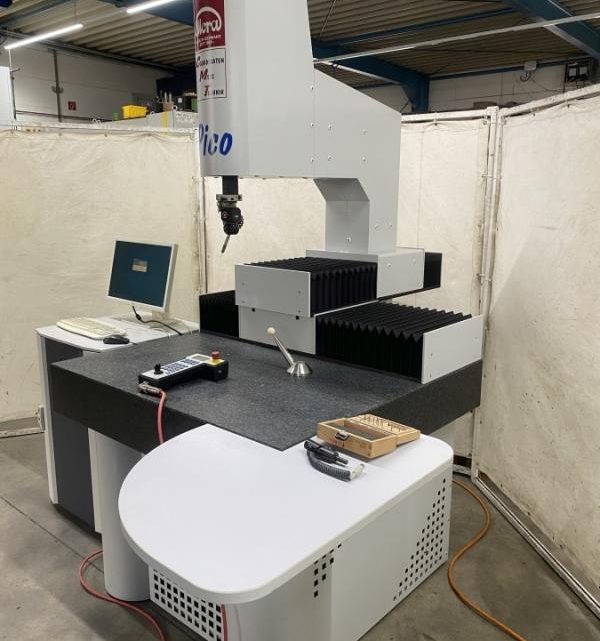
Avoid Costly Mistakes: Professional Tips for Purchasing a Pre-Owned, Surplus, Second-Hand, Used MORA PICO 0245.04.05.06 CMM Coordinate Measuring Machine made in Germany
If you are evaluating a pre-owned / surplus / second-hand / used MORA PICO 0245.04.05.06 coordinate measuring machine (CMM), you must treat it like a precision metrology asset, not just a piece of used industrial equipment. Small mechanical, thermal, or electronics faults can ruin the precision you depend on. Below is a tailored, professional checklist and strategy to avoid costly mistakes when acquiring such a CMM.
1. Understand What “MORA PICO 0245.04.05.06” Means — Baseline Specs & Capabilities
Before visiting, you must know what “good” means for that model so you can detect exaggeration or misrepresentation.
From listings:
- A listing describes the unit as Year 2005, measuring range X = 600 mm, Y = 500 mm, Z = 400 mm.
- The listing also states: “granite slab 1250 × 1200 mm,” “control: Gemodek Microspeed 10-axis control,” “RENISHAW PH10T motorized rotary/tilt head with TP20 probe,” “PC with INCA 3D software (license expired).”
- The broader product line (Mora Pico series) is marketed with granite bases/columns, “high-precision linear guides,” a “high-dynamic drive concept,” and sealed axes with bellows / covers.
- Some specs: Pico measuring ranges around 600 × 500 × 500 mm for production use.
- One source gives an alternate accuracy spec: “Type 1: Measuring range X 600 mm, Y 500 mm, Z 500 mm | Accuracy: 3.8 + L/200 µm” for a Pico variant.
- Also, the Pico series supports various probe heads (PH10, TP20, TP200, scanning probes) and options like active temperature compensation.
So, when you inspect, you’ll want to see whether the machine truly matches (or closely matches) those travel dimensions, and whether its structural elements, probe system, control, and electronics are commensurate with that era & class.
2. Pre-Inspection / Seller Due Diligence
Before paying for travel, weed out bad deals or misleading listings by getting detailed documentation from the seller.
A. Documentation & Info You Should Demand
- Serial number, model designation, year of manufacture
- Full travel / measuring volume stated and verified (X, Y, Z)
- Machine hours / cycle count or usage history (how intensively used)
- Maintenance / calibration logs — when last calibration, when axes or bearings replaced, when probe heads serviced
- List of probe(s) / probe heads / styli / accessories included (e.g. PH10T, TP20, scanning modules)
- Control system details — control brand/model (Gemodek Microspeed, etc.), version, number of axes, spare modules
- Software / license status — is the measuring software included/licensed (e.g. INCA 3D)?
- Original manuals, wiring diagrams, mechanical drawings, service docs
- Power / utility requirements — e.g. mains voltage, frequency, environmental control (temperature, humidity), whether machine used in controlled metrology environment
- Photos & video — particularly moving axes, probe head articulations, axes covers / bellows, probe head mounting, base / structure
- Spare parts included — extra probes, styli, control boards, cables, interface hardware
- Inspection / acceptance clause — your purchase must be conditional on passing full mechanical, metrology, and control tests
- Transport & dismantling plan — how seller plans to dismantle and ship, liability for damage
If the seller resists or omits these, that’s a red flag.
B. Environmental / Usage History
Ask:
- In what environment was the CMM used? (e.g. metrology lab, production shop, shop floor)
- Was it exposed to vibration, dust, coolant spray, temperature swings, humidity?
- Was it in a controlled temperature room?
- Has it been moved, reinstalled, or relocated in its lifetime?
CMMs used under adverse conditions often suffer hidden damage (loose bearings, bent axes, thermal drift, scale damage).
3. On-Site Inspection & Testing Checklist
Bring along a metrology technician (or someone experienced in CMMs) and precise measurement tools (gauge blocks, artifacts, reference spheres, temperature sensors). Below is a detailed checklist:
A. Visual & Structural Checks
- Granite base & column — inspect for cracks, chips, chips on edges, delamination
- Axis guideways / rails / linear guides — look for wear, scoring, rust, damage
- Bellows, covers, seals — must protect axes from dust / contamination
- Probe head mounting / interfaces — solid, no loosening, no damage
- Probe stylus mounting points — threads, holders, mechanical integrity
- Cables, wiring, flex arms, cable chains — insulation condition, routing, pinch points
- Electrical cabinet — cleanliness, dust, signs of overheating, burnt wiring
- Base leveling and mounting — check if the machine base has been altered or disturbed
- Signs of past repair / modifications — welding, non-original brackets, non-standard parts
B. Power-Up / Control / Interface Checks
- Boot up the control / measuring software; note any errors, warnings, license issues
- Verify axis motion through software commands (X, Y, Z) — check smoothness, abrupt stops
- Test jog at slow and moderate speed, listen for stiction, dragging
- Move probe head / indexing head (e.g. PH10T) through its motions; verify smooth articulation
- Check homing / referencing axes, repeatability of returning to zero
- Test emergency stop, axis interlocks, safety circuits
- Check software menus, options, calibration routines
C. Metrology / Accuracy & Performance Tests
- Use calibrated reference artifacts (gauge blocks, sphere, precision ring) to test:
• Length accuracy: command movements of known length and measure actual displacement
• Repeatability: multiple repeats of the same move and measure scatter
• Probe head repeatability / probe performance: move probe around fixed reference feature multiple times
• Squareness / perpendicularity: measure orthogonality between X-Y, X-Z, Y-Z directions
• Straightness / flatness / residual error mapping across axes travel
• Thermal drift behavior: warm up machine (run it for 30+ minutes), re-measure, see if significant drift occurs
- If scanning probe (if installed), test scanning output, smoothness, scanning accuracy
D. Probe Heads / Probe System Testing
- Move probe heads between different orientations; check for tilt / indexing backlash
- Test switch / trigger function of the probe(s) in multiple orientations
- Test probe stylus change, if applicable
- Try measuring known small features (e.g. spheres or cylinders) at different angles
E. Diagnostics of Feedback Systems / Scales
- If machine uses optical or glass scales / encoders / interferometers — inspect scale surfaces for scratches, chips, contamination
- Check signal strength / noise of scale feedback if accessible
- Check encoder or scale cable integrity, connectors
- Confirm axes move under closed-loop control (i.e. feedback is working)
F. Environmental / Thermal Considerations
- Measure ambient temperature and temperature stability in the room
- Check whether the machine had temperature compensation (some Pico models support compensation)
- See whether temperature gradients (walls, window, drafts) might affect accuracy
- Confirm that floor is stable and not subject to vibration
G. Extended / Stress / Load Testing (if feasible)
- Run multiple measurement cycles in sequence (say tens to hundreds) to simulate production load
- Monitor drift, repeatability, mechanical stability over time
- Check if software performance degrades / lags under sustained measurement cycles
4. Key Vulnerabilities & Red Flags for a MORA PICO / Shop-Floor CMM
When inspecting, give extra scrutiny to parts that commonly degrade or fail in older or used CMMs.
| Vulnerability / Red Flag | Why It Matters | What to Test / Watch For |
|---|---|---|
| Damaged or worn scales / encoders | Damaged scales cause measurement errors, inability to close control loop | Inspect scale surfaces, check feedback signal integrity, noise |
| Probe head wear / backlash | Probe head misalignment or looseness ruins measurement accuracy | Cycle indexing head, multi-orientation repeatability tests |
| Thermal drift / compensation failure | If compensation is missing or broken, accuracy suffers with temperature changes | Warm-up the machine and re-test repeatability over time |
| Structural damage or misalignment | Subtle twist or sag in frame / column undermines precision | Use reference artifacts to detect geometry errors |
| Software / license / control obsolescence | Old control / software may fail, or parts may be unavailable | Confirm software version, license status, module availability |
| Contamination, dust, coolant ingress | Liquids or dust entering guides, scales, electronics cause gradual degradation | Inspect seals, covers, look for evidence of ingress |
| Base / mounting distortion / mis-leveling | A poorly leveled or modified base may cause bending or drift | Check reference levels, ask about prior repositioning or remounting |
| Probe stylus / adapter wear / damage | Poor stylus condition leads to measurement error | Inspect stylus tips, thread integrity, mounting tightness |
| Movement anomalies (jerk, stiction, noise) | Mechanical wear or friction in axes degrades smooth motion | Jog slowly, sense stick-slip, listen for grinding |
| Lack of spare modules / parts | If critical control boards or modules are unobtainable, repair becomes hard | Ask for spares, document module IDs, availability |
| Inconsistent or expired calibration | If the last calibration was long ago or not traceable, the machine may not be trustworthy | Ask for calibration certificates, date, lab accreditation |
If you see multiple red flags, you should either dramatically revise your offer or walk away.
5. Hidden Costs & Total Cost of Ownership
Beyond the purchase price, many used CMM acquisitions become burdened by hidden or underestimated costs. Plan ahead.
- Transportation / packing / unpacking / reinstallation — CMMs are delicate; mistakes in lift / packing can misalign structure
- Calibration & certification — After installation, calibration by an accredited metrology lab is essential
- Software upgrades / licensing — If the included software is old, expired, or incompatible with modern OS, you may have to buy upgrades or new licenses
- Spare parts & components — probe heads, styli, control modules, cables, scales
- Retrofit / controller replacement — If the control is too old or unsupported, retrofitting to a modern control may be necessary
- Thermal/environmental control — To maintain specified accuracy, you may need temperature control, enclosures, air conditioning
- Operator training / programming / commissioning — Tuning the machine, developing measurement routines, debugging
- Downtime & measurement accuracy risk — If the CMM underperforms, measurement errors propagate to production losses
- Scheduled maintenance / service — periodic cleaning, lubrication, scale cleaning, verification checks
- Metrology lab certification renewal — ensuring periodic calibration traceability
When you make your offer, subtract from the nominal purchase price a realistic allowance for these downstream costs.
6. Negotiation & Contract Safeguards
To protect yourself, use strong negotiation and contractual provisions. Some recommended tactics:
- Conditional acceptance / hold-back: Make payment contingent on passing your full inspection, metrology tests, calibration after installation
- “Burn-in period”: Require the seller to allow you to run repeated measurement cycles during inspection
- Spare parts inclusion: Negotiate that critical spares, probe heads, cables, styli, control modules be included
- Software license guarantee: Ensure that measuring software license is valid, transferable, or that a new license is included
- Liability for damage in transit: Clearly define who bears risk during disassembly, shipping, reassembly
- Performance guarantees: Define acceptable tolerance limits (repeatability, measurement error) that must be met after setup
- Document list of included accessories: All probe heads, cables, holders, software, manuals must be listed in contract
- Right of rejection: Allow you to return or refuse to accept if major faults emerge after full setup / calibration
- Inspection by third-party expert: You or your consultant must have the right to bring in a metrology expert to certify condition
7. Decision Criteria & Risk Tolerance
As you go through this process, continually compare what you detect vs what you need for your application. Ask:
- Will this machine, after any repairs, deliver the measurement precision and repeatability you require?
- Is its control and software architecture still supportable / upgradeable?
- Are spare parts and probe systems still available?
- Can you absorb the cost of repairs, retrofits, calibration, and downtime?
- Is the seller transparent, and is the contract protective?
- Are you capturing enough margin in your offer to manage surprises?
- Is there a better (or newer) CMM within reach that would reduce risk?
If the machine passes inspection with only mild remediation, it can be a solid value. If it shows multiple serious issues, be prepared to walk away — the cost of chasing a marginal CMM often outweighs the discount.