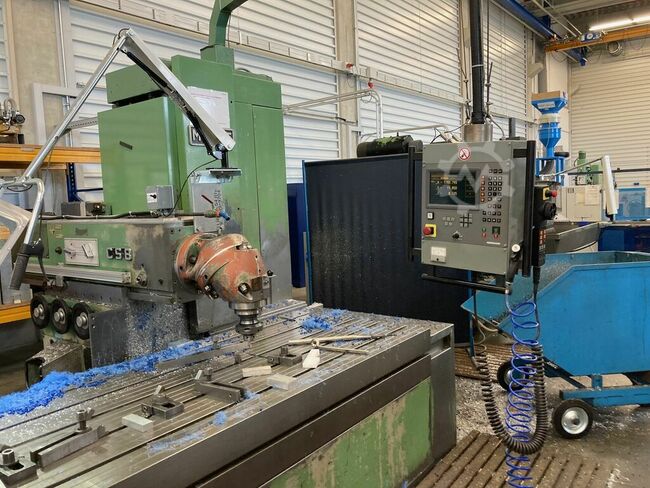
Avoid Costly Mistakes: Professional Tips for Purchasing a Pre-Owned / Surplus / Second-Hand / used Mecof C S 800 CNC Bed Type Milling Machine
Below is a tailored, professional checklist and set of tips for evaluating a pre-owned / surplus / second-hand Mecof C S 800 (or “CS 800”) CNC bed-type milling machine. Because bed mills operate under heavy loads and often over long travel, hidden wear or misalignment can be costly to remediate. Use this as a guiding framework.
Note: I found one listing for a “Mecof C S 800” machine from 1978, with Heidenhain TNC 124 control and X/Y/Z = 2,500 / 1,200 / 1,200 mm, spindle taper SK50, spindle speed ~1,400 rpm, 15 kW drive.
So you can treat those numbers as a possible reference, but always verify what your particular candidate’s configuration is.
1. Know the Candidate’s Specs & Use Them as Benchmarks
Before going onsite, clarify what the seller claims, then compare to known or plausible values:
- From the listing: X / Y / Z = 2,500 / 1,200 / 1,200 mm
- Spindle taper: SK50 (common in that listing)
- Spindle max speed: ~1,400 rpm (relatively low, heavy duty)
- Main motor drive: 15 kW in the listing
- Control: Heidenhain TNC 124 (converted in 2012 in that listing)
- Machine footprint: length ~4,000 mm, width ~1,000 mm in the listing
Use those (or whatever the seller’s stated specs) as your “yardstick.” If the seller claims much higher spindle rpm, vastly longer travel, or heavier feed motors, ask for corroborating evidence (old factory brochure, build sheet, test records).
Also, confirm whether the candidate is a fully CNC bed mill (linear table movement) or has a traveling column / special head options or retrofits.
2. Documentation & Pre-Screening Before Visiting
Try to reduce your risk before you go onsite by collecting:
- Serial number, build year, original factory spec sheets, and any modifications or retrofits (control upgrades, spindle rebuilds, head changes)
- Full mechanical, electrical, hydraulic, and lubrication schematics, wiring diagrams, parts lists, maintenance logs
- CNC / control manuals, parameter files, custom macros, compensation maps, backup of software
- Alignment / calibration / survey reports (if available)
- Videos or remote demos: jogging axes, spindle running, table motion, tool changes (if any)
- Usage history: hours powered on vs actual cutting, materials processed, duty cycles, events of overload, collisions, or power failures
- Spare parts / support availability: can you still obtain parts for Mecof machines (bearings, motors, controls) in your region?
- Transport data: machine weight, footprint, lifting points, disassembly needs
If the seller cannot or will not supply credible documentation or allow decent demos, consider that a red flag.
3. Structural & Mechanical Inspection
Check the “hard” parts carefully—these often dictate whether the machine can be restored or not.
a) Base, bed & structural integrity
- Look for cracks, weld repairs, distortions, repairs in the base, bed surfaces, frame, supports
- Using a long straightedge or reference bar, test whether bed rails or table guide surfaces are flat, twist-free, and free of sag
- Check whether wear is uneven (one side more worn) — that suggests misalignment or past misuse
b) Guideways, rails & slide surfaces
- Jog each axis (table linear motion, cross slides, vertical head if exists) and feel for stick-slip zones, binding, or variable friction
- With covers open (if possible), inspect rail surfaces or sliding surfaces for pitting, scoring, corrosion, edge rounding, dents
- Check that way covers, scrapers, bellows or guards are intact—if damaged or missing, debris likely entered and damaged interior surfaces
- Inspect adjustment / preload / gib systems: ensure the adjustment screws, shims, or preloadors are present and move freely (not seized or over-worn)
c) Ball screws, nuts, coupling & backlash
- Reverse small motion in each linear axis and measure backlash / play using a dial indicator
- Slide along full travel and feel for zones where friction changes noticeably (soft / sticky spots)
- Inspect couplings between motor and screw, anti-backlash nut housings, support bearings for looseness or wear
d) Spindle, spindle head & bearing condition
- Mount a test bar or reference rod and measure radial & axial runout (ideally within a few microns)
- Run the spindle (idle) across speed range, listen and feel for vibration, bearing hum, roughness
- After running for a while, check spindle housing temperature (IR thermometer): hot spots or nonuniform heating is a warning
- Check spindle nose, taper surfaces, retention/clamp mechanism, seals, interfaces
- Investigate whether the spindle has ever been rebuilt, or if there is any known shock / knock event in its past
e) Table, clamping, and associated hardware
- Inspect the table bed, T-slots, clamping surfaces, and how much wear or damage they show
- Check for table flatness, stability under load, and if clamping devices (vises, fixtures) can reliably anchor parts
- If the bed machine uses a cross slide or secondary axes (vertical travel, etc.), test those for motion smoothness and alignment
f) Coolant, lubrication & auxiliary systems
- Check coolant pumps, piping, filtration, coolant quality, leaks, sludge, contamination
- Verify lubrication systems (oil lines, grease lines, centralized lube) are present and functioning, and that all axes/slides receive lubricant
- Test hydraulic / pneumatic systems if used (for clamps, head tilts, auxiliary movements) for leaks, smoothness, stable pressure
- Inspect hoses, seals, valves, connectors for wear, brittleness or prior repair
- Check chip removal systems, guarding, coolant splash covers, drainage
4. Electrical, Control & CNC System Inspection
Even the best mechanical machine is useless without solid electronics and control.
- Power up the machine carefully (ideally step-by-step) and watch for smoke, blown fuses, odors, tripped circuits
- Open the electrical cabinet (if allowed) and inspect wiring harnesses, terminal blocks, connectors: look for brittle insulation, overheated wires, splices, modifications
- Boot the CNC / control: test display, diagnostics, parameter screens, error logs
- Jog each axis via the control: check smoothness, direction reversal, acceleration / deceleration, stutter or misbehavior
- Try combined or diagonal moves (if possible) to see how the axes coordinate
- Test limit switches, homing routines, overtravel / emergency stops, interlocks
- Check feedback devices (encoders, linear scales, resolvers) — ensure signals are stable, no dropout or noise
- Confirm that all software, backups, compensation tables, custom macros, tool tables are included and intact
- For older or proprietary electronics, verify whether replacement modules or upgrades are still obtainable
5. Functional / Load Testing & Acceptance Trials
Seeing the machine “move” is not enough—you need to see it perform under load.
- Bring or request a representative workpiece and tooling (similar to what you intend to run)
- Execute full machining cycles: table motion, cross / vertical cuts, direction changes, engagement/disengagement of tool, etc.
- Monitor for stalling, vibrations, axis lag, chatter, or deviation mid-cut
- Perform return-to-zero / repeatability tests: move off a reference point and return, measure deviations in each axis
- Produce test cuts; measure critical dimensions, flatness, surface finish, positional accuracy
- Run extended cycles (hours) to detect thermal drift or misalignment shift as the machine warms
- Interrupt a cycle, change a tool or reposition, then resume to see how well the machine recovers
- Test coolant flush, chip ejection, lubrication, guarding while cutting
If the seller refuses load or cutting tests, or restricts motion to idle only, that is a serious red flag.
6. Geometry, Alignment & Calibration Checks
Even a structurally sound machine may have drifted in alignment over years—check whether it can still meet tolerance.
- Request or perform alignment / calibration tests (laser, test bar, straightedge, dial indicator sweeps)
- Measure straightness over full travel, squareness between axes, flatness of table, tilt or angular error in spindle / head, repeatability / hysteresis in moves
- Check whether the CNC control supports geometric compensation / error mapping, and whether compensation tables are present / valid
- Estimate whether alignment errors are correctable (shimming, re-scraping, alignment) and whether the cost is acceptable
7. Spare Parts, Maintenance & Long-Term Support
A used machine is only as good as your ability to maintain or repair it later.
- Confirm that critical spare parts (ball screws, guides, spindle bearings, motors, drives, control boards, belts) are still available in your region
- Check whether Mecof (or third-party rebuilders) still support this model or similar ones
- Identify local service shops or rebuilders experienced with bed-type Mecof machines
- Evaluate whether retrofitting new electronics / drives is feasible if originals become obsolete
- Make sure tooling, fixtures, adapters, clamping equipment compatible with the machine remain available
- Try to include spare electronics modules, wear parts (seals, bearings, filters) in the purchase if possible
8. Contractual Safeguards & Risk Mitigation
Use your findings to protect your investment contractually.
- Insist on conditional acceptance / performance test clause: final payment only after the machine passes your defined load / machining tests
- Clearly define quantitative acceptance criteria: allowable runout, positional repeatability, surface finish, backlash, drift tolerances
- Request a short-term warranty / guarantee (30 to 90 days) on key subsystems (spindle, drives, control)
- Ensure all documentation, backups, alignment reports, wiring diagrams, manuals are delivered with the machine
- Clarify responsibility for transport, rigging, leveling, foundation work, site modifications, alignment, commissioning
- Insert a “burn-in / commissioning period” clause: defects found during initial production use must be remedied by the seller
- Ask for written disclosure of known defects, repairs, structural modifications, crash history
9. Transport, Installation & Commissioning
Even a perfect machine can be ruined in improper transport or poor setup.
- Confirm accurate machine weight, center-of-gravity, footprint, lifting points, disassembly requirements
- Use proper rigging, shock absorption, structural bracing during transport to avoid distortion or damage
- After installation, re-level, anchor, or re-grout carefully on a stable foundation
- Allow a commissioning / burn-in period under real machine loads before declaring acceptance
- After settling, repeat alignment, geometric checks, backlash measurement to confirm nothing shifted
- Be present (or send your technical staff) during first production runs to monitor for latent issues
10. Red Flags & Deal-Breaker Conditions
If you encounter several of the following, be very cautious or walk away:
- Seller refuses full inspection, internal access, or load / cutting tests
- Structural repairs, welds, or visible damage to bed, guideways, frame with no credible records
- Spindle noise, vibration, excessive heat, or lack of rebuild history
- Excessive backlash, play, or “dead zones” in axes beyond what compensation can mask
- Variable friction / binding zones in axes or noticeable “hard spots”
- Control / electronics are obsolete, unsupported, or lack spare parts
- Wiring, connectors with brittle insulation, many splices, signs of overheating or amateur repair
- Missing critical documentation (mechanical / electrical schematics, control backups, alignment reports)
- Coolant, lubrication, chip handling systems in poor condition or failing
- Excessive wear in guideways, screws, or structural surfaces making refurbishment cost near replacement
- Spare parts for major subsystems not available or extremely costly
- Alignment or geometry so far off that rework would be more expensive than a better used machine