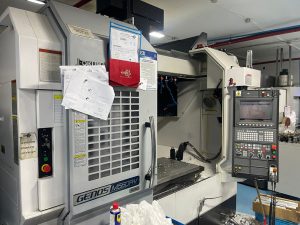
Avoid Costly Mistakes: Professional Tips for Purchasing a Pre-Owned / Surplus / Second-Hand / used HARRISSON ALPHA 550 U CNC Lathe
Here’s a professional, experience-based guide (checklist, pitfalls, and red flags) tailored to help you avoid costly mistakes when purchasing a pre-owned / surplus / second-hand Harrison / Alpha 550U (or similar “Alpha-550” family) CNC lathe. Because this is a sizable, precision lathe with expectations of long life, you’ll want to dig deep in the inspection. I’ll also include known spec references so you know what to expect.
What “Normal / Good” Looks Like: Benchmarks & Reference Specs
Before you arrive onsite, obtain or confirm the machine’s spec sheet (or advertisement) so you can spot discrepancies or exaggerations. Here are some reference figures for the Harrison Alpha 550 line and variants:
- The Harrison Alpha 550 is often listed with swing over bed ~ 554 mm, between-centers ~ 2,000 mm in many adverts.
- One spec sheet says: “Swing 554 mm, between centres 2000 mm, spindle speed 15–1800 RPM, spindle bore 90 mm, spindle motor ≈ 11 kW” for a Harrison Alpha 550 lathe.
- Another ad (Harrison Alpha 550 “Plus”) gives: swing over bed = 544 mm, distance between centers = 1,500 mm, spindle speeds 15–1,800 rpm, spindle bore 90 mm, motor 11 kW.
- A used “1997 Harrison Alpha 550” listing gives: max swing 18″, center distance 60″, spindle bore 3.5″ etc.
- A listing for “Harrison Alpha 550U” (which is often the “U” suffix version) shows DOM (date of manufacture) ~ 2003, and spindle RPM ~ 1,800 rpm.
So for a candidate, you should expect the advertised swing, center distance, and spindle speed to align (within reason) with those figures. If someone claims e.g. 6,000 rpm, or 5,000 mm center distance, you need proofs (factory spec, retrofit logs, test data).
Use these as sanity-checks. If the candidate deviates, demand proof or walk away.
Inspection & Evaluation Checklist
Use the following structured checklist during your on-site inspection (or even before, via photos / videos). Bring precision instruments (dial indicators, test bars, laser, etc.) and, if possible, a test-workpiece and tooling.
I break things into mechanical, electronic/control, and operational testing.
1. Documentation, History & Pre-Screening
Before or during your visit, collect as much of this as possible:
- Machine serial number, year of manufacture, model variant (Alpha 550U, “Plus”, etc.), any modifications or retrofits.
- Original manuals: mechanical, electrical, hydraulic (if any), part lists, wiring diagrams, lubrication & maintenance manuals.
- CNC / control manuals, backup of software parameters, custom macros, compensation tables, tool offsets.
- Maintenance logs: spindle rebuilds, bearing replacements, major repairs, crash history.
- Alignment / calibration / geometric survey reports (laser, test bar, dial-indicator reports) if available.
- Video or remote demo of axis motion (X, Z, Y / live tooling if present), tool change, spindle running, warm-up behavior.
- Operating history: total hours, cutting hours vs idle, materials processed (hardened steel, cast iron, aluminum?), shock/load events.
- Spare parts availability: Are spindle bearings, drive motors, control boards still available (or can be refurbished)?
- Transport constraints: machine weight, dimensions, lifting points, whether partial disassembly is required.
If the seller cannot provide credible documentation or refuses to allow motion test/demos, that is a red flag.
2. Structural & Mechanical Inspection
Here you examine the “hard” parts: bed, guides, spindle, etc.
a) Bed, bed ways, structure
- Inspect for cracks, weld repairs, distortions in the bed, headstock, tailstock, frame.
- Use a long straightedge or reference bar to check for twist, warp, sag along the bed and ways.
- Check for differential wear: one side of the bed or one side of the carriage may be more worn than the other—this may reveal misalignment or uneven usage.
b) Guideways / slides / ways
- Manually or via slow motion, traverse X and Z axes and feel for zones of inconsistent resistance (areas where motion becomes sticky, jumps, or friction changes).
- If covers are removable, inspect guide surface condition: pitting, scoring, corrosion, wear flats, edge rounding.
- Confirm that way covers, wipers, scrapers, bellows are present and in functional condition (a missing or damaged cover may have allowed ingress of chips / coolant, which damages guides).
- Check any gibs, preload screws, adjustment shims or mechanism — they should be present and adjustable (not seized or excessively worn).
c) Ball screws / nut, backlash & drive couplings
- Reverse motion in small increments in both directions on each axis (X, Z) and measure backlash / play with a dial indicator. For a lathe of this class, acceptable backlash must be low.
- Move through full travel and feel for zones where friction or resistance changes (soft/hard zones).
- Inspect the coupling between servo motor and screw, as well as the nut housing, for looseness, wear, or play.
- Check support bearings for play (end bearings supporting screw) if accessible.
d) Spindle & spindle bearings / headstock
- Mount a test bar or spindle gauge and take radial & axial runout measurements. Even microns of error can matter depending on your tolerance requirements.
- Run the spindle (unloaded) across multiple speeds and listen / feel for bearing noise, hum, vibration, roughness.
- After warm-up, measure temperature distribution on the spindle housing (via IR thermometer or by touch) — hot spots or skewed heating is a warning sign.
- Inspect the spindle nose, taper surfaces, drawbar or retention mechanism, sealing, keyways, interfaces.
- Try to get any records of past spindle rebuilds or shock / knock incidents.
e) Tailstock, turret, live tooling (if present)
- If the machine has a tailstock, test its alignment, travel smoothness, and whether the quill is tight / not sloppy.
- If there is a turret or live tooling, cycle it, test indexing, check for slop, misindexing, backlash, torque and stability under load.
f) Tooling, chucks, workholding & accessories
- Inspect the chuck(s): jaws, backplate, runout, mounting integrity.
- Check workholding fixtures, steady rests, tailstock alignment, etc.
- Verify that the included tooling is complete, well maintained, and in good condition (collets, toolholders, cutters, etc.).
g) Coolant, lubrication & auxiliary systems
- Inspect coolant pump(s), piping, filters, sump; check for leaks, contamination, sludge, rust.
- Check lubrication systems (grease, oil lines, central lube) to confirm everything that should receive lubrication does.
- Test any hydraulic / pneumatic circuits (if the lathe uses them for clamping, axis locks, etc.) for leaks, stable pressures, responsiveness.
- Inspect hoses, seals, connectors for age, wear, brittleness.
- Check chip removal / guard systems, coolant flushing paths, splash guards, drainage.
3. Electrical, Control & CNC Systems Inspection
A mechanically sound lathe is worthless if control / electronics are failing or unsupported.
- Power up cautiously, watching for blown fuses, smell of burning insulation, voltage anomalies.
- Open control / electrical cabinets (if permitted): inspect wiring harnesses, terminal blocks, connectors, insulation, repairs, signs of heat/stress.
- Boot the CNC / control software: navigate UI, check diagnostics, alarms, parameter sets, memory backups.
- Jog each axis incrementally (X, Z) through various speeds—observe direction reversals, acceleration response, stuttering, smoothness.
- Test combined or synchronized moves (if lathe supports contouring or synchronized axes) to catch control lag or mismatch.
- Test limit switches, homing routines, overtravel, emergency stops, interlocks.
- Confirm feedback devices (encoders, resolvers, linear scales) operate cleanly (no dropout, noise).
- Ensure all software / parameter backups, compensation tables, tool offsets, macros are included.
- Check condition / supportability of control boards, servo drives, power modules—if obsolete, their unavailability could doom the machine.
4. Functional / Load Testing / Acceptance Trials
This is where hidden faults often surface. Demand real cutting or near-cutting tests.
- Bring or have the seller run a representative test part (material, geometry, tools close to what you need).
- Run full cutting cycles: engage tool, retract, direction changes, finishing passes, etc., observe performance under load.
- Do return-to-zero / repeatability tests: move off a reference point and return; measure deviation for each axis.
- Machine a test feature and measure critical outcomes: diameter accuracy, surface finish, concentricity, taper, tool runout sensitivity.
- Run extended work cycles (hours) to detect thermal drift / alignment shifts as the machine heats.
- Interrupt mid-cycle, change a tool or reverse direction, and resume; measure how well the machine recovers.
- Test auxiliary systems (coolant, chip removal, lubrication) under real load.
If the seller refuses real tests or limits you to incremental motion only, that is a major red flag.
5. Geometry, Alignment & Calibration Check
Even a machine that seems good may have drifted. You must verify whether corrections are feasible.
- Ask for existing calibration reports (laser, interferometer, etc.).
- Use your own metrology tools (or hire a specialist) to check:
• Straightness across full travel in X, Z
• Squareness between axes
• Bed / carriage alignment relative to spindle axis
• Runout / tilt in spindle vs axes
• Backlash / hysteresis / repeatability
- Confirm whether the control supports error compensation or correction maps, and whether they are active / valid.
- Estimate the cost and effort required to realign, re-scrape or shim—if correction is too expensive, it may negate the bargain.
6. Spare Parts, Support & Future Viability
A used machine is only as good as your ability to maintain it long term.
- Confirm availability (or remanufacturability) of core spare parts: spindle bearings, servo motors, drives, control boards, feedback devices, chuck components.
- Investigate whether Harrison (or successor entities) or third-party specialists still service or support the Alpha series in your region.
- Identify local service / repair shops familiar with Harrison / Alpha lathes.
- Consider whether retrofitting a modern control or drive system (if original becomes unsupportable) is feasible.
- Ensure tooling, fixtures, collets, holders, etc., are standard/available.
- Try to negotiate inclusion of spare electronics, wear parts, tooling with the sale.
7. Contract Safeguards, Acceptances & Risk Mitigation
Protect yourself with the agreement terms.
- Insist on conditional acceptance / performance testing clause: payment or balance only upon passing specified tests.
- Define quantitative acceptance criteria: allowable runout, repeatability error, dimensional tolerances, backlash limits, thermal drift thresholds.
- Request a short-term warranty / guarantee on critical subsystems (spindle, drives, control).
- Require delivery of all documentation, manuals, calibration data, backups, wiring diagrams, etc.
- Clarify who pays for rigging, transport, leveling, foundation work, re-alignment, installation, commissioning.
- Include a “burn-in / commissioning period” clause: defects uncovered under load usage period must be remedied by seller.
- Get written disclosures of known defects, history of repair or damage, and any structural modifications.
8. Transport, Installation & Commissioning
Even a perfect machine can end up misaligned during transport or poor installation.
- Confirm weight, lifting points, footprint, clearance, disassembly needs for safe transport.
- Use proper rigging, supports, shock protection, bracing to prevent distortion during move.
- After reinstallation, re-level, anchor or re-grout to a rigid foundation.
- Wait for a burn-in period under load before final acceptance.
- After settling, re-check alignment, backlash, geometry to verify nothing shifted.
- Be onsite (or have your technician) during first production runs to catch issues early.
9. Red Flags & Deal-Breakers
Watch for one or more of these: they often indicate hidden costs or irreparable problems.
- Seller refuses full inspection, internal access, or performance / cutting tests.
- Structural repairs, welds, cracks in bed, headstock, or body without credible records.
- Spindle with noise, vibration, high runout, unknown or missing rebuild history.
- Excessive backlash, slop, or “dead zones” beyond what the control can compensate.
- Inconsistent friction in axes (e.g. “sticky” or “hard” zones) suggesting localized wear.
- Control, electronics or drives are obsolete, unsupported, or no longer available.
- Wiring harnesses or connectors with brittle insulation, cracked jackets, many splices, signs of overheating or amateur repair.
- Missing or incomplete documentation (manuals, schematics, calibration data, backup software).
- Tooling / chuck / fixtures in poor condition or missing.
- Coolant / lubrication systems leaking or nonfunctional.
- Spare parts for core subsystems (spindle, motors, control) are unavailable or prohibitively expensive.
- Geometry / alignment so far out that correction would cost nearly as much as a better machine.
- Hidden damage from flooding, corrosive coolant, neglect being concealed.