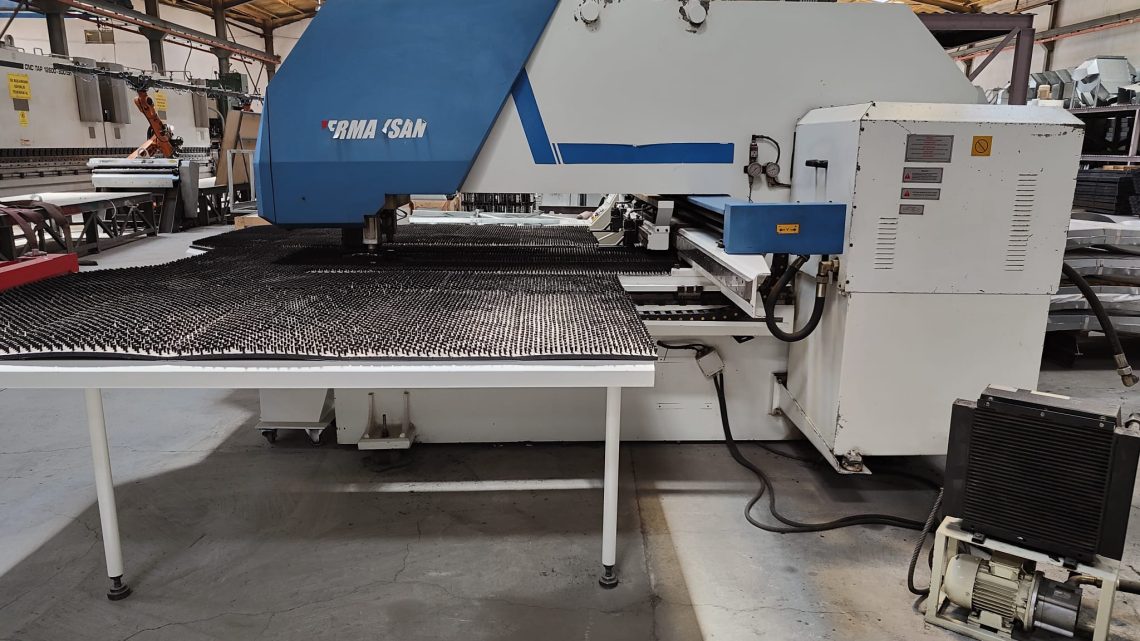
Avoid Costly Mistakes: Professional Tips for Purchasing a Pre-Owned / Surplus / Second-Hand / used Ermak EPP 1270X30 CNC Punch Press made in Türkiye
Here’s a thorough, professional checklist and set of warning flags to help you evaluate a used / surplus Ermak EPP 1270×30 CNC punch press (or similar model) without getting saddled with hidden failures or exorbitant refurbishment costs. I’ll begin with known reference specifications (so you know what “normal” looks like) and then walk you through mechanical, electrical, functional tests, contractual protections, and red flags.
Reference Specs & Performance Benchmarks
First, gather or confirm the nominal/advertised specs of the candidate machine. Use those as your baseline to spot exaggerations or inconsistencies.
From listings / market data:
- Machine model: Ermak EPP-1270×30 (often also written EPP-1270-30)
- Punching force: 30 ton (i.e. capable of ~30 tons of thrust)
- Maximum sheet (steel) thickness capacity: ~ 6 mm
- Maximum strokes (or punching frequency): up to ~ 700 strokes/min
- Motor power: ~ 11 kW in some units
- Stroke (ram travel): 40 mm is mentioned in listings
- Sheet width / “Y-axis” / back-gauge width: 1,270 mm (the “1270” in the model)
- Machine size & weight: 4,250 × 4,000 × 2,350 mm footprint, weight ~ 9,000 kg (or 11,000 kg in some listings)
Use these specs as your “yardstick.” If the seller claims a much higher punching speed (say 900+ strokes/min), much heavier sheet capacity (say 10 mm steel), or a much larger working envelope, demand proof (original data, test reports, or manufacturer documentation).
Also be aware: these listings may not exactly match the candidate unit (years, usage, retrofits), so always verify.
Inspection & Evaluation Checklist
Here’s a structured guide (mechanical → electrical → functional) to evaluate the machine onsite or via remote screening.
1. Documentation & Pre-Screening
Before or during your visit, get as much as possible in writing:
- Serial number, build year, model variant, and any upgrade / retrofit records
- Original mechanical, hydraulic, and electrical schematics, parts lists, wiring diagrams
- CNC control manuals, software backups, parameter files, tooling libraries, macros
- Maintenance and repair logs (especially any previous punch or ram repairs, crashes, collisions)
- Any alignment / calibration reports (ram alignment, frame straightness, gauge / die alignment)
- Video or remote demo: ram motion, back gauge motion, punching under light load, tool indexing (if turret), CNC interface reaction
- Operating history: hours under power, hours punching, materials processed (mild steel, stainless, etc.)
- Spare parts availability: ram guides, bearings, hydraulic components, control boards
- Transport data: machine weight, lift points, clearance, whether partial disassembly is required
If the seller cannot provide credible documentation or refuses a motion demo, that’s an immediate red flag.
2. Structural & Mechanical Integrity
These are foundational—if the frame, guides, or ram mechanics are compromised, many other issues follow.
- Frame & Casing
• Inspect the machine frame, columns, housings, and guard enclosures for cracks, weld repairs, deformation, or signs of stress
• Use straightedges or alignment tools to check that the ram frame or guide columns are straight, not bent or misaligned - Ram / Punching Slide / Guides
• Cycle the ram up/down (slow) and feel for zones of binding, uneven resistance, “stick/slip” behavior
• Observe guide surfaces (if exposed or via partial disassembly) for scoring, corrosion, wear flats, or damage
• Inspect guide rails, bushings or linear guides, wipers / scrapers, and lubrication paths; missing or damaged protectors are a red flag
• Check for wear or looseness in adjustment mechanisms (shims, preload screws) - Hydraulic / Mechanical Drive Components
• If ram force is hydraulic / servo assisted: inspect cylinders, seals, oil lines, valves, and accumulators for leaks or wear
• If mechanical cams / eccentrics / linkages are used, check bearings, pins, bushings for play or wear
• Examine the back gauge (if present) axes (X, Y) for smooth motion, backlash, or binding - Tool Holding / Turret (if applicable)
• If the press has a turret or multiple tool stations, cycle the indexing, inspect indexing mechanisms, verify that punches and dies seat cleanly
• Check the clearance, alignment, and lock-up quality of each tool station - Work Table / Die Base and Clamping
• Inspect the table or die mounting surface for flatness, wear, mounting holes, deformation
• Check clamping mechanisms or die locks for wear, smooth motion, and robustness - Coolant / Lubrication System
• Verify coolant system functions (if used): pump, piping, filtration, return, no leaks or clogging
• Check lubrication system (ram guides, bearings) is still operational, grease / oil lines are intact
• Inspect hoses, seals, valves for aging, brittleness, prior repairs
3. Electrical / Control System & Sensors
A solid mechanical machine is pointless if its control system or sensors are failing.
- Power up the machine progressively; watch for burnt smells, blown fuses, trips, irregular voltage
- Open (if permissible) the control cabinet: inspect wiring harnesses, insulation, signs of overheating or “hot spots,” loose connectors, amateur splices
- Boot the CNC / drive control: test interface responsiveness, diagnostics screens, alarm logs, backup/restore functionality
- Operate control commands: move ram, back gauge, index turret (if present), and observe reaction speed, smoothness, hesitation, or lag
- Check limit switches, home / reference sensors, safety interlocks, emergency stop circuits
- Inspect sensor signals (linear encoders, proximity sensors, position sensors) for noise, dropout, or inconsistent readings
- Ensure all software, parameter backups, tool libraries, punch/die geometry data are included
- Confirm whether the control or drives are obsolete or whether spares / replacement modules are available
4. Functional / Load Testing & Acceptance Trials
Testing under load is the ultimate proof. Don’t accept a machine unless you see it work.
- Use a representative sheet metal sample & punches/dies similar to your intended use
- Execute a full punching cycle: motion, punch, die return, indexing, back gauge shifts, tool changes (if turret)
- Monitor for mis-strikes, misalignment, vibrations, chatter, repeated misses, or over-travel events
- Perform repeatability / return-to-position tests: e.g. move gauge away, return, measure error in several positions (X, Y)
- Test maximum rated sheet thickness and see whether force is consistent and accuracy is held
- Perform extended cycles to see any degradation over time, temperature changes, drift
- Test the back gauge axes under load (if used) shifting sheet works reliably
- If applicable, test turret indexing during load
If the seller refuses loading tests or limits you to dry runs, that is a major warning.
5. Geometric & Alignment Checks
Even if motion is good, small misalignment can degrade accuracy and produce scrap.
- Request any existing calibration or alignment data
- Use your metrology tools to check:
• Squareness between ram and table / die surface
• Parallelism of ram travel versus table
• Positional repeatability across the working envelope
• Back gauge linear accuracy and squareness
• Tool / punch alignment accuracy - If the control supports compensation maps or error correction, check whether they are active and valid
- Estimate cost / feasibility of correcting misalignment (shimming, regrinding, straightening)
6. Spare Parts, Servicing & Long-Term Support
One of the largest hidden risks in buying used presses/punches is parts unavailability.
- Confirm availability of critical spares: ram guide bushings, hydraulic seals, valves, sensors, control boards, die tooling, turret indexing parts
- Check whether Ermak (or local agent) still provides parts or service support for EPP models in your region
- Identify local hydraulic / press service shops capable of repairing cylinders, valves, hydraulics
- Evaluate whether retrofitting a new control or drive might be feasible (if original electronics become unsupportable)
- Be sure tooling (punches, dies, adapter plates) for your intended jobs is compatible and available
7. Contractual Protections & Acceptance Terms
You must protect yourself legally; many defects show up only after setup or moderate use.
- Insist on conditional / staged acceptance: final payment only after full load testing and accuracy validation
- Define quantitative acceptance criteria (accuracy, repeatability, deviation, force consistency) in the contract
- Request a limited warranty / guarantee period (e.g. 30–90 days) on major systems (ram, hydraulics, control)
- Ensure delivery of all documentation: manuals, wiring diagrams, calibration data, software, tooling lists
- Clarify who pays for transport, rigging, alignment, installation, and commissioning
- Include a “burn-in period” clause: defects found during early production use must be fixed by seller
- Require disclosure in writing of any known damage, repairs, or limitations
8. Transport, Installation & Commissioning
Even a perfect machine can get misaligned or damaged in transit or poor installation.
- Confirm the machine’s weight, lifting points, base frame, and required disassembly for safe transport
- Use proper rigging, shock absorption, and bracing to avoid twisting / bending during moving
- After installation, carefully re-level, anchor (if needed), re-validate alignment
- Allocate period for commissioning / “break-in” under real load before formal acceptance
- After settling, re-check geometry, repeatability, reference positions
- Be on-site (or send your technician) during initial production runs to monitor performance and catch defects early
9. Red Flags & Deal-Breaker Indicators
Here are warning signs you should never ignore—or use as basis for walking away or demanding steep discounts:
- Seller refuses full inspection, internal access, or load / punching tests
- Visible repairs, welds, distortions in frame or ram guides with no documentation
- Ram or guides with binding, heavy wear, or inconsistent friction zones
- Hydraulics leaking, drifting, or sluggish behavior
- Inaccurate back gauge, mis-alignment across working area
- Turret indexing issues, punch/die mis-seating, tool station alignment problems
- Control or electronics obsolete, unsupported, or unserviceable
- Wiring harnesses with brittle insulation, spliced modifications, signs of overheating
- Missing or incomplete documentation (manuals, wiring, drawings, calibration data)
- Spare parts for core systems (ram, hydraulics, electronics) unavailable or prohibitively priced
- Geometric or alignment errors so large that correction would cost more than a good replacement