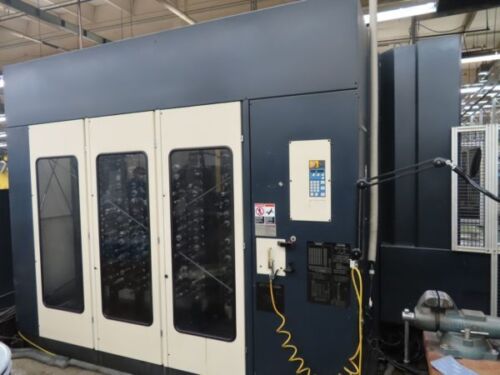
Avoid Costly Mistakes: Professional Tips for Purchasing a Pre-Owned / Surplus / Second-Hand / used Makino A55E CNC Horizontal Machining Center
Here’s a comprehensive, professional checklist + best practices guide to help you avoid expensive pitfalls when buying a pre-owned / used Makino A55E horizontal machining center (HMC). Because the A55E is a high-end, precision horizontal machine, small hidden problems can turn into very costly repairs or downtime. Use this as your evaluation roadmap.
1. Know the Benchmarks (“What Good Looks Like”)
Before you inspect, you need a yardstick. Below are representative specs and design features of the Makino A55E (from current used-market data) to help you judge claims and detect red flags.
| Parameter | Typical / Published Value | Notes / Sources |
|---|---|---|
| X travel | ~ 560 mm (22.05″) | A listing shows “X 560.07 mm” for a used A55E. |
| Y travel | ~ 560 mm | Same listing: “Y 560.07 mm” |
| Z travel | ~ 599 mm | The same ad: “Z 599.44 mm” |
| Pallet size | 400 × 400 mm | The listing gives: “Pallet-W 400.05 mm, Pallet-L 400.05 mm” |
| Spindle speed / taper | Up to 14,000 rpm, CAT / BT-40 or HSK in some units | The ad lists “14,000 RPM, Taper 40” |
| ATC / tool capacity | ~ 90 tools in published ad | The used machine “equipped with … 90 Tool Magazine” |
| Pallet load / workpiece size | ~ 500 kg / ~ 24.8″ dia × 39.4″ high | One ad: “Max Work Piece Size: 24.8″ Dia. × 39.37″ High … Pallet Load: 1,100 lbs (≈ 500 kg)” |
| Rapid traverse / feed | Several m/min (fast axis moves) | Not always stated explicitly, but A-series were designed for higher speed and reduced out-of-cut time. |
| Machine weight / footprint | ~ 20,000 lbs / ~ 180″ × 75″ layout | The listing shows “Machine Dimensions 183.1 L × 75.5 W” and weight ~ 18,960 lbs. |
Also, Makino’s own literature for the A-Series notes that the A55E’s design was intended to push higher spindle speeds (14,000 rpm in many cases) and fast pallet change / reduced non-cut time.
These benchmarks are not absolutes, but if a seller claims something wildly different (e.g. spindle 30,000 rpm, pallet 1000 mm × 1000 mm) you must demand proof (manufacturer spec sheet, original drawings, test reports).
2. Pre-Inspection / Screening (Before Travel)
You can eliminate some risky machines before you even visit, if you ask for the right information ahead of time.
- Request serial number, year of manufacture, and variant of the machine (A55E, whether it is “Plus” or any special sub-variant).
- Ask for mechanical, electrical, hydraulic, and control documentation: wiring diagrams, parts catalogs, lubrication schematics, control manuals.
- Ask for control software / parameter backups, custom macros, tool tables, compensation tables.
- Request a video or remote demo: all axes (X, Y, Z), pallet indexing, ATC cycle, spindle speed changes, ideally under low load.
- Ask for alignment / calibration reports if available: laser measurement, survey reports.
- Ask for any history of major rebuilds, crashes, or modifications.
- Ask for usage data: hours powered on vs hours milled, kinds of parts / materials, duty severity.
- Check whether spare parts (spindles, drives, control modules) are still available in your region.
- Get the machine’s footprint, weight, lifting points, disassembly needs for transport.
If the seller can’t supply credible documentation or declines to show motion tests, that’s a significant red flag.
3. Structural & Mechanical Inspection
Once onsite, carefully inspect the “hard” parts. Many failures stem from hidden wear, misuse, or misalignment here.
a) Castings, base, structure
- Examine the base, frame, and structural castings for cracks, weld repairs, heat distortion, or damage.
- Use a long straightedge or precision reference bar to check for twist, warp, or sag in mounting surfaces, especially across the pallet rails or table top plane.
- Check symmetry: excessive wear on one side suggests misalignment or uneven loading over years.
b) Guideways / linear motion / ways
- Jog each linear axis (X / Y / Z) slowly and feel for stick/slip, binding zones, sudden friction changes.
- With covers removed (if allowed), inspect guide surfaces / rails for pitting, corrosion, scoring, wear flats, edge rounding.
- Inspect way covers, bellows, scrapers—if these are missing or damaged, chips and coolant may have degraded internal surfaces.
- Check adjustment or preload mechanisms (gibs, shims, preload screws) for integrity and lack of slop.
c) Ball screws, nut assemblies & backlash
- Reverse small moves in each axis and measure backlash / play with high-precision indicators. For a machine of this class, it should be very tight.
- Move along full travel and feel for zones where friction shifts (i.e., “hard spots” or “soft spots”).
- Check for looseness or play in coupling joints between motors and screws, and nut housings.
d) Spindle & spindle system
- Mount a test bar or spindle gauge and measure radial and axial runout carefully. Even microns of error matter.
- Run the spindle at multiple speeds (no load) and listen / feel for bearing hum, unusual vibrations or noises.
- After warm-up, measure housing temperature (use IR thermometer) — any hot spots are warning signs.
- Inspect spindle nose, taper, drawbar or retention mechanism, seals, interface surfaces.
- Check for evidence of past spindle rebuilds, bearing changes, or collisions.
e) Pallet indexing / pallet changer mechanism
- Cycle pallet indexing many times; check for hesitation, mis-indexing, backlash, or drift.
- Inspect pallet rails or guiding surfaces for wear or play.
- Verify pallet clamp / unlock mechanisms for reliability and repeatability.
f) Tool changer / magazine
- Cycle ATC multiple times; observe indexing behavior, consistency, speed, any jamming or hesitation.
- Inspect magazine slides, sensors, pocket wear, and actuation mechanisms.
- Test tool mounting repeatability: when a tool is changed and reinserted, does it register accurately?
g) Coolant, lubrication & auxiliary systems
- Examine coolant pumps, piping, filters, sump cleanliness, leaks, contamination.
- Check lubrication circuits (oil / grease / centralized lube) to ensure all slides, guides, screws receive proper lubrication.
- Test hydraulic / pneumatic circuits (for clamps, locks, actuators) for leaks, proper pressure, reliable movement.
- Inspect hoses, seals, connectors for wear, cracks, prior repair.
- Check chip conveyors, guard doors, filter systems, flush systems for functional condition.
4. Electrical, Control & CNC Inspection
Often, the mechanical part is acceptable, but the control / electronics side kills a deal.
- Power the machine up carefully (with supervision) and watch for smoke, blown fuses, tripped circuits, strange smells.
- Open the control / electrical cabinet (if permitted) and inspect wiring harnesses, connectors, terminal blocks, insulation condition, signs of heat damage or amateur splices.
- Boot the control: test interface screens, diagnostics pages, memory, alarm logs.
- Jog each axis (X, Y, Z) in manual / MDI mode: check responsiveness, smooth motion, reversals, acceleration / deceleration.
- Test multi-axis coordinated moves (e.g. X + Y moves) to check for synchronization, smooth pathing.
- Verify limit switches, homing routines, overtravel protection, emergency stops.
- Confirm feedback devices (encoders, linear scales, resolvers) operate correctly, no signal dropouts or noise.
- Ensure that all software, parameter backups, compensation tables, custom macros, license dongles are included.
- If control boards, servo drives, or electronics are old, verify spare parts availability or upgrade options.
5. Functional & Load Testing / Acceptance Trials
This is critical — idle motion tests don’t reveal the real performance under stress.
- Bring or ask the seller to run a representative test part (or sample) with tooling that mimics your expected production.
- Run full-axis moves under load: X, Y, Z traversal, direction reversals, cornering, tool changes. Watch for stalling, vibration, deviations.
- Perform return-to-zero / repeatability tests: move away and return in each axis, measure errors with high-precision indicators.
- Machine features and measure critical tolerances: flatness, surface finish, positional accuracy, geometric features, alignment of multi-face work.
- Run extended cycles (hours) to observe thermal drift or gradual misalignment as the machine warms.
- Interrupt a cycle midway, perform a tool change, resume, and check if the part continues within tolerance.
- Test peripheral systems during operation: coolant, chip evacuation, guards, lubrication systems.
If the seller refuses or severely limits load tests, that is a big red flag.
6. Geometry, Alignment & Calibration Verification
Even a well-maintained HMC may drift over time; you must check whether geometry is still within acceptable bounds or repairable.
- Ask for or perform alignment / calibration checks (laser alignment, test bar, straight-edge, dial indicator tests).
- Check:
• Straightness of motion over full travel in X, Y, Z
• Squareness among axes (X↔Y, X↔Z, Y↔Z)
• Flatness and parallelism of pallet / table surfaces to axes
• Pallet indexing angular error or backlash
• Backlash / hysteresis / repeatability of all moves
- Check if the control supports geometric compensation or error mapping, and whether those maps are valid / current.
- Estimate cost / feasibility of re-alignment, shimming, straightening; if adjustments are excessive, they can kill the deal.
7. Spare Parts, Serviceability & Long-Term Viability
One of the biggest risks with buying used machines is whether you can keep them running over time.
- Confirm that critical spares are still manufactured or repairable: spindles, bearings, servo drives, control boards, pallet mechanisms, ATC modules.
- Check whether Makino (or authorized service companies) still support the A-series in your region.
- Identify local / regional service providers or rebuilders experienced with Makino HMCs.
- Evaluate whether retrofitting newer electronics / drives is feasible if components become obsolete.
- Ensure tooling, holders, pallet adapters, fixturing compatible with the machine are still available.
- Try to obtain spare modules (electronics, wear, replacement parts) with the sale if possible.
8. Contract & Negotiation Safeguards
Even after a thorough inspection, surprises can appear later—protect yourself contractually.
- Insist on conditional acceptance / performance test clause: final payment only after the machine passes your agreed load & accuracy tests.
- Define quantitative acceptance criteria: maximum runout, repeatability error, positioning tolerances, pallet indexing accuracy, surface finish.
- Negotiate a limited warranty / guarantee period (e.g. 30–90 days) covering critical systems (spindle, drives, control).
- Require all documentation: manuals, wiring diagrams, control parameter backup, alignment reports, parts lists.
- Clarify responsibility for transport, rigging, leveling, foundation work, installation, alignment, commissioning.
- Insert a “burn-in / commissioning period” clause: if defects appear during first production use, the seller must remedy them.
- Demand written disclosure of known defects, structural repairs, crashes, or modifications.
9. Transport, Installation & Commissioning Risks
Even a great machine can be ruined during move or poor setup.
- Confirm machine weight, center-of-gravity, lifting points, disassembly requirements.
- Use proper rigging, vibration-damping supports, and securement to avoid stress or distortion in transit.
- After installation, re-level, anchor, re-grout to a stiff, stable foundation.
- Allow a commissioning / burn-in period before formal acceptance.
- After the machine settles, re-check alignment, backlash, geometry.
- Be present (or send your technical staff) during initial production runs to spot issues early.
10. Red Flags & Deal-Breaker Conditions
Here are warning signs you should take seriously (be ready to walk away):
- Seller refuses full inspection or blocks internal access.
- No motion tests or refusal to allow load / cutting trials.
- Structural repair evidence (cracks, welds) in base, frame, pallet rails with no credible documentation.
- Spindle with noise, vibration, excessive runout, or missing rebuild history.
- Pallet indexing that is sloppy, mis-indexes, drifts, or shows backlash.
- Heavy play / backlash in axes beyond what control compensation can mask.
- ATC / tool changer mis-indexing, jamming, or worn pockets.
- Electronics, control boards, drives are obsolete, unsupported, or impossible to source.
- Wiring harnesses with cracked insulation, many splices, burn damage.
- Missing critical documentation (manals, wiring, alignment, control backups).
- Coolant / lubrication systems in disrepair: leaks, blockages, contamination.
- Wear so extreme (on rails, screws, pivoting parts) that refurbishment cost rivals replacement.
- Spare parts for critical systems (spindle, pallet mechanisms, control electronics) no longer available or extremely expensive.
- Geometry so far out that re-alignment would be prohibitively time-consuming or expensive.