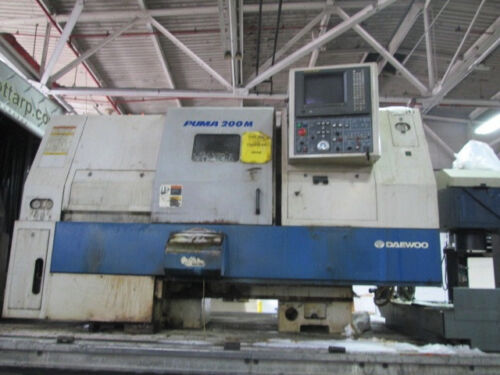
Avoid Costly Mistakes: Professional Tips for Purchasing a Pre-Owned / Surplus / Second-Hand / used DAEWOO PUMA 200 LMA CNC Lathe
Here’s a professional, detailed guide to help you avoid costly mistakes when buying a pre-owned / surplus / used Daewoo PUMA 200 LMA (or similar “200” series) CNC lathe. Because lathes (especially with live tooling, sub-spindles, or Y-axis options) are precision machines, many latent defects can be expensive or even unfixable. Use this as your inspection & negotiation roadmap.
I’ll start with known benchmark specs to set expectations, then a detailed checklist, then red flags, and contract/acceptance advice.
1. Benchmark Specs & What to Expect (Yardsticks)
Before visiting the machine, you should know roughly what a PUMA 200 LMA is supposed to deliver. That way you can spot exaggeration or mis-specs.
From listings and specifications:
- One listing for a 1999 Daewoo PUMA 200 LMA says:
• Swing: 20.1″ (≈ 511 mm)
• Turning length: 21.6″ (≈ 549 mm)
• Bar capacity: 2.5″ (≈ 63.5 mm)
• Spindle RPM: up to 4,500 rpm
• Turret: 12 stations, with 6 live tooling stations in that listing - Another listing gives physical size / weight: length ~ 2,660 mm, width ~ 1,700 mm, height ~ 2,000 mm, and weight ~ 4,100 kg.
- Some web sources list “Max Turning Diameter ~ 300 mm, Max Turning Length ~ 550 mm, Spindle Speed 4,500 rpm” for a “Puma 200 / 200 series” lathe in general.
Thus, when you go to inspect, use those parameters (swing, turning length, spindle rpm) as your baseline. If a seller claims much faster spindles, much longer travel, or greater capacity, require proof (original spec sheet, test data, upgrades) before trusting it.
Also, confirm whether the machine is “LMA” variant (which typically implies live tooling / milling capability, possibly C / Y axis, tooling systems). That adds extra systems to check.
2. Pre-Visit / Screening: Documents, Videos & Questions to Ask
Before traveling or committing money, try to collect as much as possible in advance:
- Machine serial number, production year, variant (“200 LMA”, “200 LM”, etc.), and any history of rebuilds or retrofits.
- Original mechanical, electrical, hydraulic schematics, wiring diagrams, part lists, operator manuals, maintenance logs.
- Control & CNC manuals, backup of all parameters, custom routines, compensation tables.
- Video or remote demo of axis motion: X, Z, live tool (if present), tool change, spindle running (idle) and ideally under light load.
- Ask the seller for any alignment / calibration reports (laser, test bar, geometric checks).
- Ask for spindle rebuild history, bearing replacements, crash / damage history.
- Ask for real usage data: how many hours, cutting vs idle time, typical parts produced, materials processed (steel, aluminum, etc.), load patterns.
- Ascertain availability of spare parts in your region (spindle bearings, tool modules, control boards).
- Confirm machine dimensions, weight, lifting points, disassembly needs, site constraints.
If the seller can’t supply decent documentation or refuses to show motion or test runs, that is an early warning signal.
3. Structural & Mechanical Inspection
Many defects hide under covers. Be thorough.
a) Cast structure, bed, base, frame
- Visually inspect for cracks, weld repairs or patches, distortions, signs of structural damage.
- Use a long straightedge or reference bar to check for twist, warp, or misalignment in major surfaces (bed, tool turret mounting surfaces, spindle centerline surfaces).
- Check for differential wear or sagging, especially on the bed.
b) Guideways, slides & linear motion systems
- Jog each axis (X and Z, and Y / live tool axes if present) slowly and feel for zones of “stick/slip,” binding, or sudden friction changes.
- Examine guide surfaces (rails, scraped surfaces, profile guides) for pitting, corrosion, score marks, wear flats, or edge rounding.
- Inspect wipers, scrapers, dust seals, bellows or ways covers—missing or damaged ones allow chips / coolant ingress and damage internal surfaces.
- Check adjustment mechanisms (gibs, preload screws) for integrity and ease of adjustment.
c) Ball screws, nut assemblies, backlash
- Use a dial indicator to measure backlash / play in each linear axis by reversing small motions. Acceptable limits depend on machine class but should be minimal.
- Move each axis across full travel and feel for friction irregularities or “hard zones”– that suggests local wear or damage.
- Inspect couplings, nut housings, support bearings for looseness or play.
d) Spindle & spindle head
- Mount a test bar or spindle gauge and measure radial and axial runout. Even microns of deviation matter in precision turning.
- Run the spindle at different RPMs (idle) and listen/feel for abnormal vibrations, bearing noise, hum or instability.
- After some runtime, measure spindle housing temperature—hot spots may indicate bearing issues.
- Inspect the spindle nose, taper surfaces, drawbar / retention systems, seals, keyways, and interface components.
- Ask for or look for spindle rebuild history, bearing replacements, or evidence of abuse.
e) Tool changer / turret / live tooling
- Cycle the turret many times; observe indexing speed, consistency, mis-indexing or hesitation.
- Inspect turret slides, rails, clamping surfaces, sensors, actuators for wear, play, or damage.
- Test live tooling (if present): rotation stability, torque under load, backlash, tool mounting accuracy.
- Check tool mounting repeatability: after tool change, does the tool return to precise position?
f) Coolant, lubrication, auxiliary systems
- Inspect coolant pump, piping, filters, sumps, for leaks, sludge, corrosion, clogging.
- Verify lubrication system (grease / oil / centralized lube) is intact and reaches all axes / slides.
- Test hydraulic / pneumatic systems (if they serve turret, tool clamps, axis locks etc.) for leaks, pressure stability.
- Inspect hoses, connectors, valves, seals—look for deterioration or prior repairs.
- Test chip conveyor, guard doors, flush nozzles, coolant splash guards.
4. Electrical & Control Systems
Even a mechanically perfect machine fails without a working control system.
- Power up the machine carefully; watch for smoke, smell of burning insulation, tripped breakers, voltage fluctuations.
- Open the electrical / control cabinet (if permitted)—inspect wiring harnesses, terminals, cable insulation, signs of overheated wires or amateur splices.
- Boot the CNC / control: test UI, diagnostics, parameter screens, history / alarm logs.
- Jog each axis via manual / MDI: check smoothness, direction reversals, acceleration / deceleration, stuttering.
- Test combined or diagonal moves (X + Z, or tool motions) to see if coordination is reliable.
- Check limit switches, home return routines, overtravel protection, interlocks and emergency stops.
- Verify encoder feedback, resolvers, or scale signals: check for dropout, noise, signal stability.
- Ensure that all software, backups, compensation tables, custom macros, license dongles are included.
- If the control’s boards or firmware are old or proprietary, confirm whether replacement or repair options are available.
5. Functional / Load Testing & Acceptance Trials
This is where hidden defects or weaknesses manifest. Demand real tests.
- Bring or ask for a representative test part & tooling, ideally matching your intended production usage.
- Run full-axis moves under load (turning, live tooling, direction changes, tool change) and watch for stalling, vibration, synchronization problems.
- Perform return-to-zero / repeatability tests: push away and return, measure deviations with high-precision indicators.
- Machine test features and measure critical tolerances: diameters, roundness, surface finish, concentricity, residual error from tool paths.
- Run extended cycles (hours) to observe thermal drift or alignment changes as machine warms up.
- Interrupt mid-cycle and perform a tool change; resume and see whether the part continues with minimal deviation.
- Test coolant, chip flushing, guards and auxiliary subsystems during actual machining.
If seller refuses full load testing, or only allows idle jogging, that is a serious red flag.
6. Geometry, Alignment & Calibration
Once mechanically sound, check whether geometry has drifted—and whether it’s repairable.
- Ask for or perform alignment / calibration tests (laser alignment, test bar, geometric probe).
- Check straightness over full travel in X and Z, squareness between axes, table or turret indexing perpendicularity, concentricity of spindle to axes.
- Check backlash and repeatability across axes.
- See if the CNC control supports compensation maps / error correction, and whether they are active and valid.
- Estimate the effort required (in time/cost) to realign or correct geometry—if it’s too great, it may not be worth buying.
7. Spare Parts, Support & Future Viability
One of the biggest long-term risks with used machines is inability to service them later.
- Verify availability of critical spares: spindle bearings, servo motors, drive amplifiers, control boards, tool turret modules, feedback devices.
- Check whether Daewoo / Doosan (or aftermarket suppliers) support parts for PUMA 200 series in your region.
- Investigate local service providers / rebuilders who work on Daewoo lathes.
- Consider upgrade paths: if control boards become obsolete, is it feasible to retrofit new electronics?
- Ensure tooling, holders, adaptors for your intended operations are still available.
- Try to secure spare modules (electronics, wear parts) as part of the purchase deal.
8. Contract & Negotiation Safeguards
Even after inspection, you must protect yourself legally.
- Insist on conditional acceptance / acceptance testing — payment only after passing agreed performance tests.
- Define quantitative acceptance criteria: allowable runout, repeatability, backlash, surface finish, transfer accuracy post tool change.
- Request a short-term warranty (e.g. 30–90 days) on major subsystems (spindles, drives, control).
- Demand delivery of all documentation, backup files, calibration data, parts lists, and manuals.
- Clarify responsibility for transport, rigging, leveling, foundation, re-alignment, installation, and commissioning.
- Include a “burn-in / commissioning period” clause: defects found during early production work must be remedied by the seller.
- Require written disclosure of any known defects, prior repairs, structural damage, or crash history.
9. Transport, Installation & Commissioning
Even a great machine can suffer during move or poor setup—plan carefully.
- Confirm accurate machine weight, footprint, lift points, disassembly needs.
- Use proper rigging, supports, shock protections to avoid twisting or stress during transport.
- After installation, re-level, re-anchor or re-grout on a stiff foundation.
- Allow a commissioning / burn-in period under real loads before declaring final acceptance.
- After “settling,” re-check alignment, backlash, geometry to ensure nothing shifted.
- Be present (or send your technician) during first production runs to monitor for issues early.
10. Red Flags & Deal-Breaker Conditions
If you see many of these, walk away or demand very steep discount + assurances:
- Seller refuses full inspection, internal access, or load testing
- Structural repairs, cracks, welds in bed, column, spindle head with no credible records
- Spindle noise, vibration, excessive runout, or no rebuild history
- Motion axes with zones of binding, inconsistent friction, or excessive backlash
- Tool turret mis-indexing, hesitation, or inconsistency
- Control, drives, or electronics that are obsolete, unsupported, or without spare parts
- Wiring harnesses with brittle insulation, cracks, many splices, signs of overheating
- Missing or incomplete documentation (manuals, wiring, calibration, parameter backups)
- Coolant / lubrication systems in bad condition or not functional
- Spare parts for key systems (spindles, drives, control) not available or extremely expensive
- Geometry / alignment off so badly that correction costs approach machine’s value
- Hidden damage from flooding, coolant corrosion, neglect being concealed