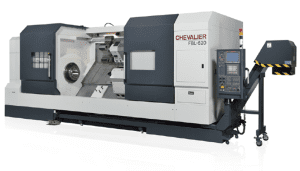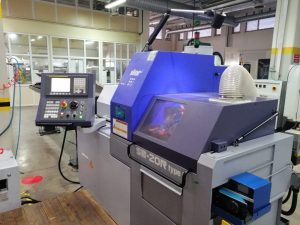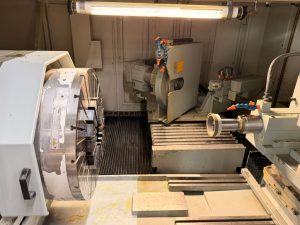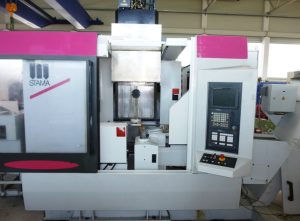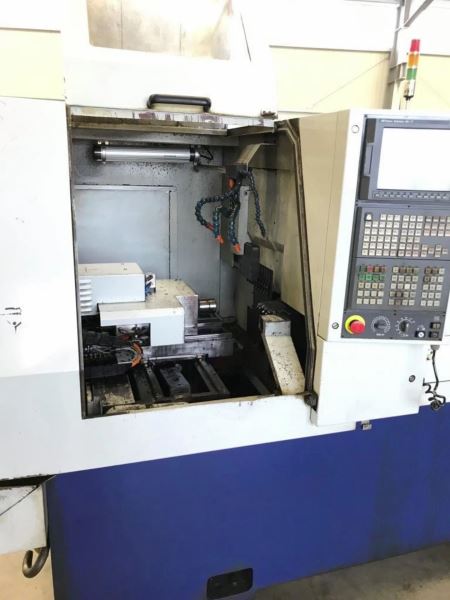
Avoid Costly Mistakes: Professional Tips for Purchasing a Pre-Owned, Surplus, Second-Hand, Used Maier ML26D CNC Swiss Type Lathe made in Germany
When you’re looking at a used Maier ML26D (or similar Maier “ML-series” Swiss / multi-axis lathe), the margin for hidden defects is high. This type of machine is complex (multi-axis, Swiss-style, typically lots of tooling axes), and mistakes in buying one can cost dearly in downtime, repairs, or lost precision. Below is a professional “due diligence / red-flag / negotiation” guide tailored to the ML26D and similar Maier machines.
What is the Maier ML26D — Key specs & baseline expectations
Before you inspect, you must know what this machine should be capable of, so you can detect when it’s out of spec. Some known published data:
- It is (or was) listed among Maier’s discontinued Swiss type automatic screw machines.
- In one used listing:
• Control: Fanuc 16i-T
• Year: 2001
• 9 axes (X1 Z1 Y1 C1 – X2 Z2 C2 – X3 Z3)
• Main spindle bar capacity: 26 mm; sub spindle: 20 mm
• Spindle speed: up to 8,000 rpm; drive power ~7.5 kW
• Max machining length / Z travel: ~220 mm - Another listing: “Bar Capacity: 1.023″ (≈ 26 mm), Spindle Speed 8,000 RPM, Z Travel 12.6″ (≈ 320 mm) etc.”
- Maier (the company) positions itself as a manufacturer of modular, multi-axis long-turn and Swiss-style machines, emphasizing spare parts availability, modular building blocks, etc.
These “typical” values (bar size, spindle speed, axis count, required control, number of tools) are your baseline. Any machine you inspect should approach those specs; significant deviation is suspect or must be justified.
Inspection / Test / Red-Flag Checklist for Used Maier ML26D (Swiss-type / multi-axis)
Here is a structured, subsystem-by-subsystem checklist. Wherever possible, test or verify in person or remotely (video) with the seller. If feasible, have a machine-inspection expert (Swiss / multi-axis specialist) accompany you.
| Subsystem / Area | What to Check / Test | Why It Matters / Risk | Red Flags / Unacceptable Conditions |
|---|---|---|---|
| Machine History, Documentation, Options | • Request full maintenance logs, repair history, rebuilds, retrofits. • Get original as-delivered spec sheets (axis layout, tooling counts, control options). • Ask which axes / features are active (Y-axis, live tooling, sub-spindle, driven tools). • Confirm the control version and whether option licenses (C-axis, Y, probing, etc.) are active & transferable. • Check whether any modifications or customizations were made (non-OEM parts, structural changes). | Used machines often hide chronic problems in logs or undocumented modifications that impair functionality. If you don’t see documentation, you’re flying blind. | No or insufficient documentation, missing specification sheets, undocumented modifications, missing option licenses are serious red flags. |
| Spindle(s) & Main / Sub Spindle Performance | • Run the spindle(s) at low → high RPM; listen for unusual noise, vibration, heating issues. • Use test bars or gauges to measure spindle runout, taper integrity, repeatability. • Under load (if possible), test cutting operations to detect chatter, instability, tool slippage. • Inspect spindle lubrication, seals, coolant flow to spindle (if internal coolant). • Check for oil leaks, contamination, or overheating in spindle housings. | Because in Swiss-style lathes the spindle is central and often heavily loaded, any spindle imperfection will degrade every part you make. Repair or rebuild is costly. | Excessive runout (beyond a few µm), vibration, heat, leaks, inability to run stable under load—any one of these is a major warning. |
| Axis / Guide / Ballscrew / Guides / Linear Motion | • Move each axis (X, Z, any Y, sub-spindle axes) through full travel, both directions, at slow and high speeds. Listen / feel for smoothness, jerks, stalls, or speed irregularities. • Reverse direction (back-and-forth) to detect backlash or “kicks.” • Remove covers / guards (if permitted) and visually inspect guideways, rails, slides, lubrication lines, signs of wear, scratches, chips embedded in ways. • Inspect ballscrews (or lead screws), check for pitting, play, irregular wear. • Check linear encoder / feedback accuracy vs commanded movement. • Test end-of-travel / limit switches, homing routines. | Wear or play in axes leads to positional error, chatter, quality degradation, possibly scrapped parts. In multi-axis Swiss machines, small errors compound. | Binding, rough motion, audible knocks, large backlash, inconsistent motion, visible damage or scoring on guides is unacceptable. |
| Tooling / Tool Magazine / Tool Change / Driven Tools / Live Tooling | • Cycle all turrets / tool magazines (front, back) through full operations (pick, change, return) repeatedly. • Inspect tool holders, grippers, magazine indexing, sensor / actuator integrity. • Test repeatability of tool changes. • Test live tooling (rotary cutters, drills) under load—see if speed, torque, rigidity are acceptable. • For cross-machining / Y-axis, test tool offsets, interference, axis synchronization. | The complexity of tooling systems means failures or misalignment in tool change are frequent and damaging. Live tooling is particularly stress-prone. | Mis-indexing, tool drop, imprecise seating, sensor failures, chatter in live tooling, mismatch of tool geometry or collisions are red flags. |
| Counter Spindle / Sub-Spindle (if present) | • If this machine has a sub-spindle, test its alignment, run-up behavior, coupling / transfer of part from main to sub. • Check collet / chuck grip integrity, repeatability, defects. • Run sample part through sub-spindle operations to check for vibrational or alignment drift. | The sub-spindle is critical for many Swiss turning sequences—if misaligned or unreliable, throughput and accuracy suffer. | Misalignment, weak clamp force, drift on transfer, vibration or instability in sub operations – immediate concern. |
| Coolant / Lubrication / Hydraulic / Pneumatic Systems | • Inspect pumps, filters, piping, valves, hoses, connections. • Run coolant under full flow & pressure; check for leaks, clogging, pressure drop. • Verify that automatic lubrication (linear guides, ball screws) is functioning, that lines are intact and delivering lubricant. • If hydraulics / pneumatics are used (e.g. for collet opening, clamps, dampers), test their function under load. | Without good coolant or lubrication, tool wear skyrockets, thermal distortion increases, and parts quality degrades rapidly. | Leaks, low pressure, clogged filters, nonfunctional lubrication, intermittent behavior—any of these is problematic. |
| Electrical / Control / Drives / Wiring / I/O | • Power up the CNC, check boot sequence, alarm/fault history, alarm logs. • Open control cabinet; inspect wiring, connectors, boards, any burnt or modified components. • Check servo drives, spindle drives, I/O modules, sensors for fault codes or warning lights. • Test limit switches, home sensors, emergency stops, interlocks. • Upload/download test programs, ensure communication I/O ports function. • Confirm that all functional modules / options (C-axis, Y, special interpolations) are enabled and working. | Control or drive failures are among the most expensive and lengthy to repair, especially for proprietary or obsolete modules. | Burned boards, patch wiring, missing modules, constant faults, disabled options, inconsistent I/O — major red flags. |
| Thermal Stability, Drift & Compensation | • Let the machine idle (or run light motion) for 30–60 minutes, then re-check reference geometry to detect drift. • Test whether thermal compensation (if built in) yields meaningful correction. • During long run cycles, re-check positional accuracy to see if drift or expansion degrades geometry. | Over time, thermal drift is one of the biggest silent killers of accuracy in precision lathes. Without control or compensation, tolerances suffer. | Excessive drift beyond what your tolerance allows, or nonfunctional compensation, is a serious weakness. |
| Geometry / Test Part / Accuracy Validation | • Mount a known precision test bar or calibration workpiece and measure (runout, straightness, roundness, taper). • Execute a sample machining job (turning, cross-drilling, milling) and measure all critical dimensions across multiple axes. • Use metrology tools (dial indicators, gauge blocks, CMM / portable measuring system) to verify that actual results meet your tolerance demands. • Test at extremes of travel or positions to see if deviations escalate. | A machine that “moves” but cannot produce parts to spec is worthless. This is the ultimate test of real-world usability. | If measured deviations exceed your needed tolerances (or exceed what an original spec would allow), demand price reduction or reject. |
| Extended Run / Production Simulation | • Run a production-like program for extended time (hours) under realistic load. • Monitor tool wear consistency, vibration changes, thermal drift, error accumulation, alarms. • Inspect parts periodically during the run to see if accuracy degrades. | Many latent defects only manifest over extended continuous operation. A short test won’t reveal fatigue, cumulative error, or thermal creep. | If accuracy, stability, or behavior degrade over time, that’s a red flag indicating deeper problems. |
| Foundation / Mounting / Machine Base / Leveling | • Check how the machine is mounted: base, anchor bolts, leveling shims, floor rigidity. • Ask if the machine has ever been relocated and if re-leveling / re-commissioning was done. • Inspect base structure for warpage, damage, welds, repairs. • Look for leveling markers, alignment surfaces, residual squares used in prior setups. | If the foundation is poor or the machine has been mis-mounted, you can never recover full precision — it will haunt you. | Warped base, missing or tampered leveling marks, signs of structural damage or frame distortion. |
| Spare Parts, Tooling & Consumables Inventory | • Ask which spare parts are included (servo modules, sensors, cables, collets, tooling, control boards). • Verify availability (and cost) of critical spares for Maier machines or compatible models. • Inspect the tooling / collets / holders for condition and compatibility. • Ask whether proprietary or obsolete modules or electronics exist that are hard to replace. | A machine is only as useful as its maintainability. If a critical part fails and you can’t replace it, the machine becomes a liability. | Missing or hard-to-get spares, reliance on one-off parts, obsolete modules or parts clustered around the used machine with no supply chain. |
| Contractual Protection, Acceptance & Warranty | • Demand final acceptance after installation in your facility (not just at seller’s site). • Secure a limited warranty (e.g. 30–90 days) for key systems (spindle, drives, control). • Allow independent inspection by a third-party metrology / machine-tool specialist before final payment. • Define in contract “deal-breaker” tolerances (max backlash, runout, drift thresholds). • Hold back a portion of payment until acceptance tests are passed. | Without legal recourse, hidden defects become your burden. Sellers often gloss over known flaws unless accountability is enforced. | Seller refusing inspections, warranty, or demanding full payment before testing is high risk. |
| Transport, Dismantling, Reassembly & Re-Alignment Risk | • Request rigging / lift drawings, weight specs, alignment instructions, disassembly procedures. • Ask whether the machine has been moved before, and whether it was realigned after move. • Budget skilled labor, metrology, alignment tools, alignment runs, bolts and shims. • Be aware of shock, vibration, alignment shift during transport. | Even a “perfect” machine can be ruined if improperly transported or reassembled. Precision alignment is critical post-move. | Underestimating alignment / reinstallation costs is a common error. Any misreassembly or misalignment can degrade precision permanently. |
| Obsolescence & Life-cycle Risk of Electronics & Control Modules | • Check whether the control system, drive modules, boards, firmware versions are still supported (by Maier or third-party). • Ask when key modules were last replaced. • Verify whether compatible replacements or retrofits exist for rare/legacy parts. • Confirm that options/features (C-axis interpolation, Y-axis, probing) are not “locked” in software in a way that can’t be restored. | A mechanical-perfect machine is useless if the control or electronics fail and cannot be replaced or repaired. Obsolescence is a real threat. | Evidence of end-of-life modules, locked features, missing firmware, or boards that cannot be sourced is a serious red flag. |
Negotiation Strategy & Price Protection Tips
- Set your “go / no-go” tolerances ahead of time (e.g. maximum allowed runout, backlash, drift). If the machine exceeds them, walk.
- Use defects to negotiate — every flaw found is a point to reduce price or request repair/upgrade before purchase.
- Holdback / retention / staged payment — keep back a portion until final acceptance in your facility.
- Third-party inspection clause — let your metrology / machine-inspection expert examine the machine before you pay everything.
- Warranty for subsystems — even 30–90 days on spindle, drives, control gives you recourse.
- Spare parts package — insist the seller include or discount critical spares (boards, sensors, collets, modules).
- Transport / installation buffer — always allow more time and budget than initial rigging quotes, particularly for machines with fine alignment demands.
- Run under full load — never accept only idle tests. Demand a realistic production-like test in your presence.
- Cold-start test — after machine has been off for hours, power it cold and run basic motions to catch issues that only appear on first startup.
- Verify licensing and active options — ensure that features like C-axis, Y-axis, probing, special interpolation are enabled and functioning.
- Check local support / service network — having a nearby service partner for Maier or compatible machines is a huge advantage.
- Document every defect you see (get photos, video, measurement prints) and include in contract as “known conditions” so you have recourse.