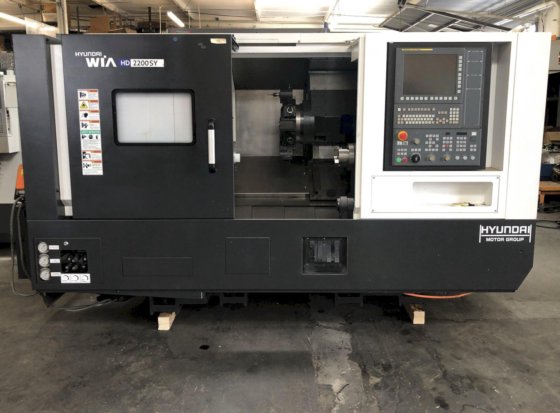
Avoid Costly Mistakes: Professional Tips for Purchasing a Pre-Owned, Surplus, Second-Hand, Used HYUNDAI HD2200SY CNC Turning Center made in South Korea
If you’re considering buying a pre-owned / surplus / second-hand HYUNDAI HD2200SY (or equivalent HD-SY series) CNC turning center, the stakes are high: the machine is large, complex, expensive to repair, and failure to do your due diligence can lead to major hidden costs. Below is a detailed “do not fail to check” checklist plus professional tips and traps, tailored to this specific machine class and to the used-equipment market in general.
1. Know What You Are Getting — Machine Background & Specs
Before physical inspection, arm yourself with the nominal design data and common failure points of the model.
Key specs / design features of the HD2200SY / HD-SY series
(You should verify such values with the actual machine’s nameplate / documentation.)
| Parameter | Typical Value / Range | Why It Matters |
|---|---|---|
| Max turning diameter | ~ 300 mm (≈ 11.8 in) | Confirms that it will suit your workpiece size |
| Max turning length | ~ 610 mm (≈ 24 in) | Ensures your parts fit |
| Spindle speeds | Main spindle: 4,000 rpm; Sub-spindle: often 6,000 rpm or other specified rate | Spindle health is critical — high-speed bearings are expensive |
| Spindle power / torque | Around 18.5 kW or 25 HP (max) | Helps you assess whether it is undersized or may have been pushed beyond limits |
| Guide system / bed | Box guideways, slanted bed (30°) design | Check wear and rigidity of guides |
| Turret / tooling | 12-station turret is common; live tooling, Y-axis, B-axis may be options | Additional moving axes and tooling devices are often weak points |
| Control system | Likely Fanuc‐based (or variant) | Ensures compatibility with your programming, spare parts, and service knowledge |
Understanding these specs will help you detect when a machine is misrepresented or when performance has degraded.
2. Pre-visit Document Review & Vendor Screening
Before you ever travel to see the machine, vet the vendor and the machine’s history.
A. Vendor / Seller Due Diligence
- Reputation and track record: Seek references, check reviews, speak to prior customers. Sellers who regularly deal in used CNCs and provide good after-sales support are safer.
- Transparency: A reputable seller should willingly share maintenance logs, repair records, parts replacements, control history, electrical schematics, user manuals, etc.
- Inspection / acceptance terms: Insist on a conditional offer subject to a full mechanical/electrical inspection by your expert. Don’t commit sight-unseen.
- Spare parts support in region: Confirm in Türkiye or in your local region whether parts (bearings, servo drives, guides, control boards) are still available (new or used) and at what lead times.
B. Request Pre-Information
Ask the seller, and obtain:
- Machine serial number / year of manufacture
- Total operating hours or cycles (if counted)
- Maintenance / service logs — when were guides replaced, spindle overhauls, etc.
- Alarm / error history — see if the control’s fault logs indicate recurring problems
- Original manuals, electronic and mechanical drawings, wiring diagrams, control manuals
- List of included accessories — chucks, bar feeders, tool sets, probes, IoT/remote diagnostics, software modules
- Photos / video of all axes moving, spindle running at speed, tool change, Y-axis motion, etc. (with sound)
- Control version, software / firmware levels, license status / updates
- Electrical specs & wiring — does the machine’s power / phase configuration match what you have or can supply (voltage, current, panel)?
- Foundation / anchoring details — what kind of mounting did it have, and whether the base is level / toleranced.
These advance disclosures help you decide whether to go in person and what to emphasize in the inspection.
3. On-Site Inspection Checklist (Mechanical, Electrical, Control)
Bring along a seasoned CNC technician or machinist if possible. Use a structured checklist to avoid missing show-stoppers.
A. Visual / External Checks
- Check for rust, corrosion, pitting — especially on exposed surfaces, coolant trays, chip conveyors, covers.
- Inspect the bed, saddle, ways — check for nicks, pitting, uneven wear, or skips.
- Look at covers, way shield boots, scrapers — missing or damaged covers often indicate neglect or abuse.
- Check bolts, fasteners, covers — missing fasteners or misaligned covers may hint at recent repairs or substandard reassembly.
- Check that leveling pads are present and that the base mounting is level (or at least, not grossly warped).
- Inspect chip conveyor, coolant system, pipes, hoses, tanks — leaks, corrosion, sludge, inappropriate modifications.
- Examine wiring, cable trays, connectors — brittle insulation, loose wiring, signs of overheating or rework are red flags.
B. Mechanical & Motion Tests
With power ON and safety precautions in place:
- Axis movement tests (X, Y, Z, B, if present)
- Jog axes slowly and fast, observe smoothness, checking for chatter, jerks, or binding
- Listen for mechanical noises—rattling, grinding, gear whining
- Check backlash / play in axes
- Ball screws / linear guides
- With covers open, inspect ball screws for scoring, pitting, discoloration
- Check ease of movement when the drive motors are disabled (manually push or unlock axis, if possible)
- Check lubrication system and consistency of grease / oil feed
- Spindle test
- Run the spindle through full speed range (if safe) and listen carefully for bearing noise, whine, vibration
- Use a dial indicator (if possible) to measure runout, axial play, radial play
- Check spindle temperature (if running) or past history of overheating
- If sub-spindle is present, test that too
- Tool changer / turret / Y-axis / B-axis
- Cycle the turret/tool changer, listen for smooth indexing
- Command Y-axis and B-axis motions, verify they reach limit positions correctly
- Test live tooling (if present) — bring the spindle into live-tool mode and check proper operation
- Check for correct synchronization, no misalignments or excessive delay
- Control / probe / offsets / probing routines
- Run a simple test program: e.g. a square pocket, circle, repeat moves
- Check whether the tool probing and workpiece probing (if available) function correctly
- Review the controller’s error logs / alarm history
- Open and test auxiliary functions — coolant, flood, chip conveyor, doors, interlocks
C. Electrical & Control System
- Inspect the electrical cabinet — cleanliness, burnt components, dust, presence of spare control boards
- Check for component branding, replacement parts, and spares
- Power up and observe control boot sequence — does it load cleanly, are there warnings, or “no license / expired module” messages
- Test control responsiveness — pressing keys, soft keys, jogging axes, interface response times
- Verify servo drives, amplifiers, power supplies, feedback systems (encoders, resolvers) — look for burnt resistors, smelling signs, discoloration
- Confirm wiring and shielding integrity, proper grounding, absence of loose cables
- Check for backups — is there a backup of the control program? Are there external USB / floppy / Ethernet backup files?
D. Geometry / Accuracy Checks
If possible, perform basic metrology:
- Place a test bar / gauge and measure produced dimensions along X, Z axes
- Cut a test ring or test feature and measure roundness, runout, straightness, repeatability
- Use dial gauges or laser alignment tools to check squareness, alignment of axes
- Measure residual bearing runout / spindle taper deviation
- Thermal drift test (if possible): after a 30-minute warm-up, re-check geometry
4. Analyze Wear, Life-Limit Components & Risk Factors
Even if everything “runs,” the lifetime of key parts may be exhausted. Some costly components include:
- Spindle bearings / spindle overhauls — one of the most expensive repairs
- Ball screws / linear guides — replacement or refurbishment is costly
- Turret, tool changer, Y/B-axis servo drives — mechanical or electronic failures
- Control / drives / power electronics — repairs or hardware replacements
- Hydraulic systems, coolant pumps, piping, filters
- Structural limitations — any cracks in casting, warpage, or distortion
Ask whether the seller has already replaced or refurbished any of those, and at what cost. If a major overhaul or replacement is due, deduct that from your offer.
Also, factor in downtime risk: if a critical part fails shortly after purchase, you may lose weeks waiting for parts or repair.
5. Total Cost of Ownership (Beyond Purchase Price)
Many buyers forget that the initial price is just one piece. Here are cost items easily overlooked.
- Transport / rigging / shipping: heavy machines require special cranes, dismantling/assembly, shipping costs often run tens of thousands USD or equivalent locally.
- Foundation / mounting / leveling: proper base, concrete, grout, anchoring work
- Electrical / power upgrades: transformer, wiring, circuit protection, harmonics filtering
- Installation, alignment, calibration: often required after move
- Training / setup / process validation: time to bring into production
- Spare parts inventory: having essential spares on hand (bearings, seals, belts, drives, etc.)
- Inspection / warranty / acceptance service: consider hiring a third-party inspector
- Control software upgrades / licensing
- Preventive maintenance / overhaul budgeting
- Downtime risk buffer — you should budget for repair contingency
As a rule of thumb, anticipate secondary costs (shipping, install, spare parts, risk) to be 20–50 % (or more) of the machine’s purchase cost.
6. Negotiation Pointers & Contract Safeguards
- Use any detected issues (wear, missing parts, repair needs) as leverage to reduce price
- Make payment conditional on successful acceptance testing / inspection
- Agree on a performance guarantee window, e.g. the machine must meet tolerance on a test part within X days
- Insist on detailed as-is vs. seller-represented condition clauses
- Agree on who bears the risk / cost during transport and installation — I often see disputes over damage during moves
- Try to have the seller or vendor do a “burn-in” / test run in your presence
- Retain the right to bring your own technician or inspector before finalizing
- Ask for extra spare parts, tooling, or software licenses as part of the deal
7. Market & Local Considerations
- Local support / service: check availability of service engineers conversant with Hyundai WIA / HD-SY machines in your area
- Import duties, customs, taxes: if buying from outside the country, be careful to include all levies
- Availability of spare parts locally: bearings, servo drives, linear guides, etc.
- Power infrastructure compatibility: voltage, frequency, phase, grounding standards in your facility
- Transportation constraints: roads, crane capacities, access to your shop — measure door widths, overhead cranes
- Regulation / safety compliance: ensure the machine and its electrical systems comply with industrial / electrical codes
8. Major Mistakes to Avoid (and Red Flags)
| Mistake / Red Flag | Why It’s Dangerous | What to Do Instead |
|---|---|---|
| Accepting low-quality “video demo” only | Videos can hide noise, vibration, misalignment | Insist on live demonstration; bring your own technician |
| Trusting “low hours” claim blindly | Hours don’t tell you how hard or poorly it was used | Corroborate with wear, maintenance history, usage type |
| Overlooking spindle noise or bearing whine | Bearing failure is one of the costliest repairs | Use stethoscope / vibration meter; test full-speed |
| Ignoring control / electronics condition | Drives may fail or be obsolete | Power it on, test control, check spare boards |
| Not performing geometry / accuracy checks | Machine looks okay but parts will be out of spec | Run test parts, measure critical tolerances |
| Failing to account secondary costs | Transport, install, downtime can double your investment | Estimate all costs before final offer |
| No contractual protection | Once money changes hands, recourse is limited | Use conditional acceptance, guarantees, inspection rights |
| Lack of spare parts path | Machine becomes unusable if a key part fails | Vet local supply chain before purchase |
| Underestimating installation challenges | Wrong foundation, misalignment, vibration can kill performance | Plan site, foundation, leveling carefully |
9. Suggested Inspection Sequence
- Review documents & history
- Walk around visually — note condition, missing parts
- Power up and test control boot sequence
- Jog axes slowly & fast, listen / feel for problems
- Run spindle at various speeds, check runout
- Cycle turret, Y-axis, B-axis, tool changer
- Run a simple test cut (if allowed)
- Geometry / metrology checks
- Inspect electrical cabinet, drives, wiring
- Run long cycle (stress test) if possible
- Negotiate adjustments based on findings