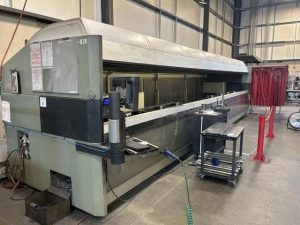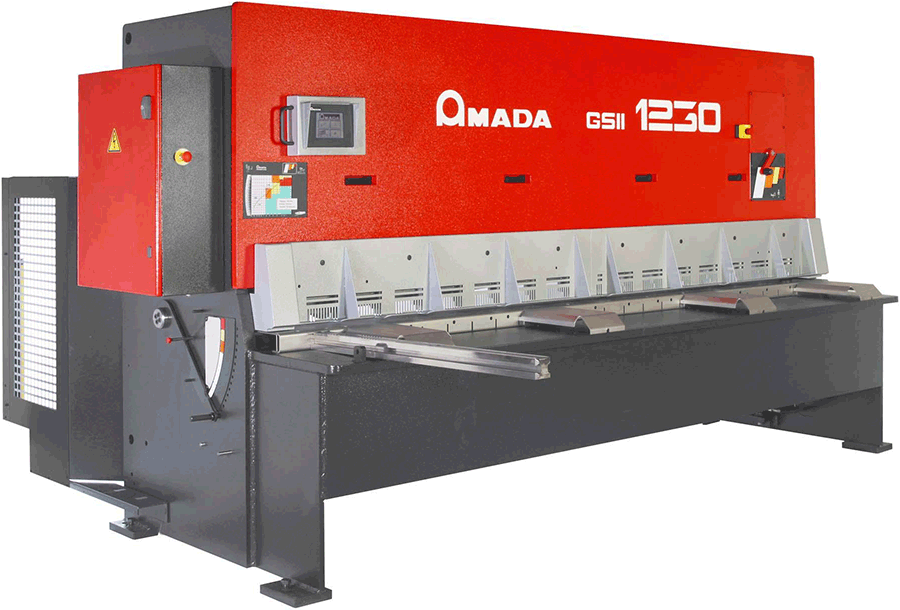
Avoid Costly Mistakes: Professional Tips for Purchasing a Pre-Owned, Surplus, Second-Hand, Used AMADA GSII 1230 CNC shears made in Japan
If you’re considering buying a pre-owned / surplus / second-hand / used AMADA GSII 1230 (or GS-II / GS 1230 series) CNC / NC guillotine shear (sheet metal shear) made in Japan, the risks are real: hydraulics wear, control obsolescence, alignment drift, and hidden mechanical fatigue can all lead to big repair costs. Below is a thorough “what to check / what to demand / what to avoid” guide specifically for that style of machine, plus red flags and negotiation tips.
Disclaimer: Every machine’s history is different. Use this as a guide, bring in your own experienced technician or fabricator, and revise the checklist to your local conditions (e.g. power, service availability).
0. Know the Basic Specs & What “1230” Implies
Before inspection, it helps to know what you’re dealing with, so you can spot exaggerations or misrepresentations.
From listings and references:
- The AMADA GS-II 1230 is a guillotine (straight-line) shear with NC (numerical) backgauge control.
- Its declared capacity is 12 mm (≈ 0.472 in) for steel (depending on steel grade) at a cutting length ~3,050 mm (i.e. ~3 m)
- Stroke / cut length, cutting angle adjustment, number of hold-down fingers, gauge travel, and speed will be key parameters you’ll want to verify against the spec sheet.
- Its frame is heavy; one listing shows machine weight ~8,800 kg.
Knowing these “nominal” specs gives you a baseline to see whether the machine delivered matches what you expect (or what the seller claims).
1. Pre-Inspection / Seller Due Diligence
Before traveling or sending a team, demand documentation and information to weed out obviously bad deals.
Requests / questions to the seller:
- Serial number, year of manufacture, model details
- Sometimes “1230” might be mis-stated, or parts swapped.
- Operating / cut hours, cycle counts, usage history
- How many cuts has it done? What sheet thickness / material types were typical?
- Was it used in heavy duty / production service, or light/occasional work?
- Maintenance / service logs / repair history
- Have hydraulics been overhauled or replaced?
- Blade changes, table rebuilds, gauge calibrations, electronics replaced.
- Original manuals, NC control software, electrical drawings, hydraulic schematics
- Are spares available? Is software proprietary / discontinued?
- Can you get backups (control program, part programs)?
- List of attachments / accessories / options included
- Backgauge (range, fingers), clamps / fingers, sheet supports, conveyors, safety guards, etc.
- Photos & videos (in operation, movement, control panel, hydraulics, blades, underside, backgauge, etc.)
- Request video of a cut cycle, backgauge motion, blade clearance command, hydraulic system noise.
- Power / utility requirements
- Voltage, phase, frequency, current draw, hydraulic oil type & specification, cooling, compressed air needs.
- Base / foundation / anchoring info
- Was the machine grouted / anchored? How level was it? Any foundation modifications?
- Spare parts inventory
- Which spare blades, hydraulic cylinders, seals, sensors, NC control modules come with it?
- Inspection / acceptance right
- Make your purchase contract conditional on a full mechanical / functional acceptance test.
If a seller is evasive or unwilling to supply these, that’s a red flag.
2. On-Site / In-Person Inspection Checklist
Bring along a knowledgeable technician/fabricator who knows guillotine shears and hydraulics. Use a structured checklist.
A. Visual & Preliminary Checks
- Overall cleanliness, corrosion, paint condition, signs of repair, welds, rust, deformations
- Check all covers, guards, panels present, not bent or missing
- Examine the blades (upper and lower) for nicks, uneven wear, previously re-ground condition
- Inspect the table bed / lower die surface for scoring, pitting, deformation
- Examine the backgauge assembly, fingers, rails, leadscrews / ball screws, guide rails
- Inspect hydraulic lines, hoses, fittings, return lines, oil leakage, tank, filters
- Look for oil leaks, stains on the floor, seepage around valve blocks, cylinder rams
- Examine electrical cabinet: cleanliness, signs of overheating, smoke stains, wire routing
- Check the condition of control panel: buttons, screen, wear, cracked keys
B. Power-Up / Control / Electrical Tests
- Power the machine up and watch the boot / initialization sequence
- Confirm the NC control is functional, all axes respond to commands
- Test each function (gauge move, blade gap adjust, cut cycle command, clamp / hold-downs)
- Check for control alarms, error messages, abnormal delays, or fault codes
- Check that the remote / local control mode switching works, emergency stop, interlock circuits
C. Mechanical / Motion / Alignment & Accuracy Tests
- Backgauge motion: move backgauge full travel, mid travel, test repeatability. Does it return to exact positions?
- On many shears, the backgauge is a weak point (wear on guides, leadscrews).
- In some forum reports, the backstop can go “out of calibration” or drift sideways.
- Blade approach / gap adjustment: test programmed blade gap (thickness compensation), check actual gap vs target
- Cutting / “dry run”: run a cut cycle without material; listen for unusual noise, hitting, binding
- Cut test (if allowed): shear a sample plate of known thickness and length; check the quality—straightness, burrs, twist, edge condition
- Cutting angle / clearance consistency: command various thicknesses and see if the machine dynamically adjusts cutting angle / rake (if that feature exists)
- Hold-down (clamps) functionality: check that hold-down fingers clamp material consistently and test across table width
- Ram motion: observe approach, cutting stroke, return stroke, smoothness, vibrations or jolts
- Gauge parallelism / squareness: use precise measuring devices (micrometers, dial gauges, straightedges) to check across the width
- Return to zero / home repeatability: move to home / zero and see whether repeatable positioning is consistent
D. Hydraulic & Pneumatic System Tests
- Check hydraulic oil level, cleanliness, color, luster (dark / milky = bad)
- Check for pressure stability: use pressure gauges to monitor system pressure under idle and under load
- Cycle the clamping (hold-downs) hydraulics — do they close smoothly and hold firm?
- Cycle the ram hydraulics — check if stroke time is consistent, any lag, overshoot, or drift
- Inspect valve blocks, cylinders for leaks (piston seals, rod seals)
- Test relief / safety / overload valves — do they operate?
- Check filter condition, gauge pressure drops across filters
- Test whether hydraulic oil cooling or heat exchanger (if present) is functional
E. Accuracy / Geometry / Metrology Tests
- Shear a known-length part and measure length variations across the gauge span
- Test multiple cuts (repeatability) and see how gauge accuracy holds up
- Check edge quality: burr height, distortion, twist, tilt
- Check secondary cut alignment across length (are cuts parallel)
- During measurement, test after warming up the machine (thermal drift)
F. Extended / Stress Testing (if possible)
- Run multiple cut cycles back-to-back (say dozens) to simulate production load
- Observe stability, hydraulic temperature rise, drift, accuracy drift
- Monitor whether the machine begins to lose precision under load
G. Documentation, Spare Parts & Accessories Verification
- Compare the delivered accessories vs what was promised
- Confirm the serial numbers / part numbers of control modules / valves / cylinders
- Ensure any spare parts (blades, seals, gauge fingers) are present
- Photograph and record all relevant machine markings, model plates, wiring labels
3. Specific Weak Points / Red Flags for GS / GS-II Shears
From references, user forums, and general knowledge, here are some issues that tend to haunt used shears (especially of the GS / GS-II family):
| Weak Point / Red Flag | Why It’s Risky | What to Look / Test |
|---|---|---|
| Backgauges drifting / going out of calibration | Backgauge rails or ballscrews wear unevenly; control homing or coupling error | Move gauge repeatedly, record deviation; look for loose belts or misalignment. A forum post noted GS 1230 backstop drift issues: “back stop keeps going out of calibration… 5 mm error” |
| Blade wear, regrinds, damage | A worn or mis-sharpened blade leads to poor edge quality, increased force, vibration | Visually inspect blade edges, check if regrinds are deep, check lower die face for matching wear |
| Hydraulic leakage / weak pressure | Loss of force leads to poor cuts, reduced capacity, slipping | During idle and cut strokes, listen/observe for leaks; measure pressures; watch oil level changes over cycles |
| Cylinder seals / rod seal failures | Internal leaks (bleeding) degrade force or consistency | Look for oil weeping at cylinder rods, rod ends; manually hold ram in down position and see if it drifts |
| Valve block or spool valve sticking / wear | Sluggish or erratic response, pressure loss | Cycle valves, gauge response speed, test responsiveness |
| Frame fatigue, misalignment | Over time the shear frame may warp, stress cracks develop | Visually inspect frame, welds, corners; check squareness across cutting span |
| Obsolete control / software / parts | If the NC control is old or proprietary, sourcing parts or updates may be costly | Check the control name/version, ask about spares or replacements, compatibility |
| Loose or worn gauge lead screws / guides | Introduces backlash, inaccuracy | Manually move gauge, feel for play, measure positioning errors |
| Poor lubrication / neglected maintenance | Accelerates wear on guides, screws, moving parts | Observe lubrication points, grease fittings, ensure motion axes are well-lubricated |
| Electrical / wiring issues | Frayed insulation, bad connectors, heat damage | Inspect all wiring, cable insulation, connector integrity, signs of overheating |
| Safety devices / interlocks broken / bypassed | Dangerous to operate, non-compliant | Test safety circuits (doors, interlocks, light curtains), ensure they cut off motion when triggered |
| Control homing / encoder / sensor errors | Homing drift leads to cumulative error or mispositioning | Watch how the machine homes; see whether it repeats zero reliably |
Knowing these weak areas lets you probe them specifically during inspection.
4. Hidden / Overlooked Costs & Risks
Even if the machine “works,” you must model all downstream costs and risks.
- Transport / rigging / dismantling / reassembly: This machine is heavy (several tons) and delicate; mistakes in moving can exacerbate misalignment or damage.
- Foundation / re-leveling / installation / anchoring: The shop must have adequate floor, grout, leveling services.
- Power / hydraulic oil / cooling system setup: You may need to provide clean hydraulic oil, cooling, filtration, power conditioning / voltage matching.
- Spare parts / consumables: Blades, hydraulic seals, gaskets, sensors, electronics. If parts are obsolete or hard to source in Türkiye, you may be at risk.
- Downtime & productivity loss: If a part fails, downtime waiting for a replacement may cost more than the machine’s depreciation.
- Calibration / certification / safety upgrade: After installation, you might need to re-calibrate, certify safety, align geometry.
- Control upgrades / software licensing: The NC control or its modules may need upgrades or replacement; incompatible or obsolete software is a liability.
- Wear reconditioning: Rails/gauges might require scraping, regrinding, or refurbishment.
- Operator training / setup / trial runs: You’ll need time to integrate into production, run test jobs, tune cutting settings.
- Warranty / acceptance testing costs: If the seller does not guarantee performance, you bear the risk.
Make sure your offer accounts for these “soft costs.”
5. Negotiation & Contract Safeguards
- Make payment conditional on passing your full mechanical / functional acceptance test
- Insist on a “burn-in / test run period” under your supervision (say, cutting multiple plates over several hours)
- Require the seller to supply as-is vs represented condition documentation
- Ask for extra blades, spare parts, NC modules as part of the deal
- Schedule the transport / dismantling / re-shipping plan in the contract, with liability clauses for damage
- Define tolerance / performance guarantees: e.g. backgauge accuracy within X mm, smoothness, cut quality
- Keep hold of a portion of payment until final acceptance after installation
- Include right to reject / return if defects appear within a short period after installing
- Document all agreed accessories, parts, revision levels, software versions in writing
6. Sample Inspection Flow (Suggested Order)
- Initial walk-around & visual check (blades, bed, rails, hydraulics, general condition)
- Power-up & control check (boot, alarms, control panel)
- Backgauge motion test (full travel, intermediate, repeatability)
- Blade gap / adjustment test
- Hold-down / clamp check
- Dry cut / cut cycle test (no material)
- Actual cut test on sample material — measure cut quality and geometry
- Hydraulic pressure / valve / cylinder tests
- Extended cycle test (stress test)
- Metrology / measurement / repeatability checks
- Inspection of electronics, wiring, labels, spare parts
- Review documentation, compare with what was promised
This systematic approach helps you avoid oversight.
7. Summary & Decision Criteria
When considering a used AMADA GS-II 1230 CNC shear, your primary concerns should be:
- Is the backgauge accurate and repeatable?
- Are hydraulics and blade systems in good order, with minimal leakage and full force?
- Does the control system work, is not obsolete, and has spares available?
- Can the machine deliver the quality of cut (straightness, clean edge, low burr, no twist) you require?
- Are the secondary costs (transport, install, spares, downtime) manageable?
- Can you legally and contractually protect yourself via conditional acceptance, performance guarantees, spare parts inclusion, and inspection rights?
If, during the inspection, you encounter multiple of these red flags (worn gauge, leaky hydraulics, control faults, inability to pass test cuts), you should either dramatically discount the price or walk away.