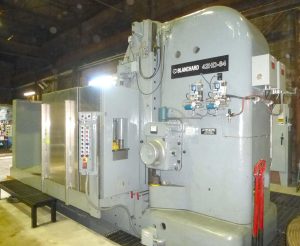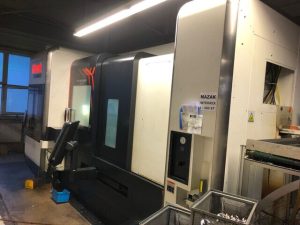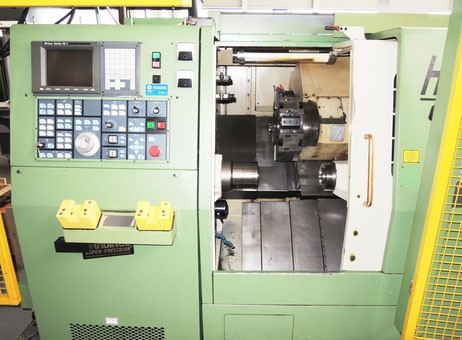
Avoid Costly Mistakes: Professional Tips for Purchasing a Pre-Owned / Surplus / Second-Hand / used HARDINGE CONQUEST T 42 SP made in USA
Buying a used Hardinge Conquest T 42 SP (or a variant of the Conquest T42 with sub-spindle / live-tooling) is a smart move if you’re cautious. These are well-built American CNC turning centers, but over years of use things degrade. Below is a professional, practical checklist—tailored for this model—to help you avoid costly mistakes.
Background / Typical Specs & Key Features (to benchmark against seller claims)
Before you inspect, arm yourself with common specs so you can spot exaggerations or inconsistencies. Some reference specs:
| Parameter | Typical / Published Value |
|---|---|
| Max swing over bed | ~ 21.2 in (≈ 538 mm) |
| Max turning diameter | ~ 9 in (≈ 228.6 mm) |
| Machining length (Z travel) | ~ 13.1 in (≈ 333 mm) |
| X (radial) travel | ~ 5.31 in (≈ 134.6 mm) |
| Spindle bore (bar capacity) | ~ 1.625 in (≈ 41.3 mm) |
| Spindle speed range | ~ 50 – 5,000 rpm (main spindle) |
| Motor / power | ~ 10 hp (≈ 7.5 kW) for main spindle |
| Control | Often GE Fanuc 18T (for this model variant) |
| Turret / live tooling | 12 stations; often 6 with live tooling (depending on variant) |
Use these as your “sanity check” when sellers quote specs. If they promise, say, 10,000 rpm or double the feed rates, question those claims strongly.
Also, get a copy of the machine’s manual (e.g., the Hardinge Conquest 42 operator’s manual for the 18T control exists) to understand control, parameters, and originally intended tolerances.
Inspection / Due Diligence Checklist
Below is a structured checklist you can bring with you (or send to a technician) when evaluating a used Conquest T 42 SP. Go through it step by step.
1. Documentation & History
- Maintenance logs & service history
Request all historical records: lubrication, alignment checks, spindle rebuilds, control repairs, etc. - Usage profile & parts history
What kinds of materials did it run (stainless, cast iron, etc.)? Heavy duty or occasional work? - Hours / cycles / duty
Try to get spindle hours, axis movements, tool changes count. - Modifications, retrofits, and “surprises”
Ask whether any drives, motors, controllers, or electronics were replaced or retrofitted. - Parts, schematics, wiring diagrams, and spares included
Having original drawings and spare boards is a big advantage. - Manufacturer’s original specs / certificate
Confirm serial number and model plate (T 42 SP vs plain T42) to avoid mislabeling.
If the seller cannot or will not produce decent documentation, treat that as a red flag.
2. Visual / Structural Inspection (Before Powering)
Some problems reveal themselves even when cold.
- Frame, castings, base
Look for cracks, welds, distortions or repairs. Check whether the bed is warped or sagged. - Way covers, scrapers, bellows, guards
Damaged or missing protective covers mean that chips or coolant may have infiltrated critical surfaces. - Guideways / ways
Examine for pitting, scoring, rust, or signs of heavy wear. - Ball screws / leadscrews
Check for wear, backlash, binding, or uneven friction when manually moving (if possible). - Spindle nose / taper / contact surfaces
Inspect for nicks, wear, or corrosion. Use a test holder to verify how well it seats. - Coolant and hydraulic systems
Look for sludge, corrosion, leaks, and condition of coolant tanks and piping. - Electrical cabinet & wiring
Inspect insulation, terminal blocks, signs of overheating, or ad-hoc wiring. - Accessory systems
Check tool turret, live tooling drive units, sub-spindle (if present), chucks, collet assemblies, coolant nozzles, chip conveyor, etc.
Take plenty of photos and record locations of wear or damage. They become your evidence.
3. Powered / Functional Testing (Live Machine)
If the machine can be powered and controlled, perform the following:
A. Power-up & Basic Control Behavior
- Watch for abnormal startup currents, phase imbalances, or tripping.
- Observe any initial alarms, error messages, or control faults.
- Let the machine warm up; check whether temperatures stabilize or drift.
- Confirm that all control functions, keys, jogs, overrides, etc., are responsive.
B. Axes Motion Tests
- Move each axis (X, Z) over full travel at slow, medium, fast speeds. Note smoothness, stiction, binding, rough patches.
- Reverse direction, see backlash, hysteresis, overshoot behavior.
- Test accelerations / decelerations to detect lag or overshoot.
- If simultaneous motion (e.g., movements while spindle turning) is possible, test that.
C. Spindle Tests
- Spin spindle(s) across speed range (low to high). Listen for unusual noise (grinding, whine, squeal).
- Let spindle run for an extended period and monitor temperature.
- If possible, test for axial and radial play in the spindle; any measurable looseness is expensive.
- Inspect spindle lubrication (oil or grease), check for metal particles, contamination in coolant.
- Under light load (if safe), test vibration or runout behavior.
D. Turret / Live Tooling / Sub-spindle (if applicable)
- Cycle the turret fully, index it randomly, test response and repeatability.
- Run live tooling (milling/drilling) if installed; test rpm, torque, vibration.
- If there’s a sub-spindle, test transfer, chucking, back and forth motion.
- Test tool change sequencing under load, check for misfeeds or errors.
- Operate clamping systems (hydraulic, pneumatic) and check for stable pressure, leaks, slow response.
E. CNC & Software / Control
- Access alarm logs, diagnostic screens, memory usage, and error histories.
- Load or enter a test program; run a dry (no-cut) test to check motion logic.
- Edit, save, and restore a program to test memory reliability.
- Verify offset tables, macro usage, parameter loading, backup/restore capabilities.
- If the control is original (Fanuc 18T or equivalent), confirm firmware / hardware authenticity.
If any subsystem refuses to function or shows serious deviations, use that in negotiation or walk away.
4. Accuracy, Tolerance & Test Cut Validation
Even if the machine “works,” it must produce parts within your required tolerances.
- Linear positioning / repeatability tests (compare actual vs nominal). Use high-precision measuring equipment (laser interferometer, gauge blocks, etc.).
- Ballbar / circular interpolation tests to detect servo misbehavior or dynamic errors.
- Test cuts / benchmark parts: machine representative parts and measure key dimensions, surface finish, runout, roundness, repeat cycles.
- Thermal drift / warm-up stability: run for a few hours, check whether dimensions drift.
- Dynamic load tests under real cutting conditions (speeds, feeds) to see stability under load.
Establish and enforce acceptance criteria in writing (e.g. “X-axis repeatability must be ≤ ± 0.01 mm over full travel”) prior to purchase.
5. Spare Parts, Serviceability & Obsolescence Risks
This is often where used machines become expensive over time.
- Critical wear / consumable parts
Spindle bearings, collets, seals, belts, guides—all must be available. - Electronics, drives, and control modules
Older controls, boards, or drive modules may be obsolete. Confirm parts’ availability or equivalent substitutes. - Control support & firmware
Ensure the CNC system (Fanuc 18T or variant) is still supported and spare parts exist. - Local serviceability & support
In Türkiye / your region, verify whether there are suppliers, retrofit houses, or service engineers familiar with Hardinge machines. - Documentation & parts catalogue
Having original parts lists, exploded views, wiring diagrams is a huge asset. - Spare / backup modules included in deal
Negotiate for essential spares (bearings, fuses, boards, collets) as part of the purchase.
If a key module is unobtainable, your machine becomes a liability.
6. Installation, Logistics & Hidden Costs
Many buyers underestimate the “other” costs around the machine itself.
- Transport / rigging
Large CNC lathes are heavy and require proper disassembly, crating, crane/rigging at both ends. - Foundation & leveling / anchoring
The floor may need reinforcements, anchor bolts, damped foundation or vibration isolation. - Electrical power / infrastructure
Confirm supply voltage, phase, grounding, cable sizing, power quality, transformers. - Cooling / coolant systems & filtration
You may need to refurbish or replace coolant pumps, piping, filtration, sumps. - Commissioning, alignment & calibration
After installation, you must align axes, calibrate, tune. - Operator training, tooling setup & debugging
Expect time and expense in bringing your operators up to speed. - Downtime & ramp-up period
Allow buffer time for debugging, rework, fine-tuning before full production.
Get realistic quotes for these “soft” but expensive items and include them when comparing against new/other machines.
7. Contractual Protections & Acceptance Terms
Because risk is higher with used machines, your purchase contract should protect you:
- Conditional / provisional acceptance
Don’t finalize full payment until all tests, alignments, and test cuts pass. - Holdback / escrow
Retain part of payment until satisfactory performance is proven. - Acceptance criteria specification
Write in allowable tolerances, test protocols, alignment tolerances, etc. - Warranty / guarantee period
Even for used machines, negotiate a limited warranty on major components (spindle, drives, control). - Spare parts & documentation handover
Ensure delivery of any spare parts, manuals, schematics, and parameter backups. - Liability for hidden defects
Include recourse if critical faults emerge soon after installation. - Right to third-party inspection
Allow your technician or an independent party to inspect and sign off.
8. Major Red Flags / Deal Killers
Watch out for these; encountering more than one is a warning sign:
- Seller refuses full functional tests, motion tests, or test cuts.
- No maintenance or service history; or logs look falsified.
- Long idle period, especially in poor environment (damp, dusty, unprotected).
- Spindle play, vibration, or abnormal noises on test spin.
- Axes binding, rough motion, or excessive backlash.
- Turret mis-indexing, tool change errors, or failed live tooling.
- Obsolete or unavailable parts.
- Control modules are missing or heavily modified.
- Price far lower than comparable machines without clear justification.
- Serial numbers, nameplates, or model plates are missing or defaced.
If you hit multiple red flags, walk away or negotiate heavily.
9. Post-Delivery / First Tasks After Taking Ownership
Once you accept delivery and installation, do the following immediately:
- Thorough cleaning & flushing of coolant, oil lines, filters, sumps.
- Replace consumables / wear parts: seals, filters, belts, fluids, collets if needed.
- Precise leveling, alignment & calibration.
- Baseline performance testing: same ballbar, test cuts, positioning checks.
- Set up compensation / offsets as needed based on test results.
- Preventive maintenance plan: schedule lubrication, inspections, vibration monitoring.
- Stock essential spares: bearings, seals, electronics, collets.
- Operator training & process validation.
- Performance monitoring & logging: alarms, drift, deviations — watch trends.