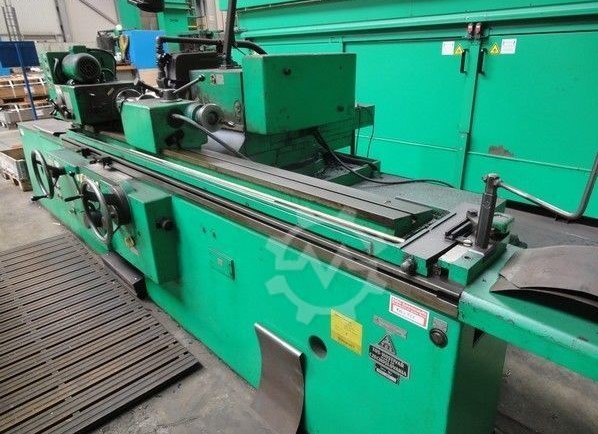
Avoid Costly Mistakes: Professional Tips for Purchasing a Pre-Owned / Second-Hand / used TOS-HOSTIVAR BHU 32/1500 CNC Cylindrical Grinder
When buying a pre-owned / second-hand TOS-Hostivar BHU 32/1500 CNC (or “universal” / cylindrical) grinder, you must be extremely thorough. Cylindrical grinders are precision machines, and small errors or hidden wear can become very expensive to fix—or impossible to repair to acceptable tolerances. Below is a professional checklist and set of tips to help you avoid costly surprises.
I’ll also include known spec ranges / benchmarks for the BHU 32/1500 to help you assess claims.
1. Benchmark & model knowledge (what to expect)
Having the spec “yardstick” helps you spot exaggerations or mis-labels. For the TOS BHU 32/1500:
| Parameter | Typical / published value(s) | Source / notes |
|---|---|---|
| Grinding (swing) diameter | ~ 315 mm | MachineTools spec “Swing 315 mm” |
| Center distance (max work length) | 1,500 mm | As model name indicates; also in machine listings |
| Grinding wheel diameter | ~ 500 mm | As per TOS datasheet for BHU 32-1500 |
| Table / workpiece max weight | ~ 250 kg between centers | TOS spec “max workpiece weight: … 250 kg” |
| Spindle speed | Work-head speeds ~ 12 to 400 rpm | As per used machine listings |
| Grinding spindle speed | ~ 1,230 rpm (on some models) | TOS datasheet gives grinding spindle head speed ~ 1,230 rpm |
| Table feed / traverse | ~ 0.005 to 5 m/min | TOS datasheet: table speeds ~ 0.005 to 5 m/min |
Use these as rough expectations. If a seller claims wildly different numbers (e.g., far higher spindle speed, vastly greater swing, or heavier workpiece), probe carefully: could be mislabeling or a misremembered spec.
Also verify whether the machine is strictly conventional or already upgraded/retro-fitted to CNC or semi-CNC. Many BHU units are originally conventional.
2. Documentation & history
Before inspection, get as much “paperwork” as possible:
- Serial number, build year, and any modification history (e.g. retrofit of CNC controls, or internal/external grinding conversion).
- Original machine manuals: mechanical, electrical, hydraulic, parts lists, wiring diagrams.
- CNC / controller manuals, software backups, parameter files, custom macros (if retrofit).
- Maintenance logs: spindle rebuilds, guideway refurbishing, alignment reports, component replacements.
- Calibration / geometric alignment reports (laser alignment, block tests, etc.).
- Usage logs if available (total hours, cutting vs idle, severity of duty).
- List of tooling, fixtures, steady rests, internal grinding attachments, wheel sets, spare parts.
- Records of any crashes, collisions, power failures or unusual incidents.
If the seller cannot or will not supply these, that’s a major red flag.
3. Mechanical & structural inspection
These items are critical. Wear or misalignment in any of them can degrade achievable precision or require prohibitively expensive rework.
a) Base, bed, columns, structure
- Visually inspect for cracks, weld repairs, repaired castings. Any structural repair must be documented and verified.
- Use long straightedges, precision levels, or light optics to check for twist, sag, bias, or warp in the bed or table mounting surfaces.
- Examine the saddle / table support surfaces for flatness, corrosion, pitting or wear patterns.
- Look for uneven wear (e.g. one side worn more) which may indicate misalignment or past abuse.
b) Guideways / slides / gibs
- Move each axis (X / longitudinal, Z / traverse, etc.) across full travel. Feel for zones of “drag,” stiction, jumps, or roughness.
- Check that the adjusters (gibs, shims, springs) are intact and functional, not overly loose or worn out.
- Inspect for scoring, pitting, corrosion, or contamination on sliding surfaces.
- Where protective covers / scrapers / bellows are present, check for broken or missing parts.
c) Lead screws / feeds / drive mechanisms
- Check backlash in each movement axis by reversing direction under light load and measuring shift with a dial indicator.
- Feel for play in the screws or couplings; if there is intermittent binding or backlash, repair may be needed.
- Check for excessive spindle motor / drive motor coupling misalignment or looseness.
d) Spindle, bearings & nose interface
- Measure spindle radial and axial runout using a precision test bar or mandrel and dial indicator. Even a few microns off can be dangerous in grinding tasks.
- Spin the spindle at various speeds (unloaded) to check for vibration, noise, bearing hum, or instability.
- After a run, measure temperature of the spindle housing—excessive heat or hot spots are red flags.
- Inspect the spindle nose, taper, keyway, locking / drawbar mechanism, and interface surfaces.
- Check whether there is any wobble or looseness in the spindle taper or interface.
e) Wheelhead, grinding head, attachments
- If the grinding head swivels or has oscillation, test that the swivel or indexing is true, smooth, and repeatable.
- Test the traverse of the wheelhead (manual / rapid / feed) for smoothness over full travel.
- Verify that the dresser / dressing devices (if present) are in good condition and precisely adjustable.
- If there is internal grinding equipment (hydrodynamic spindle, internal grinding attachments), check those parts meticulously (bearings, runout, coaxial alignment).
f) Coolant, lubrication, hydraulics & pneumatics
- Inspect coolant system: pumps, piping, filters, tanks, cleanliness, leaks.
- Check lubrication lines, automatic / centralized lubrication systems: ensure that all sliding surfaces are getting lubricant.
- Any hydraulic (or pneumatic) components (clamping, head movement, tailstock, etc.) must be checked for leaks, stable pressure, valve operation, responsiveness.
- Chip removal, guarding, coolant splash covers, chip trays: inspect for condition, cleanliness, wear.
4. Electrical, CNC / control systems, wiring
Often the “hidden killer” in used machines is outdated or damaged electronics.
- Power up the machine gradually (with protection in place) and observe for unusual smoke, smells, tripped breakers, or unstable voltage.
- Open the electrical cabinets (if allowed) and inspect wiring harnesses for brittle insulation, breaks, splices, overheating marks, modification work.
- Check logic panels, relay boards, power modules, servo drives (if applicable), control systems.
- Boot the CNC (if CNC is installed) and test basic functions: jog axes, reference / home, tool offsets, program transfer, display, diagnostics.
- Move axes under control: test acceleration, deceleration, reversals, high and low feeds under control. Look for stuttering, overshoot, vibration.
- Test limit switches, overtravel, emergency stop circuits, safety interlocks, homing routines, and error handling paths.
- Verify all software, parameter backups, custom macros, license dongles or tokens (if any) are supplied and working.
- If the control is too old or proprietary, ensure you can still source replacement boards or modules.
5. Functional / performance testing under realistic load
You must see the machine working in real grinding conditions—not just idling.
- Bring a representative workpiece and grinding wheel, or ask seller to prepare one.
- Run full stroke moves in all axes (with load) and check for stalling, signs of motor overload, irregular motion or chatter.
- Do return-to-zero / repeatability tests: move away and back, measure with a high-precision indicator the deviation.
- Grind test parts: external diameters, internal bores (if internal grinding attachment exists), face grinding, plunge passes, etc.
- Check achieved surface finish, roundness, cylindricity, taper, runout across the piece.
- Monitor thermal drift if the machine is run continuously for a while: see whether dimensional changes occur over time.
- Use the dressing system during grinding to see whether the dressing is precise, stable, and doesn’t introduce excentricity.
- Test coolant supply during grinding and see whether coolant delivery is even, stable, and filtered.
If the seller refuses to run tests or only shows the machine idle, treat it as a red flag.
6. Geometric & alignment checks
Even a well-maintained machine might have skewed geometry over time or after relocation. You must assess whether alignment can still be restored.
- Obtain or perform alignment / calibration reports (laser, test mandrels, gauge blocks).
- Check squareness, straightness, perpendicularity: for example, ensure the work spindle axis is orthogonal to sliding table axes, check table travel alignment.
- Verify whether the wheelhead axis is aligned and doesn’t introduce runout or angular error.
- Check whether control (if CNC) allows compensation tables or error mapping to correct minor geometric deviations.
- If there is a swivel table or head indexing, check repeatability and accuracy of those movements.
If the geometry is too far out of spec and cannot be fixed, the machine may not reach your required tolerances.
7. Spare parts, consumables & support
One of the biggest risks with buying used machines is the inability to maintain them in the future.
- Verify whether critical spares are still available: bearings, spindles, motor / drive modules, electrical boards, control components, dressing device parts.
- Ask whether TOS-Hostivar (or successors) or 3rd-party suppliers still support the BHU 32/1500 or compatible parts.
- Check whether reconditioned parts or aftermarket equivalents exist.
- Ensure that consumables (wheel flanges, wheels, dressing tools, coolant filters, seals) are commercially available.
- If CNC retrofit is in the future, assess whether the machine structure, axes, drives are compatible with modern control systems.
- Check local/regional service support: are there machine tool rebuilders, grinding specialists, control technicians near your location?
If parts or support are extremely hard to get, even a “cheap” machine can become a liability.
8. Negotiation, contract & acceptance criteria
Use all findings to protect yourself and negotiate smartly.
- Insist on conditional acceptance: final payment only after the machine passes a formally agreed acceptance test (you define).
- Define quantitative acceptance specifications: allowable spindle runout, repeatability error, positional accuracy, surface finish, error tolerances.
- Demand a short warranty / guarantee period (perhaps 30–90 days) for major subsystems (spindle, control, drives).
- Require delivery of all promised documentation, software backups, drawings, and parts lists.
- Clarify who pays for transport, rigging, leveling, re-grouting, site modifications, and final alignment.
- Insert a “burn-in / commissioning period” clause, so that defects discovered during initial production use must be remedied by the seller.
- Get written disclosure of any known defects, repairs, or limitations (especially structural or spindle) from the seller.
9. Transportation, installation & commissioning
Even a perfect machine can be damaged or misaligned in transit or installation, so plan meticulously.
- Confirm accurate weight, dimensions, center-of-gravity, and lifting points.
- Use proper rigging, shipping supports, and protection to avoid stress or distortion during move.
- After installation, re-level, re-anchor, or re-grout the base properly.
- Provide time for burn-in / commissioning under load, with final acceptance tests only after the machine has stabilized.
- Re-check alignment, geometric tests, and performance after installation, not only before shipment.
10. Red flags & deal-breakers
Be ready to walk away (or demand major concessions) if you encounter:
- Seller refuses or restricts your inspection, disallows test under load, or hides the spindle / internal components.
- Evidence of structural repairs or welding in the bed, column, or base with no credible record.
- Spindle with noise, vibration, excessive runout, or no documentation of rebuild.
- Excessive backlash or axis play that cannot be compensated in software/control.
- Control or electronics that are obsolete, proprietary, or not serviceable with no spares.
- Cable harnesses, wiring, connectors in poor condition (cracked insulation, many splices, overheating marks).
- Missing or incomplete documentation (manuals, wiring diagrams, software backups, parts lists).
- No means to get spare parts or support in your region.
- Wear in key components so heavy that repair / reconditioning cost approaches buying a better machine.
- Hidden damage (flooding, coolant corrosion, collisions, neglected maintenance) that is not disclosed.