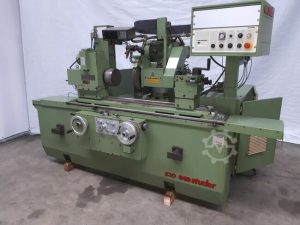
Avoid Costly Mistakes: Professional Tips for Purchasing a Pre-Owned / Second-Hand / used STAR Micronis SR-20 JII type B CNC Swiss Sliding Head Lathe
Here’s a professional, deep-dive “due diligence” guide for buying a used STAR Micronis SR-20 JII Type B sliding-head (Swiss style) lathe. Because Swiss / sliding head machines are highly engineered and have many critical subsystems, even small wear or defects can lead to very expensive repairs. Use this as a checklist and negotiation tool.
I’ll break it down into:
- Key specs & design features to know in advance
- Documentation & history you must demand
- Visual / structural inspection before power up
- Motion / mechanical / axis tests
- Spindle, tooling, and sliding-head / guide systems tests
- Control / electronics / software checks
- Test machining & precision verification
- Hidden cost traps and wear items
- Deal structuring & negotiation safeguards
- Major red flags and when to walk away
If you like, I can compile this into a printable inspection checklist you can bring on site.
1. Key Specs & Design Features You Should Know
Before you even visit the seller, you should understand what a healthy SR-20 JII Type B is expected to deliver. These specs let you spot overstatements or hype.
From published datasheets:
- It’s a Type B variant: includes a Y2 axis for back-machining (counter-operational machining) on the back side.
- Total number of axes (Type B) = 8 axes (front & back)
- Control is typically FANUC 31i-B on many builds.
- Bar capacity / turning diameter: ~ Ø 20 mm (option for Ø 23 mm)
- Headstock stroke (sliding head mode) ~ 205 mm, fixed headstock mode ~ 50 mm
- Spindle speed: up to 10,000 rpm (main & sub) in many configurations
- Main spindle drive power: commonly 2.2 kW (standard) up to 3.7 kW for upgraded models
- Back (counter / sub) spindle: similar speed (10,000 rpm), drive power ~2.2–3.0 kW for sub spindle in many setups
- Tooling arrangement: the gang tool post on the front, plus multiple front & back working tools (drilling, cross working) with driven tooling.
- Rapid feed rates across non-C axes: ~ 35 m/min
- Coolant tank: ~170 liters (for many builds)
- Dimensions / weight: typical footprint ~ 2,250 × 1,200 × 1,700 mm; weight ~ 2,200–2,750 kg (depending on configuration)
Knowing these helps you immediately challenge any claim like “spindle 20,000 rpm” or “bar capacity 32 mm” unless it’s been heavily modified.
2. Documentation & Provenance You Must Demand
No matter how good a machine looks, without proper documentation you’re taking a big gamble.
Ask the seller for:
- Original manuals (mechanical, electrical), parts lists, wiring / hydraulic / pneumatic schematics
- Control / parameter backups, tool libraries, macro programs
- Maintenance logs (bearing replacements, spindle rebuilds, linear slide refurbishments, alignment work)
- Repair invoices and parts replaced (especially spindles, guide bush systems, Y2 axis components)
- Usage history: hours, cycles, whether running 2 or 3 shifts, material hardness profiles
- Information on any modifications or upgrades (e.g. higher power spindle, retrofitted Y2, extra tooling, updated electronics)
- What is included: all tooling, collets, guide bush sleeves, steady supports, spare parts, coolant units
- Test or inspection reports (if the machine was aligned or refurbished recently)
- Proof of compatibility / availability of spare parts (some models or custom parts may be discontinued)
If the seller can’t produce significant evidence of regular care and service, you should lower your valuation or reconsider.
3. Visual / Structural Inspection (Before Powering Up)
Before touching anything, do a careful visual scan. Many issues are visible before power is involved.
- Frame, bed, columns, slide rails: inspect for cracks, weld repairs, distortions. Swiss lathes must remain rigid.
- Guide bush and sliding head structure: check the sliding head mechanisms (ways, dovetails) for wear, scoring, pitting.
- Covers, seals, bellows, way covers: if these are missing, torn, or misaligned, chips / coolant can erode internal surfaces.
- Spindle nose, headstock faces, chucks / collet area: look for rust, burrs, damage.
- Tool turret / gang post faces: examine tool mounting surfaces for wear or misalignment.
- Back/Counter side (Y2, back tool station, sub spindle housing): check for staining, leaks, coolant paths, possible damage.
- Electrical cabinets, wiring ducts, cable trays: open them and look for signs of moisture, corrosion, burn marks, aging wiring insulation.
- Coolant tank, pump, plumbing, filtration housings: check for leaks, rust, clogging or corrosion.
- Overall cleanliness and care: a well-kept machine often indicates better internal condition.
4. Mechanical / Motion Test (With Power, No Load)
If the seller allows powering the unit, you must test how it behaves in motion before running any cutting.
- Boot the control and check for startup errors, missing modules, alarms in diagnostics.
- Jog all axes (X1, Y1, Z1, X2, Y2, Z2, C axes) through full travel, both directions, at moderate speed. Feel for any binding, stiff zones, jerkiness, or sudden changes in resistance.
- Reverse direction mid-stroke to sense backlash / play. Use a dial indicator or test indicator to quantify backlash on each linear axis.
- Listen during motion for scraping, rubbing, metallic contact, grinding noises.
- Test motion transitions (e.g. from rapid to feed) to detect lag or control stutters.
- If there are gear changes or mode switching (sliding head ↔ fixed headstock), test switching modes if possible.
- Monitor the noise level of servo drives, coupling, and motion during motion.
5. Spindle, Tooling & Sliding-Head / Guide Systems Tests
Because the sliding head, guide bush, spindle & tool systems are central to Swiss machining accuracy, you must test carefully.
Spindle & Collet / Chuck
- Run the main spindle (no load) at multiple speeds (low, medium, high). Listen for bearing hum, vibration, irregular rotation.
- Mount a test bar or mandrel; measure radial and axial runout throughout a full rotation. Repeat this at various positions along the stroke (since spindle lubrication behavior may vary along the slide).
- Inspect the spindle taper / collet interface for scoring, burrs, or damage.
- If the machine has a sub spindle or counter spindle, test that likewise.
Sliding Head, Guide Bush, Travel / Stroke
- Test the sliding head stroke (205 mm sliding mode typical) with and without load (or light load): it should move smoothly, without “stiction” or sudden speed change.
- Check for play or looseness in the sliding head’s guide surfaces. Any detectable play in a Swiss sliding guide is dangerous for micron-level work.
- If the machine can convert to fixed head mode (50 mm mode in some SR-20 builds) test that mode if possible.
- Check the guide bush mechanism: its clamps, jaws, wear surfaces, escape of bypass leaked coolant.
- Test tool changes on front station (gang tool, drilling, cross tooling) and back side (Y2, back tool stations) cycling through all available tools.
Tooling Stations & Turrets
- Cycle each tooling station: tool pick up, tool drop, indexing, repeatability.
- Check driven tools (milling / drilling) for smooth, vibration-free spin (idle).
- Inspect the mounting surfaces of tool holders for wear or misalignment.
- If there are cross working or deep drilling attachments, test those (no load) and feel for vibration or noise.
6. Control / Electronics / Software / Diagnostics Checks
Even if mechanics are good, old or corrupted electronics can kill usability.
- Examine the control cabinet internals: look for burnt circuit boards, capacitor bulging, discolored wiring, corrosion.
- Power up the CNC / control. Look at the fault / alarm log, check for historical errors or recurring problems.
- Verify all switches, joysticks, override knobs, emergency stops, panel buttons, displays are functional.
- Inspect servo drives, power modules, feedback encoders and connectors.
- Test communication with the CNC (load / store parameters, tool library, backup / restore).
- If possible, check software version, patch status, license & support availability.
- Cycle the machine idle for some time (without cutting) and verify no overheating, fan issues, or drive errors.
7. Test Machining & Accuracy Verification
This is the ultimate proof: can it still machine parts within your tolerance?
- Mount a known precision reference bar / ground test workpiece. Use indicators along its length to check runout, straightness, taper.
- Retract and return to the same point and re-measure: that tells you repeatability.
- Make a light finishing pass on a test bar / typical job material. Measure diameter, straightness, roundness at multiple points along length.
- Perform a full cycle (front + back machining) if the machine supports that, and verify alignment / registration between front and back operations.
- Test at extremes of the sliding head stroke and check for drift or dimensional error variation.
- Warm up the machine (run for 20–30 minutes) and repeat measurements to check for thermal drift.
- Check surface finish quality under light cuts to ensure vibration, chatter, etc. are within acceptable levels.
8. Hidden Cost Traps & Wear Items You Need to Budget For
Even “good” machines often need refurbishment. Here are the most common and expensive failure items:
- Spindle bearing replacement or rebuild (main / sub spindles)
- Sliding head guide wear: re-scraping / refurbishment of guide surfaces
- Wear or play in guide bush / clamping jaws
- Worn tooling mounting surfaces / tool holders
- Servomotor / drive replacement or repair, especially older electronics
- Replacing or reworking the Y2 axis mechanisms (Type B adds complexity)
- Refurbishing the cooling / filtration / plumbing systems
- Electrical cabling, connectors, harness replacements
- Retrofit or replacement of obsolete control modules / PCB boards
- Calibration, alignment, test cuts after installation
- Transport, rigging, leveling, foundation work
- Spare parts procurement (some specialized components may be hard to find)
Plan to reserve a “refurbishment buffer” (often 10-20 % of machine cost) for unforeseen expenses.
9. Deal Structuring & Negotiation Safeguards
Use your inspection findings to structure protections in the purchase.
- Insist on an “acceptance test period”: you must be able to run all axes, test cuts, alignment before full payment
- Withhold a portion of payment until the machine passes your acceptance criteria
- Require the seller to provide all documentation (manuals, backups, schematics, parts lists)
- Ask the seller to sign a condition disclosure: list known defects, wear, or prior repairs
- If possible, negotiate a short-term warranty (30–90 days) on critical systems (spindles, drives)
- Clarify responsibility for transport, installation, leveling, calibration
- Request inclusion of tooling, collets, guide bush sleeves, spare parts, etc.
- If the seller is able, ask them to assist (or pay for) final alignment / test machining at your site
10. Red Flags / Walk-Away Criteria
Some defects or warning signs are too serious or risk-laden to accept. If you see any of these, you should be very cautious or walk away:
- Seller refuses full inspection / motion testing / tool cycles
- Excessive backlash, binding, or nonuniform motion in any axis
- Spindle hum, vibration, or unacceptable runout
- Sliding head guide play or detectible looseness
- Tooling station misindexing, dropped tools, or poor repeatability
- Control faults, missing modules, corrupted parameter files
- Electrical panels showing burn marks, water damage, corrosion
- Major components missing (servo modules, drives, Y2 axis parts)
- Retrofits done badly (poor machining, sloppy alignments)
- Spare parts or replacement modules are unavailable or extremely scarce