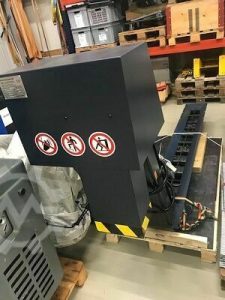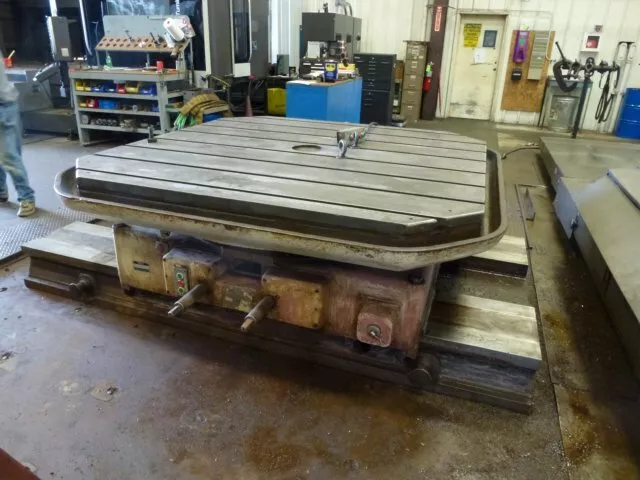
Avoid Costly Mistakes: Professional Tips for Purchasing a Pre-Owned / Second-Hand / used SKODA E20 Powered Rotary Table
Here’s a guide—tailored to powered rotary tables used on boring machines (such as a Skoda E20 model or equivalent)—to help you avoid expensive mistakes when buying a used unit. Even though “rotary table” seems simpler than a full CNC, there are many hidden wear issues and integration pitfalls. Use this as a checklist when inspecting or negotiating.
Key Background / Reference Data
Before you step on site, know what “normal” looks like for a Skoda E20 (or similar heavy-duty rotary table) so you can call out exaggerations. Some known data points:
- One listing shows a Skoda E20 powered rotary table 80″ × 80″ with 44,000 lb (≈ 20 metric ton) capacity.
- Another listing for Skoda E20 shows table dimensions 2000 × 2000 mm with 20 ton load capacity.
- A used listing shows Skoda E20 has table weight ~ 9,350 kg for a 2000×2000 mm table.
- The “E20” name is used for heavy duty rectangular / powered rotary tables with large capacity.
Thus, if someone offers a “Skoda E20” that claims a 100 ton load, or extremely fast indexing, you should demand proof and test carefully.
What to Inspect / Test On-Site
1. Documentation & History (First Gate)
- Maintenance / repair logs: when bearings, drive gears, clamping surfaces were serviced
- Overhaul or refurbishment records
- Electrical / motor / gearbox schematics
- Control / indexing system backups, software / parameter files
- Past usage: how often used, loads carried, shift schedule
- What comes with sale: power cables, control modules, spare motors/gears, mounting hardware
If the seller cannot provide credible history, you should discount heavily.
2. Visual / Structural Inspection (Before Powering Up)
- Check the table top / indexing surface for wear, scoring, pitting, or misalignment.
- Inspect clamping / locking surfaces (if hydraulic or mechanical clamps) for wear or damage.
- Check the drive motor / gearbox housing for oil leaks, seal damage, cracked housings.
- Inspect the brushes / slip rings / electrical connections (if applicable) for corrosion or wear.
- Open the motor / gearbox housing (if allowed) and look for internal wear, chipped gears, metal chips.
- Check the mounting surfaces / base frame for misalignment, cracks, distortions.
- Inspect the support structure, bearings, raceways, cross-members for signs of stress or fatigue.
- Examine cables, connectors, and wiring for damage, insulation wear, corrosion.
3. Power-Up & Basic Motion / Rotation Tests
If allowed, power up and test motion (no heavy load):
- Test indexing or continuous rotation: rotate the table (360° or incremental) and watch motion smoothness
- Reverse direction multiple times; measure backlash in the drive (e.g. via dial indicator)
- Listen for noise: gear whine, metallic scraping, irregular pitch changes
- Run at different speeds (if multiple speed settings exist) and check for consistency
- Observe drive motor behavior: current draw, temperature, vibration
- Engage / disengage the clamping or locking mechanism (if present) and verify full engagement / release
- Test stop accuracy: command stop at known positions, see if the table returns to exact stop location
4. Load & Stability Test (If Possible / Safe)
Under light load (if seller allows a test load):
- Mount a representative workpiece or dummy load; rotate or index under load and check for deflection, vibration, drift
- Check radial runout of workpiece after indexing under load
- Test if clamping holds the position firmly under torque
- Run extended or repetitive cycles to test thermal stability or drift
5. Accuracy & Test Measurements
- Use a fixed indicator (dial test indicator) on a mounted bar to check radial and axial runout over full rotation
- Index back to the same position multiple times; measure the deviation (repeatability test)
- At various rotation angles, measure runout to detect ellipticity or gear wear
- For inclined or tilted mounted work, check tilt / flatness over the table surface
- Warm the table (run for some time) and re-check to see if drift occurs
6. Gearbox, Motor, & Electrical System Checks
- Inspect the gearbox: gear teeth condition, backlash between gear stages, oil level / quality
- Check motor: bearings (listen / feel), shielding, connection integrity
- If using slip rings or brushes for feedthroughs, inspect for wear, continuity, signals
- Test limit switches, sensors, encoders, position feedback devices
- Check the condition of cabling (flex, insulation, connectors) from motor to control system
Hidden Costs / Common Failure Modes to Budget For
- Worn bearings or bearing replacement in the table or gearbox
- Gear tooth wear / gear replacement or re-grinding
- Re-scraping or lapping of table surfaces
- Motor / drive replacements or rewind
- Control / encoder or feedback module failures
- Clamping system overhaul (hydraulic seals, pistons, mechanical latches)
- Electrical wiring replacement, connectors refurbishment
- Foundation alignment or correcting mounting distortions
- Calibration, alignment, precision testing after installation
- Spare parts scarcity for Skoda or niche rotary table components
Budget a refurbishment reserve (e.g. 10–20% or more) to cover surprises.
Negotiation & Contract Safeguards
- Require a testing / acceptance period where you can run index / rotation tests, measurement checks before final payment
- Hold back part of payment until acceptance criteria (runout, backlash, repeatability) are met
- Demand delivery of all documentation: drawings, control / motor wiring, gear specs
- Secure a condition disclosure from the seller listing known defects, wear, prior repairs
- If possible, negotiate a short warranty on the drive system, clamping mechanism, motor
- Clarify responsibilities for transport, mounting, alignment, leveling
- Include any spare gears, motors, clamping parts if available
Red Flags / Walk-Away Conditions
- Seller refuses rotational / indexing tests
- Excessive backlash, jerky motion, irregular gear sounds
- Clamping mechanism fails to lock firmly, slips under torque
- Motor or gearbox leaks, or signs of heavy oil / metal particle contamination
- Gear teeth visibly damaged, chipped, worn
- Control / encoder feedback missing or erratic
- Table surface severely worn, distorted, or warped
- Structural cracks, mounting distortions
- Worn bearing noise, excessive vibration
- Critical parts or modules no longer available from OEM