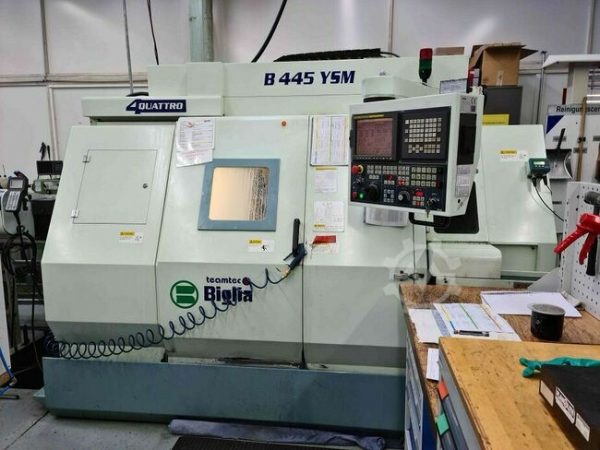
Avoid Costly Mistakes: Professional Tips for Purchasing a Pre-Owned / Second-Hand / used BIGLIA B 445 YSM CNC Turning Center Sub-spindle Y+C Axis
Here’s a detailed, professional guide and checklist for buying a used Biglia B 445 YSM (or similar B 445 Y + sub-spindle / C-axis / YSM variant) CNC turning center with Y + C axes. These machines are complex and expensive to refurbish if things go wrong, so the inspection must be rigorous.
I. Reference Specs & “Reasonable Envelope”
II. Documentation & Provenance Requirements
III. Visual / Structural Checks Before Powering
IV. Motion / Mechanical Testing (No Load)
V. Spindle / Turret / Tooling Subsystem Tests
VI. Precision / Test Machining & Accuracy Validation
VII. Electronics, Control & Software Inspection
VIII. Known Wear Areas & Hidden Cost Risks
IX. Deal Structuring & Safeguards
X. Red Flags & Walk-Away Conditions
I. Reference Specs & “Reasonable Envelope”
Before arriving, arm yourself with what a “normal” Biglia B 445 YSM might offer, so extravagant claims can be challenged. For example, from used listings:
- Machine type: Biglia B445 YSM, double turret, sub-spindle, with Y axis on the upper turret, live tools, C-axis options.
- Dimensions / weight: ~ 4,150 mm long × 2,100 mm wide × 2,200 mm high; weight ~ 6,800 kg (without bar feeder)
- Control: Fanuc 18i-TB cited on some used units.
- Main spindle: 15 kW, 5,000 rpm, bar capacity Ø 45 mm (45 mm bar passage), working diameter turn ~ 240 mm, turning length ~ 250 mm (for that particular unit)
- Y-axis travel (upper turret): ± 50 mm (i.e. 100 mm total) cited in a used listing
- Turrets & live tools: Two turrets, up to 12 live tool stations per turret on some models; lower and upper turrets’ X / Z travels listed in used spec (upper turret X ~ 160 mm, Z ~ 390 mm)
Use these as your baseline. Any claim substantially above these (e.g. “spindle 10,000 rpm,” “Y-axis ± 100 mm,” “turning length 600 mm”) should come with proof and be tested.
II. Documentation & Provenance Requirements
Even a visually perfect machine can be disaster behind the scenes if history is unknown. Before serious negotiation, insist on:
- Service / maintenance logs — when bearings, turrets, guides were serviced, replaced, overhauled
- Modification / retrofit history — especially any Y-axis, C-axis, turret or spindle upgrades
- Electical / wiring schematics, pneumatic / hydraulic diagrams
- CNC control backups / parameter files / tool libraries / custom macros
- Usage history — hours powered, hours cutting, shifts used, types of workpieces processed
- Included accessories / tooling — turret tools, live tool holders, subspindle collets, steady rests, part catchers
- Calibration / alignment / verification certificates (if any)
- Spare parts availability — whether Biglia or third-party still supports critical modules
If the seller can’t supply credible documentation, the risk and discount required go way up.
III. Visual / Structural Checks Before Power
Walk around the machine carefully, before switching anything on. These checks often reveal protection, wear, or structural issues.
- Castings / frame & bed: look for cracks, repairs, distortions, signs of shifting or misanchoring
- Guideways / slides: check for scoring, rust, pitting, surface wear on linear rails or box ways
- Covers, bellows, wipers, shields: missing, torn, misaligned covers are red flags (chip / coolant ingress risk)
- Turret / tool faceplates: inspect for wear, dings, alignment damage
- Y-axis slide components: rails, bearing surfaces, slide block — check for wear or binding
- Spindle housings & turret / tool holders: look for oil leaks, stains, evidence of past repairs
- Electrical / control enclosures: open if permitted — look for corrosion, water stains, burnt traces, dust accumulation
- Piping / coolant plumbing / lubrication lines: leaks, rust, degraded hoses
- Foundation & anchoring: signs that machine has been moved, re-anchored, or foundation cracked
A sloppy external appearance often (but not always) correlates with internal damage or wear.
IV. Motion / Mechanical Testing (Without Cutting)
If the seller allows powering, conduct motion tests to reveal mechanical issues before actual machining.
- Control Boot / Diagnostics
- Power up CNC: watch for fault codes, missing Module errors, alarm logs
- Test all operator controls, jog keys, emergency stop functions
- Linear Axes (Upper turret X, Z, Y; Lower turret X, Z)
- Jog each axis across full travel (slowly, then moderate speed)
- Feel for unevenness, binding, stiffness or sudden resistance changes
- Reverse direction mid-travel; measure backlash / play with a dial indicator
- Test simultaneous movements (X + Z) to detect coupling or interference
- Y-Axis Behavior
- Move Y axis through full ± travel; check for binding, variable resistance
- Reverse motion; measure backlash or play
- Rotary / Turret / Tool Indexing
- Index turret(s) through all tool positions multiple times
- Check for hesitation, mis-indexing, drift, repeated indexing error
- If the turret includes C-axis / live tool rotation, test that for smoothness
- Speed / Mode Changes
- Switch between rapid, feed, and different speed modes (if applicable)
- Observe transitions; any “jerk” or lag is suspect
- Auxiliary Systems
- Turn on coolant pumps, lubrication / oil systems, chip conveyors — check for leaks, noise, smooth flow
- Run hydraulic / pneumatic subsystems (tool clamps, turret lock) to verify proper behavior
If any axis feels coarse, sticky, or irregular, that signals components may need refurbishment.
V. Spindle, Tool Systems & Drive Tests
These are among the most expensive subsystems; test them carefully.
- Run the main spindle (and the subspindle) at various speeds under no load; listen for bearing hum, vibration, instability
- Mount a test bar / mandrel and measure radial & axial runout over 360°
- Inspect spindle nose / taper surfaces for wear, burrs, damage
- Cycle tool changes / turret indexing repeatedly, checking repeatability, locking, tool seating
- If machine has live tooling / driven tools, spin them idle (no cutting) to verify vibration, runout
- Where possible, perform a very light cut (e.g. mill, drill) to test spindle under light load
If spindle or tooling systems are problematic, repair or replacement is very expensive.
VI. Precision / Test Machining & Accuracy Verification
This is where the machine proves whether it still performs.
- Mount a reference bar or precision workpiece; measure straightness, taper, runout at multiple points
- Retract and return to same point; measure deviation (repeatability)
- Perform a light finishing cut under actual part/ material; measure final part geometry (diameter, flatness, surface finish)
- Test at multiple positions (center, ends) to see if error drifts near travel limits
- Warm up the machine (run for 20–30 min) and re-measure to detect thermal drift
- If your work will use complex cycles (Y + C driven tool moves etc.), test such complex motions
If the machine cannot maintain tolerances, you face costly alignment, scraping or rebuild.
VII. Electronics, Control & Software Inspection
A good mechanical machine is worthless without reliable control.
- Inspect the CNC control cabinet: boards, wiring, connectors for corrosion, burn marks, dust accumulations
- Boot into diagnostics: check error logs, missing modules, parameter integrity
- Test handwheels, overrides, encoders, panel switches
- Backup / load parameter files, tool libraries, programs
- Run idle cycles; monitor drives for overheating, faults
- Ask about software version, upgrade path, OEM module support
VIII. Known Wear Areas & Hidden Cost Risks
Even “good” machines commonly hide expensive refurbishment items.
- Worn linear guides, rails, slide surfaces
- Ball screws / nuts wear or backlash
- Turret indexing gear / clutch wear
- Y-axis slide wear or probables requiring rework
- Spindle bearing wear / spindle rebuilds
- Drive electronics / servo amplifier failures
- Cable harness aging, connector damage
- Lubrication / coolant system pumps, seals, filters needing replacement
- Re-alignment, calibration, precision testing after relocation
- Difficulty sourcing spare modules for Biglia or variant drives
Always budget a refurbishment reserve—10–20% (or more) of the purchase price.
IX. Deal Structuring & Risk Mitigation
Use your inspection findings as leverage in the purchase agreement.
- Require an acceptance / testing period to run all axes, spindle, test cuts, precision checks before full payment
- Hold back part of payment until the machine meets agreed tolerances / performance
- Require the seller to deliver all documentation, backups, schematics
- Get a written condition disclosure listing known wear or defects
- Negotiate a short warranty (30-90 days) on critical systems (spindle, drives, turret) if seller agrees
- Clarify who does transport, rigging, alignment, calibration after move
- Request inclusion of tooling, fixtures, spare parts
- If possible, request the seller’s assistance or warranty for startup / alignment
X. Red Flags & Walk-Away Criteria
If you see multiple of the following signs, you should seriously reconsider (or demand steep discount).
- Seller refuses full access, limits motion tests, or denies test cuts
- Excessive backlash, jerky or inconsistent motion in any axis
- Spindle noise, vibration, or high runout on test bar
- Turret misindexing, hesitation, dropped tools
- Y-axis binding, poor motion, sag or excessive play
- Burned or corroded electronics, missing modules
- Cracked castings, structural repairs, misalignment evidence
- Missing or damaged covers (chip ingress risk)
- Spare parts or modules for Biglia / variant drives are no longer available