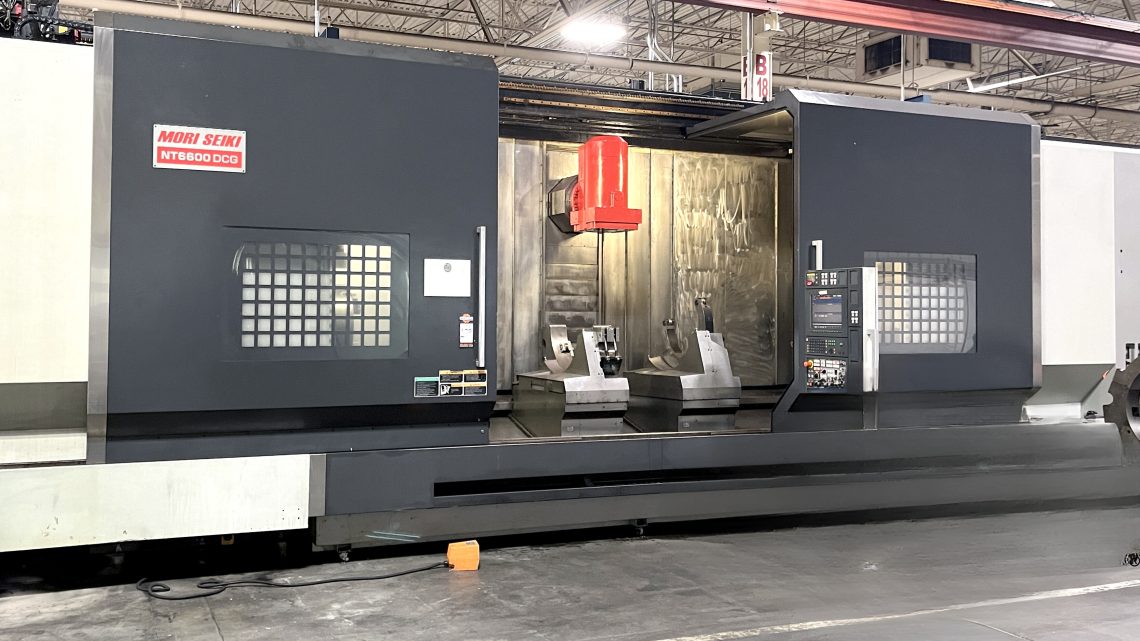
Avoid Costly Mistakes: Professional Tips for Purchasing a Pre-Owned / Second-Hand / used Mori Seiki NT6600DCG/4000CS CNC Multi-Tasking Turn-Mill Center
Here’s a professional, high-risk / high-reward checklist you should follow when inspecting a used Mori Seiki NT6600DCG / NT6600CS / NT6600 (mill-turn / multi-tasking) machine. Because these machines combine turning, milling, multiple axes, live tooling, B/C axes, Y-axis offsets, steady rests, etc., there are many subsystems that can fail or be worn. The more careful you are now, the less likelihood of massive repair bills later.
Below is a structured guide (with reference specs, what to test, red flags, and negotiation tips).
I. Reference Specs / What “Normal” Should Be for NT6600 DCG / CS
First, know what a healthy machine should deliver. Use these as guard rails during your inspection. (These are from Mori Seiki / DMG MORI published specs and used listings.)
Key published data:
- The NT6600 DCG is an integrated mill-turn center: combining turning + milling capabilities.
- Maximum turning diameter: Ø 1,070 mm (42.1 in)
- Maximum turning length options: up to 6,076 mm (for the long-version)
- Y-axis travel: 660 mm (which is among the largest in its class)
- Rapid traverse rates: X ~ 40 m/min, Y ~ 30 m/min, Z ~ 32 m/min (published)
- Turning loads: B-type 3,500 kg, C-type 7,000 kg (depending on variant)
- Machine options often include: steady rest(s), long boring bar, dual turret, C/B axes, thru-spindle coolant, live milling / live tooling
- Some used listings show: main spindle speed ~1,000–1,500 rpm, milling spindle up to 8,000 rpm, multiple turrets / live tooling, B/C axes, chip conveyor, thru-spindle coolant
These specs help you call BS if the seller claims “spindle 6,000 rpm turning” (unless specially upgraded), claims huge Y travel beyond 660 mm, or claims unrealistic load capacities.
II. Documentation & Provenance: Your First Gate
Even a beautiful machine is a gamble without history. Before you even schedule heavy tests, demand:
- Full service / maintenance records (bearing changes, spindle rebuilds, linear axes overhaul)
- Modification / retrofit history: e.g. controller upgrade, live tooling addition, B/C axis retrofitting
- Electrical / wiring / hydraulic / pneumatic schematics
- CNC / parameter backups, tool library files, program archives
- Usage details: hours powered, hours in cutting, shift patterns, type of parts made
- What’s included in the sale: tools, fixtures, steady rests, long bars, chucks, parts, Kanban of spare modules
- Calibration / alignment / test reports, especially recent tests
- Spare parts / module availability: check whether OEM modules, servo amplifiers, encoder boards are still supported
If the seller can’t deliver many of these, be ready to walk or negotiate heavily downward.
III. Visual & Structural Inspection (Before Power)
Walk around the machine before powering up. Use your eyes, feel, and simple tools.
- Casting / frame: Look for cracks, repairs (welds, patched metal), distortions, signs of uneven support
- Guideways, linear rails, box ways: Check for pitting, scoring, rust, worn zones
- Covers, bellows, shields, wipers: Missing or torn covers mean chips / coolant ingress into internal axes
- Turrets, tool interfaces: check for wear, damage, misalignment on turret faces or tool mount surfaces
- Y-axis slide: inspect for uneven wear, damage, binding or misalignment
- Spindle housings / headstocks: stains, leakage trails, worn seals
- Electrical panels: open if allowed; check for corrosion, dust, burnt boards or traces
- Cooling / coolant piping / filtration / plumbing: leaks, corroded lines, degraded seals
- Foundation / installation evidence: look for signs that base has moved, been re-anchored, or floor cracks
If the machine looks neglected, the internal axes likely suffer too.
IV. Motion / Mechanical Tests (No Cutting)
Once the seller allows powering the machine, test each axis and subsystem before attempting actual machining.
1. Control / Boot & Diagnostics
- Power up the CNC: watch for errors, missing modules, alarms, diagnostics
- Test all operator controls, handwheel jogs, emergency stops, panel overrides
2. Axis Motion Tests
- Jog X, Y, Z axes through full travel at low and medium speeds. Feel for smoothness, binding, variations in resistance.
- Reverse direction mid-travel and measure backlash / play using a dial indicator.
- Move combinations (e.g. simultaneous X + Y) to detect binding or chatter crossing axes.
- If there are multiple traverse rates or rapid modes, switch them and observe transitions.
3. Y-Axis (if present)
- Move Y axis full stroke; look for binding, zones of stickiness, inconsistent resistance
- Reverse direction, measure for play
4. Turret / Tool Change / Rotary Axes
- Index turret(s) through every station multiple times; check for hesitation, mis-indexing, backlash
- If B or C axes exist, rotate through full range, including reversal tests, checking for backlash or jitter
- Test synchronized moves (e.g. milling + turn) under no load, if possible
5. Auxiliary Systems
- Activate coolant pumps, lubrication, filtration systems; check for leaks, smooth flow
- Run chip conveyor, test chutes, check for clogging or vibration
- Run hydraulic / pneumatic systems (tool clamp, axis locks) and check smoothness
If axes feel rough, sticky, or noisy, these are early warning signs requiring repair.
V. Spindle, Tooling & Drive System Tests
These represent among the highest cost risks in such a complex machine.
- Run the main spindle (and sub spindle if present) through speed range (under no load). Listen for bearing hum, vibration, erratic behavior.
- Mount a test bar / mandrel, measure radial and axial runout while rotating through 360°
- Inspect spindle nose, taper surfaces, chuck mounting surfaces for burrs, damage
- Cycle tool changes / turret indexing; check tool seatedness, repeatability, clutching
- If live tooling / milling spindle is part of the machine, spin it idle (no cutting) to test vibration, runout
- Under light milling (if the seller allows), run light cuts to judge spindle stiffness
If spindle or tooling systems underperform, the overhaul cost is high.
VI. Precision / Test Machining Validation
This is your “mileage test” — can the machine still produce accurate work?
- Mount a known precision bar or workpiece; measure straightness, taper, runout across length
- Retract / return to same position and re-measure (repeatability test)
- Make light finishing cuts on sample material, measure resulting part (diameter, flatness, surface finish)
- Test near the extremes of each axis (begin, mid, end) to see whether errors increase near travel limits
- Warm the machine (run it for 20–30 minutes), then re-measure to check for thermal drift
- If multi-axis moves (e.g. simultaneous milling + turning, B / C interpolation) are requested in your work, test such complex moves
If the machine cannot maintain tolerances across its travel, major alignment or re-scraping may be needed.
VII. Electronics, Control & Software Audit
Even if mechanics are perfect, dying electronics kill usability.
- Inspect control cabinet: circuit boards, capacitors, wiring for burn marks, corrosion, dust
- Boot into diagnostics: check for error histories, missing modules, parameter integrity
- Test handwheels, overrides, encoders, panel functions
- Backup / view parameter sets, tool libraries, program memory
- Run prolonged idle cycles; monitor drives for overheating, errors
- Ask about software version, upgrade path, OEM module availability
VIII. Hidden Wear / Major Risk Items to Budget For
Even good-looking machines often require refurbishment. Some of the most expensive areas to watch:
- Worn linear axes, rails, guides
- Ball screws / nuts wear and backlash
- Spindle bearings, dual spindle repairs
- Turret indexing gear wear or clutch failures
- Y-axis slide wear or misalignment (for variants with Y)
- Drive electronics, servo drives, control modules needing replacement
- Cable harnesses, connectors, aging insulation
- Cooling / filtration systems, pump repairs
- Re-alignment, scrapping, calibration after move
- Structural fatigue, frame drift
- Spare parts scarcity for high-end modules
As a rule, preserve a refurbishment reserve (10-20% or more of the machine’s purchase price).
IX. Deal Structuring & Risk Mitigation
Use what you uncover in inspection to protect yourself contractually.
- Insist on an acceptance / testing period (run all axes, spindle, test cuts etc.) before full payment
- Retain part of the payment until the machine meets agreed tolerances
- Demand delivery of all documentation, schematic, parameter backups, etc.
- Require a written condition statement from the seller disclosing known defects
- If the seller is amenable, negotiate a short-term warranty (30-90 days) on critical systems (spindle, drives)
- Specify who handles transport, installation, leveling, calibration
- Request inclusion of tooling, fixtures, adapters, spare modules
- If possible, require the seller assist (or warranty) with first alignment / commissioning
X. Red Flags / Walk-Away Conditions
Some signs are too serious or too expensive to accept without huge discounts (or rejection altogether):
- Seller refuses full inspection, motion / spindle / test cuts
- Excessive backlash, rough / jerky axis movements
- Spindle noise, vibration, high runout on test bar
- Tooling / turret mis-index, dropped tools, repeatability failure
- Burnt electronics, missing control modules, corroded control cabinet
- Cracked castings, structural repairs, frame distortion
- Missing or severely damaged covers / guards (chip ingress risks)
- No spare parts or module support from OEM
- Poor or undocumented modifications or retrofits