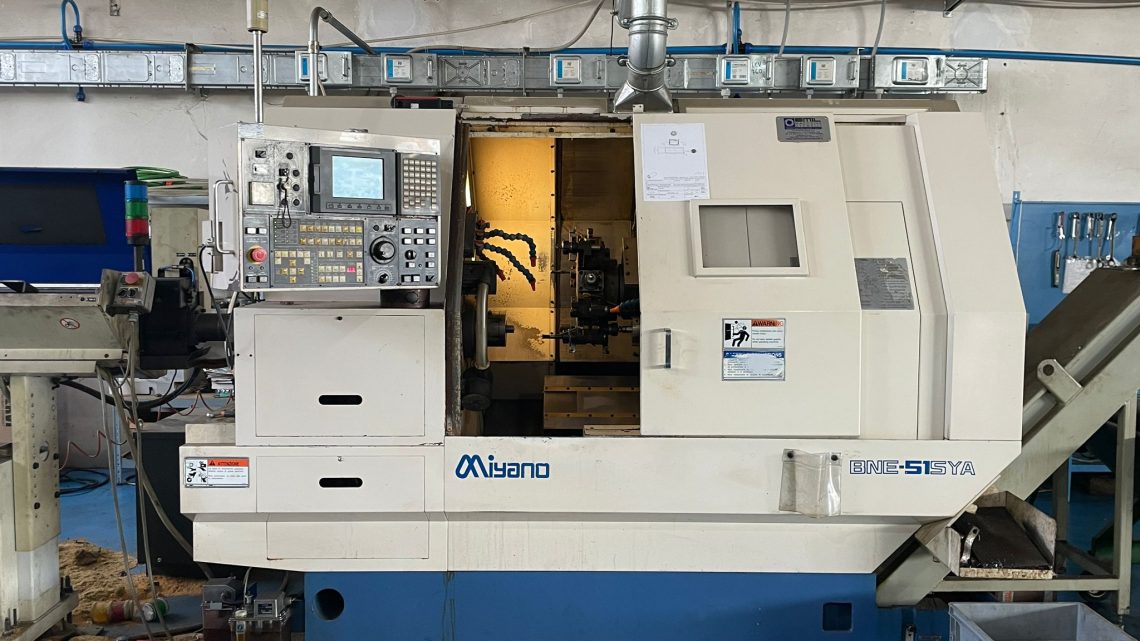
Avoid Costly Mistakes: Professional Tips for Purchasing a Pre-Owned / Second-Hand / used Miyano BNE-51SYA CNC Turning Center
Here’s a professional, in-depth guide to help you avoid costly mistakes when buying a used / second-hand Miyano BNE-51SYA (or variant in the BNE-51 family) CNC turning center. Because Miyano machines tend to be high precision and include multiple subsystems (dual spindles, turrets, Y-axes, etc.), you must inspect carefully. I’ll also point out known spec ranges (from related BNE models) so you know what’s plausible.
I. Baseline / Reference Specs & “Plausible Range”
Before inspection, you need a reference envelope so that unrealistic claims are immediately suspect. The BNE-51 family (S / SY / MSY variants) provide useful benchmarks.
From published data:
- Main spindle speed: up to 5,000 rpm in many BNE-51 units
- Spindle drive / motor power: e.g. 15 kW / 11 kW typical in BNE-51S / SY models
- Revolving (rotary) tools: up to 6,000 rpm, torque ~ 20 Nm in many BNE S / SY models
- Turrets: 12 station turrets are common in BNE S / SY types
- Rapid traverse / feed rates: ~ 18 m/min in X1 axis in many BNE models
- Y-axis travel (if SY variant): ± 40 mm around center line in many BNE-51SY types
- Bar / work capacity: ~ Ø 51 mm for main spindle in many BNE-51 models
Use these as guard rails: if a seller claims 10,000 rpm spindle, or 200 Nm torque, or 100 tool stations, you should demand proof or test extensively.
Also note: the “SYA” suffix suggests a Y-axis (or special axis) variant, so expect the added complexity of that axis (with its travel, backlash, servo drive, etc.).
II. Documentation & History (Your First Line of Defense)
Before you commit to viewing or negotiating, demand the following records:
- Service and maintenance logs, repair invoices, spindle rebuild history, turret maintenance
- CNC / control backups — parameter sets, tool libraries, macro code, user custom programs
- Electrical / wiring / pneumatic / hydraulic schematics
- Modification / retrofit documentation (e.g. Y-axis retrofits, turret upgrades, spindle swaps)
- Usage history: hours powered, hours cutting, shifts, material types
- List of included accessories / tooling / fixturing / spares
- Calibration / alignment / certification reports (if recently tested)
- Spare parts availability / vendor support history
If the seller cannot provide credible, coherent documentation, that greatly increases your risk and reduces your leverage.
III. Visual / Structural Inspection (Before Power-Up)
Even before powering the machine, a careful visual inspection can uncover serious problems.
- Cast frame / bed / column / base: check for cracks, repaired welds, distortions
- Guideways / linear rails / box slides: look for scoring, pitting, rust, wear marks
- Covers, bellows, shields, wipers: missing or torn covers allow chips / coolant ingress
- Turrets / turret faces / mounting surfaces: check for damage, wear, misalignment
- Y-axis slide (if SYA type): inspect rails, slide surfaces, strokes for damage
- Spindle housings / headstock: signs of leakage, stains, degraded seals
- Electrical enclosures / panels: open them (if permitted) and look for corroded boards, burnt traces, water damage
- Cooling / lubrication / plumbing: check pipes, seals, leaks, rust
- Foundation / anchoring: evidence of re-anchoring, shifting, floor damage
If the machine looks neglected externally, it is often a warning that internal parts may have suffered too.
IV. Motion / Mechanical Tests (With Power, No Load)
If permitted to power the machine (ideally with seller supervision), check how the axes behave under control (before any cutting).
- Control / System Boot-Up
- Observe the CNC startup, error codes, missing modules, alarm history
- Test all operator panel controls, jog keys, emergency stops
- Linear Axes (X1, Z1, possibly X2, Z2)
- Jog each axis through full travel at slow and moderate speeds
- Feel for zones of uneven resistance, “dead zones,” binding
- Reverse direction mid-travel to test backlash / play — use a dial indicator to measure it
- Listen for scraping, metallic contact, irregular noise
- Y-Axis (if SYA variant)
- Move the Y axis through full travel; check for smoothness, backlash, binding
- Reverse direction, test for play in Y axis
- Turret / Rotary Motion
- Index turret(s) through all stations multiple times
- Listen and feel for mis-indexing, hesitation, backlash
- Test torque / backlash in rotating tools (if applicable)
- Axis Speed Transitions
- If multiple traverse or feed speed ranges exist, shift among them and check transitions
- Check for lags or delays in mode changes
- Auxiliary Systems
- Turn on coolant pumps, lubrication systems, chip conveyors — check for leaks, noise, smooth flow
- Check hydraulic / pneumatic systems (tool clamp, turret actuation)
If motion is coarse, uneven, sticky, or noisy, these are red flags that repairs will be needed.
V. Spindle, Tooling & Drive System Tests
Critical components whose condition will largely determine refurbishment cost.
- Spindle running (no load): Run across speed range; listen for bearing hum, vibration, instability
- Runout / Whirl test: Mount a test bar / mandrel, measure radial & axial runout over full rotation
- Spindle nose / taper condition: Inspect for burrs, wear, pitting
- Tool change / magazine / turret tests: Cycle all tool changes; check for repeatability, tool seating, mis-index
- Rotary tools (if present): Run idle, check vibration or runout
If the spindle or tool-change system shows defects, expect a costly rebuild or replacement.
VI. Precision & Test Cutting / Machining Verification
This is the “proof by fire” to see whether the machine can still make parts accurately.
- Mount a precision test bar or reference piece
- Use dial indicators or test instruments to check straightness, taper, runout at multiple points
- Retract / return to the same point – check repeatability
- Perform a light finishing cut on sample material; measure final workpiece geometry (diameter, straightness, surface finish)
- Perform test cuts near extremes of travel (start, mid, end)
- Warm up the machine (20–30 min run), then re-measure to detect thermal drift
If the machine cannot maintain tolerances, you are facing major alignment, scraping, or rebuild costs.
VII. Electronics, Control & Software Audit
Even the best mechanics won’t help if control or electronics are failing.
- Inspect the CNC control cabinet: boards, wiring, connectors for corrosion, burnt traces, aging insulation
- Boot the control: check parameter memory, errors, module presence
- Test handwheels, overrides, encoder feedback signals
- Load / backup system parameters, program files, tool libraries
- Run idle cycles: monitor drives, temperature, error logs
- Verify whether the control system is still supported (spare modules, software updates)
VIII. Hidden Wear & Cost Risk Areas
Be realistic: even a seemingly good machine often hides expensive refurbishment needs.
- Worn guides, linear rails, ways, slide surfaces
- Ball screw / nut wear, backlash corrections
- Spindle bearing wear or complete spindle rebuild
- Turret gear wear, indexing mechanism refurb
- Y-axis servo or slide wear (for SYA variant)
- Control / servo drive or electronics failure or obsolescence
- Cable harnesses, connectors, aged insulation
- Cooling, filtration, lubrication system overhaul
- Calibration, alignment, fine tuning after installation
- Spare part scarcity for older / exotic modules
Reserve a “refurbishment contingency” (10–20% or more of purchase price) for these surprises.
IX. Deal Structuring & Safeguards
Use your inspection leverage to protect yourself contractually.
- Insist on an acceptance / testing window (full motions, test cuts, precision tests) before final payment
- Hold back part of the payment until performance criteria are satisfied
- Require delivery of all documentation, backups, schematics
- Secure a written condition disclosure from the seller, listing known defects
- If seller is open, negotiate a short warranty on critical systems (spindle, drives, turret)
- Define who is responsible for transport, rigging, leveling, calibration
- Ask that tooling, fixtures, spare modules be included
- Request seller’s help (or warranty) with first alignment / commissioning
X. Red Flags / Walk-Away Conditions
If you encounter any of these during inspection, you should seriously reconsider or demand steep discount.
- Seller refuses full inspection, motion tests, or test cuts
- Excessive backlash or jerky, inconsistent motion in any axis
- Spindle noise, vibration, or unacceptable runout on test bar
- Turret mis-indexing, hesitation, dropped tool issues
- Y-axis sag, play, or misbehavior (in the SYA variant)
- Control cabinet with burned boards, corrosion, missing modules
- Cracked castings, evidence of structural repairs or distortion
- Missing covers / guards (chip ingress risks)
- Critical spare parts or modules no longer available