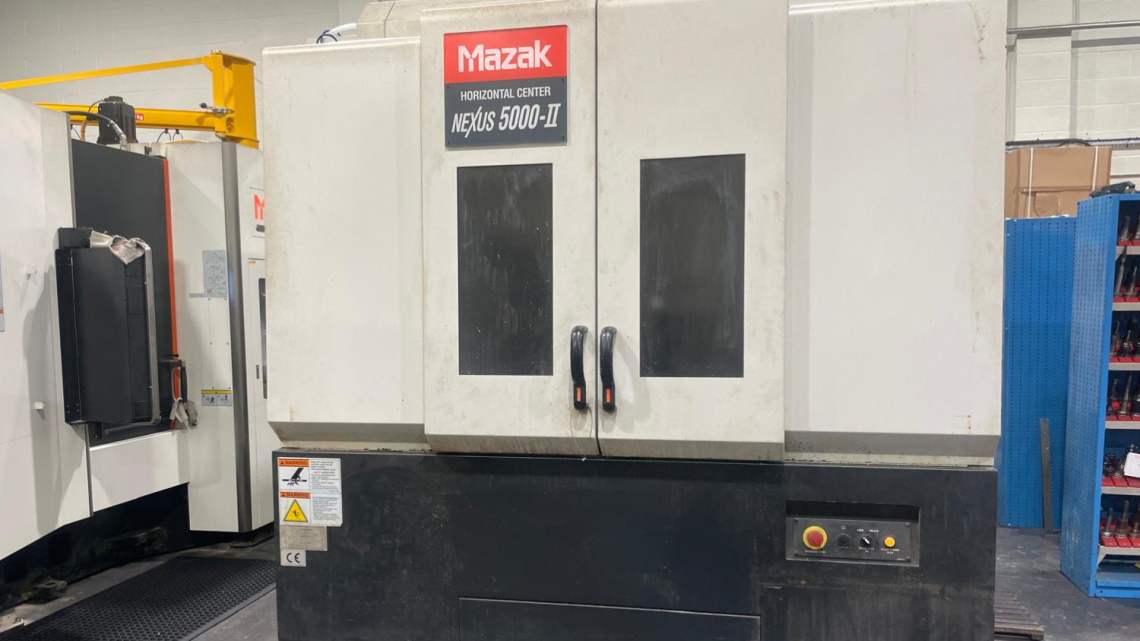
Avoid Costly Mistakes: Professional Tips for Purchasing a Pre-Owned / Second-Hand / used Mazak Horizontal Center Nexus 5000-II CNC Horizontal Machining Center
Here’s a thorough, professional due-diligence guide (with key checks and “red flags”) for inspecting a used Mazak Nexus 5000-II Horizontal Machining Center (HMC). Because horizontal machines are complex (pallet handling, spindle, axes, rotary indexing, etc.), you need to be meticulous. I also include reference spec ranges from real listings so you know what “reasonable” is.
You can use this as both a checklist and negotiation tool.
I. Understand the Baseline / “Reasonable Expectation” Specs
Before you inspect, you should know what a healthy Mazak Nexus 5000-II typically delivers. Use these as guardrails to spot exaggerations or misrepresentations:
| Parameter | Typical / Quoted Value(s) |
|---|---|
| X / Y / Z travels | ~730 mm × 730 mm × 740 mm |
| Pallet size | 500 × 500 mm, 2-pallet setup, load ~700 kg |
| Spindle speed | Up to 18,000 rpm in many listings |
| Spindle motor power | ~30–35 kW in many configs |
| Tool magazine / tool count | 80 tools in some units |
| Rapid traverse | Many quotes show 60 m/min for X / Y / Z axes |
| Table / indexing | Rotary / pallet indexing, sometimes with B-axis / table indexing capabilities |
| Options often seen | Through-spindle coolant, chip conveyor, Renishaw probe, pallet changer systems |
If a seller claims something wildly beyond (e.g. 30,000 rpm spindle, 1,500 mm travel, 1,500 kg pallet load) without proof, treat it skeptically.
II. Documentation & History: What You Must Demand
A machine like this has many systems; good history is your first guard against surprises.
Insist on:
- Service / maintenance logs – spindle rebuilds, major repairs, axis replacements
- Electrical / control schematics, wiring diagrams, parts lists
- Control / program backups / parameter files / tool libraries
- Modification history – any retrofits, upgrades, non-OEM parts
- Usage history – hours powered on, hours cutting, shifts used, workpiece types
- What’s included – pallets, chucks, fixtures, probes, tooling, spare modules
- Calibration / alignment / performance reports (if the vendor has tested the machine after refurbishment)
- Spare parts availability – check whether Mazak or authorized vendors still supply critical parts
If the seller cannot provide these with credibility, your risk is high.
III. Visual / Structural Inspection (Before Powering Up)
Many serious issues can be caught by a careful walk-around before applying power.
- Inspect the pallet / table / rotation mechanism for wear, scoring, alignment marks
- Check the way surfaces, linear guides, rails for rust, pitting, scratch marks
- Look at covers, bellows, shields, chip guards — torn or missing covers often mean chips / coolant got into critical components
- Examine the spindle housing, motor housing, lubrication points for leaks, stains, patched welds
- Open (if allowed) the electrical cabinets and inspect circuit boards, wiring, signs of water, corrosion, burnt connectors
- Inspect the coolant / filtration / pump / plumbing lines for leaks, corrosion, degraded seals
- Examine crane / attachment points, foundation mounting, signs of prior moves or misalignment
A machine that looks neglected externally often hides internal wear or damage.
IV. Motion / Mechanical Testing (With Power, No Cutting)
Once you can power the machine (with the seller present and safe):
- Control / Boot Checks
- Power the CNC; watch for startup errors, missing modules, fault codes
- Test all control panel buttons, emergency stops, overrides
- Axis Jogging & Motion Feel
- Jog X, Y, Z axes through full travel at slow, then medium speeds
- Feel for zones of uneven resistance, jerky motion, binding spots
- Reverse direction mid-travel to test for backlash — measure with dial indicators
- Rotary / Pallet / Indexing Mechanism
- If rotating table / indexing, run table rotation, check stop accuracy, indexing behavior
- Test reversal, oscillation, and check for mechanical play
- Speed Transitions & Modes
- Cycle between rapid, feed, mode changes; see if transitions are smooth
- In machines with multiple speed ranges, test those transitions
- Auxiliary Systems Check
- Turn on coolant, filtration, chip conveyors; check for smooth operation, leaks, noise
- Check lubrication / oil systems
If motion feels coarse, sticky, or inconsistent, that’s a serious red flag.
V. Spindle / Tool / Drive Tests
The spindle and tooling systems often carry the highest risk of expensive failures.
- Spindle run (no load)
- Run through its speed range; listen for hum, vibration, temperature rise
- Runout / Whirl test
- Mount a test bar or mandrel; measure radial and axial runout over 360°
- Tool change / magazine / turret test
- Cycle through all tool slots, test tool pickup / drop repeatability
- Check that each tool seats fully, locks, and aligns properly
- Load test (if possible lightly)
- Under light load, see if spindle drives smoothly or if torque sag, stalling, or noise appear
If the spindle or tool changes misbehave, repair costs could be very high.
VI. Accuracy / Test Cuts
This is your “proof in operation” check.
- Mount a precision workpiece (ground bar or known reference)
- Measure dimensions (X, Y, Z) at multiple positions for straightness, taper, runout
- Retract / return to same point and measure repeatability
- Perform a light finishing cut; measure final workpiece geometry (flatness, parallelism, surface finish)
- Repeat at different positions (center, extremes) to check for degradation
- Warm up the machine (30 min or so) and re-check to assess thermal stability / drift
If the machine cannot hold tolerances, you may face major re-scraping or alignment work.
VII. Electronics, Control & Software Audit
No matter how good the mechanics are, faulty control electronics can ruin usability.
- Inspect the CNC control, drives, amplifiers, boards for signs of damage, corrosion, burnt components
- Boot into diagnostics: check error logs, parameter integrity, module presence
- Test handwheels, overrides, panel switches, encoders
- Load / backup parameter sets, tool libraries, programs
- Run idle cycles to see if drives overheat, produce errors, or misbehave
- If control is old version, check whether upgrades or parts are still supported
VIII. Hidden Wear / Major Risk Items (Plan for These)
Even good-looking machines often hide expensive necessary repairs:
- Worn linear axes, guides, ball screws, backlash correction
- Spindle bearing wear, spindle rebuilds
- Tool magazine / turret wear or indexing gear damage
- Replacement / repair of control / drive electronics (especially obsolete models)
- Cable harness aging, connector failures
- Coolant / filtration / pump system overhaul
- Re-alignment, scraping, calibration after transport
- Spare parts scarcity (for specific Mazak modules)
- Structural fatigue or frame drift
Always budget a “refurbishment reserve” (10-20%, or more in older machines).
IX. Negotiation & Contract Safeguards
Use your inspection leverage to protect yourself:
- Insist on an acceptance / test period: run full motions, test cuts, precision checks before final payment
- Retain some payment until agreed performance criteria are met
- Require delivery of all documentation, backups, schematics, tool lists
- Demand a written condition disclosure listing known issues
- If seller agrees, negotiate a short warranty on critical systems (spindle, drives, tool change)
- Clarify responsibilities: transport, rigging, installation, leveling, calibration
- Ask that tooling, fixtures, spare modules be included
- If possible, request the seller to assist with first startup / alignment
X. Red Flags / Walk-Away Conditions
Be ready to walk or demand huge discounts if you see:
- Seller refuses full inspection, test cuts, motion checks
- Excessive backlash, jerky or inconsistent axes motion
- Spindle noise, vibration, high runout in test bars
- Tool change failures, misindexing, dropped tools
- Burnt or corroded control cabinets, missing modules
- Cracked castings, structural repair evidence, misalignment
- Missing or damaged covers, guards (chip ingress risk)
- Spare parts / modules no longer available for Mazak Nexus control