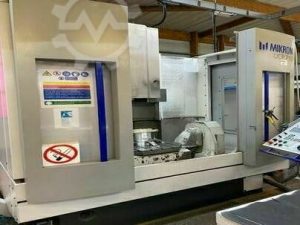
Avoid Costly Mistakes: Professional Tips for Purchasing a Pre-Owned / Second-Hand / used MICHAEL DECKEL S20 Turbo CNC Tool & Cutter Grinding Machine?
Here are detailed, professional tips & red flags when evaluating a used Michael Deckel S20 Turbo CNC Tool & Cutter Grinder. This is a precision machine; small defects or neglected parts can lead to expensive repairs or poor results later.
Basic Specs / What to Expect
Before jumping into condition, know what the machine is supposed to do and what its capabilities are. Based on used-machine listings, the S20 Turbo often has these typical specs:
| Specification | Approximate Value / Range |
|---|---|
| Travel (X / Y / Z) | ≈ 340 mm / 240 mm / 240 mm |
| Max workpiece diameter | ≈ 250 mm |
| Max workpiece length | ≈ 500 mm |
| Grinding spindle power | ≈ 7 kW |
| Spindle speed range | Commonly 1,000-8,000 rpm spindle speed (for grinding wheel) in many units |
| Work-holding taper / spindle nose | SK 50 (or similar) in many units |
| Control type | Often PMAC CNC, with various axis (incl. C/A, rotary) capabilities. |
Knowing these helps you test whether the machine meets what the seller claims, and to spot deviations or losses of capability due to wear or damage.
What to Inspect / Test
Here are detailed areas to check, plus how to test them and what problematic signs to watch for.
| Area | What to Inspect / Test | Why It’s Important / Common Problems |
|---|---|---|
| Spindle & Grinding Wheel Assembly | – Run up spindle (no load) and listen for roughness, noise, or vibration. – Measure run-out (chuck/flange) using dial indicator. – Inspect wheel mount flange for wear, corrosion, or damage. – Check spindle bearings for heat rise when in use. – Confirm speed range works (all RPM settings functional). | Spindle defects lead to poor surface finish, chatter, shortened wheel life. Replacing bearings, repairing shaft run-out is expensive. If wheel mount is damaged, wheel balancing / mounting will be compromised. |
| Axes (X, Y, Z) Accuracy and Motion | – Move axes full travel; check for smooth movement, stalls, sticking, backlash. – Check for wear on slideways: visible wear marks, scoring, rust. – Test accuracy: move to a point, retract, return; check if same point reached. – Check if the axes are stiff (no looseness) under load. – Inspect ball screws, linear guides, or whatever drive system is used, for wear or play. | Deteriorated axes reduce precision, repeatability. Wear in slideways can lead to uneven pressure, irregular wear on workpieces, and cost in rebuilding or replacing guideways. Backlash can destroy accuracy. |
| Control System / Software / Electronics | – Power up and check all axes/controllers – are there error codes? Are parameters/documentation provided? – Confirm that CNC control (often PMAC) is stable, display work fine, wiring isn’t brittle or damaged. – Verify the user interface, MDI or program editing, backup / memory, that backups are available. – Check that software version is supported, or spare/control boards still available. – Check all sensors, limit switches, and rotary/tilt axis if present. | If control electronics are now obsolete or parts are unavailable, repair can be costly or impossible. Bad wiring/connectors cause intermittent failures. Without good documentation/manufacturer support, future maintenance becomes harder. |
| Workpiece Holding, Fixtures & Collets | – Examine work holding taper (SK-50 etc.), collet chuck or vise: any wear, damage, fretting. – If counter-tips, tail-stock or work-rest / steady rest are used, check condition. – Check for alignment between spindle axis and tailstock/counter-tip (if used). – Try actual mounting of a tool you’ll use; see if setting and holding are stable. | Poor work holding causes poor surface finish, inaccuracies. Worn collets or taper damages the spindle, causes vibration. If you plan to use long tools or large diameter cutters, the capacity & holding are critical. |
| Tool / Wheel Changer (if equipped), Loaders, and Peripheral Systems | – If there is a wheel changer, test all positions: do they switch cleanly and accurately? – Loaders (e.g. chain loader / part loader) to be tested under cycles – see if positioning, alignment, timing are good. – Filtration / coolant systems: check filters, pumps, coolant condition & flow, cleanliness. – Lubrication system: centralized auto lubrication if present; inspect pump, lines, cleanliness. – Any oil mist extraction or environmental control equipment working properly. | These systems affect uptime and quality. A bad loader slows down operation and causes misfeeds; poor coolant allows thermal issues and wheel glazing; lubrication neglect accelerates wear; missing filtration leads to debris damage. |
| Condition of Consumables & Maintenance History | – Ask about wheel history: types used, how often replaced, wheel balancing & dressing frequency. – Maintenance logs: what parts replaced, when; particularly bearings, seals, motors. – Environmental exposure: is the machine kept in dry / clean conditions? Dust, temperature, humidity can matter. – Whether original manuals, spare parts, electrical diagrams are included. | A well-maintained machine with logs is much more trustworthy. For precision machines, environmental factors (humidity, dust, thermal stability) have big effects. Lack of history often means hidden wear. Consumables often cost more than you realize in lifetime. |
| Test Job / Finishing Quality | – If possible, do a trial job with materials similar to what you plan to run. Examine surface finish, edge accuracy, runout, chatter. – Under load, test whether machine holds tolerances over a longer run, not just a few minutes. – Test rotation axes (if present): indexing, angular accuracy, repeatability. – Check thermal stability: run machine for some time and measure drift in cuts. | Even if everything looks good “bare”, only a real working job reveals whether all systems are good enough. Thermal drift, loss of precision under load or after heating are common sources of later defects. |
| Physical Condition & Structural Integrity | – Look for signs of crashes or mechanical damage: dents, misaligned parts, visible weld repairs. – Inspect structure for rust, corrosion, especially in slide ways, base, columns. – Check guards, covers, safety interlocks present and in good shape. – Check the condition of paint / sealing ‒ has the machine been exposed to coolant / water leaks / bad dust control. – Check base/foundation / level: is the machine properly installed; are there signs of settling or shifting. | Structural issues degrade precision or may indicate neglected maintenance. Rust or corrosion can be surfaced but often hides deeper damage. Safety compliance issues often overlooked but expensive to remediate. Poor foundation or leveling can lead to misalignment, wear. |
| Power Requirements, Utilities & Infrastructure | – Verify your facility has correct voltage, phase, stable supply; check drive motors, control cabinet ratings. – Check coolant disposal, filtration, and environmental requirements. – Check if the machine needs special cooling / temperature control / air supply. – Inspect transport and installation logistics: weight (~2,200-2,500 kg in many listings) required machine footprint, crane or rigging points. | Unexpected utility or installation costs often catch buyers off guard. Also, if installation is substandard, machine performance and longevity suffer. Transport costs and risks are nontrivial for heavy precision machinery. |
Red Flags / Deal-Breakers
These are warning signs that either indicate serious hidden problems, or require large discounts / refurbishment before purchase.
- Significant spindle run-out, vibration, or noise that doesn’t go away in tests.
- Grinding wheel mount flange is damaged, badly worn or has play.
- Major wear or scoring in slideways or ways. Deep rust or pitting, especially on surfaces that must be very flat or smooth.
- Excessive backlash or “slop” in axes (especially in rotary/Tilt/C-/A-axes).
- Control or electronics with missing boards, damaged wiring, burnt/smoke smell, or obsolete control with no parts.
- No documentation/manuals; no parameter backups.
- Filtration or coolant system in very poor condition; dirty oil, sludge, leaks.
- Workpiece mounting issues: damaged collets / taper; inability to hold tools / cutters accurately.
- Loaders / changers that are misaligned, slow or prone to failure.
- Cracks or structural damage: frame or base that’s been bent, weld repaired.
- Machine has been operated in extreme environment (very dusty, very hot, corrosive) without protection.
- Safety or compliance issues: missing guards, non-functional interlocks or emergency stops.
Estimating Hidden Costs & Negotiation
When negotiating, you should build in buffers for costs you might not see immediately. Here are some likely ones:
- Refurbishing spindle, including bearings or taper work.
- Replacing worn axes components: guides, linear rails, ball screws.
- Replacing seals, pumping, coolant, filters.
- Replacing or balancing grinding wheels; maybe buy new wheel assemblies.
- Repair or replace control electronics if parts are old or failing.
- Transport, rigging, installation, alignment, leveling.
- Safety / environmental upgrades (guards, extraction, mist control etc.).
- Time spent on first production pieces for tuning, setting up, calibrating.