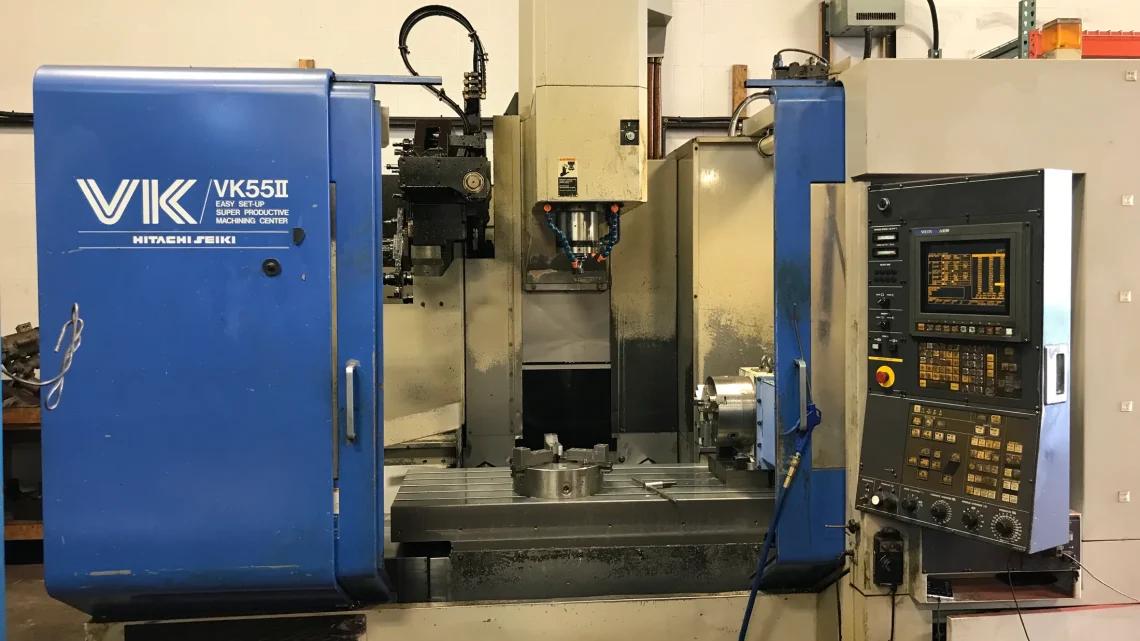
Avoid Costly Mistakes: Professional Tips for Purchasing a Pre-Owned / Second-Hand / used HITACHI SEIKI VK55 II CNC Vertical Machining Center?
Here are professional tips, inspection check-points, and red flags to watch for when buying a used Hitachi-Seiki VK55 II vertical machining center. Getting this machine right can save you serious money in maintenance, downtime, and lost precision.
What to Know Up Front — Key Specs & What the Machine Should Deliver
Before inspecting, it helps to know typical spec ranges and what variants of this machine are out there, so you can see if what you’re being offered is realistic.
| Spec | Typical Values / Range for VK55 II | What Variants Might Differ |
|---|---|---|
| Table size | ~ 55.1″ × ~ 22″ | Some units differ slightly, depending on bed style or configuration. |
| Travel (Axes) | X ~ 40″, Y ~ 22–23.6″, Z ~ 19.7–22″ | Older or modified units may have less Z travel. |
| Spindle speed | Up to ~ 8,000 rpm in some offers, others ~ 4,500 rpm depending on spindle motor / setup. | Higher rpm more demanding on spindle bearings and balance. |
| Spindle motor power | ~ 7.5 – 15 kW in many listings. | Units with higher power will have more capability but also more stress. |
| Tool changer / control / taper | CAT / NT-50 taper, automatic tool changer (20 tool pots in many cases), Seicos control (Seicos-Lambda / Seicos MII etc.) | Different control versions (older/newer) and tools magazine sizes affect usability. |
Knowing these gives you a benchmark to test seller claims — for instance, if the seller claims 8,000 rpm but shows a weaker motor or older spindle, that may be false or overstated.
What to Inspect / Test In Detail
Here are critical areas to inspect, and what to look / test for. Bring instruments (dial indicator, feeler gauges, thermal sensors etc.) if possible.
| Area | What to Check/Test | Why It’s Important / What Can Go Wrong |
|---|---|---|
| Spindle & Bearings | • Run spindle at various speeds (low, mid, high) with no/tool/trial load; listen + feel for vibration, noise. • Check spindle run-out at nose / taper using a dial indicator. • Check for heat rise after running in “warm” condition. • Inspect spindle taper: wear, fretting, damage, polish. • Review maintenance of bearings, lubrication. | Spindle bearing failure or damage is among the most expensive repairs. Damage in the taper or imbalance causes poor surface finish, tool chattering, reduced tool life. If spindle was abused, you may need full rebuild. |
| Axes (X, Y, Z) Motion & Guideways | • Move axes full travel and observe for stick-slip, binding, uneven motion. • Check backlash: move to a position, reverse, see how far before motion begins. • Use a dial-indicator or electronic probe to verify repeatability: return to “home” / known point multiple times. • Inspect guideways / rails for wear, scoring, rust, pitting. • Check ball screws (if used): noise, backlash, smoothness. | Worn guideways reduce accuracy, may need regrinding or replacement. Backlash and wear reduce repeatability and tolerance. Repairs here are expensive and may require downtime. |
| Control System / CNC Electronics | • Power up and check control panel: display, emergency stops, buttons/switches. • Inspect controllers, drives, I/O boards for signs of heat damage, burned components, moisture, corrosion. • Check for alarm history: spindle drive errors, overcurrent, axis errors, limit switch trips etc. • Verify that required software/firmware versions are available; that manuals, wiring diagrams exist. • Check battery backup / memory retention; RAM / parameter memory; test backup/restoration if possible. | Control/drive failures are often no-use machines until repaired. If parts are obsolete or unavailable, replacement is costly. Losing control parameters can render the machine unusable. |
| Tool Changer and Tooling Handling | • Operate ATC through several cycles; test loading/unloading, tool pick-up accuracy, potential misalignment. • Inspect the magazine: tool holders, indexing arms, pot positions for wear, damage. • Check sensor/limit switches in ATC; check if tool change time is consistent. • Inspect tool holders, shanks, pull studs: wear, deformation. | A failing or mis-aligned tool changer slows production, causes tool breakage, affects accuracy. Worn holders degrade performance and can damage spindle taper. |
| Coolant and Lubrication Systems | • Inspect coolant tank: sludge, cleanliness, layering, sediment; smell for bacterial growth; check pump flow. • Check pumps, hoses, seals, filtration; see if coolant lines reach properly; no leaks. • Check lubrication of guideway ways/axes: are there automatic lubrication systems; are they functioning; check lines and reservoirs. • Check whether cooling of the spindle (if coolant through spindle, if extra cooling options are present) works and wasn’t bypassed. | Poor coolant or lubrication leads to overheating, accelerated wear of bearings and ways, surface finish degradation, rust or corrosion. Fixing leaks or replacing lubrication circuits is expensive. |
| Table, Workholding & Taper / Spindle Nose | • Inspect table top (slotted table): flatness, surface damage, slotted T-slots condition, slot wear/corrosion. • Test workholding: chuck or vise mounting, clamps. Verify that work can be held rigidly. • Check spindle nose, taper, drawbar mechanism (if applicable), whether drawbar is still reliable. • Check for any wobble or misalignment when holding a test workpiece. | If table or T-slots are worn, setup is difficult and accurate positioning may be compromised. Drawbar issues or taper damage reduce grip and precision. |
| Machine Geometry & Accuracy (Test Part) | • Run a test job, preferably material and cut types similar to your intended usage; check surface finish, tolerances (flatness, parallelism, concentricity). • Thermal behavior: run machine for some time (warm-up) and check for drift in dimensions. • Check alignment of spindle to table, squareness of axes. Use square gage or test indicator. | Even if all mechanical parts seem okay, only with real cutting will issues like thermal expansion, spindle flex, or mis-alignment show. If geometry is off, many parts may come out of spec. |
| Electrical / Wiring / Environmental Condition | • Open control cabinet (when seller allows) and inspect wiring, cable routing, harnesses; look for burnt connectors, signs of overheating, moisture ingress. • Inspect insulation of cables, grounding, bondings. • Check if environmental protections exist: chip guards, splash protection, enclosure seals. • Check whether ambient working environment was clean, humid, dusty; machines kept in shelter. | Electrical issues can be subtle and expensive. Moisture or dust can degrade wiring, sensors etc. Poor environmental condition can accelerate wear and cause corrosion. |
| Power / Infrastructure / Installation | • Confirm that your facility can supply required voltage / phase / amperage; check if any step-up / transformers needed. • Foundation / leveling: is the machine properly leveled? Any sign of base distortions, shifted mounting. • Space and clearance for crane / moving, installing, maintenance access. • Check for needed utilities: coolant supply, chip removal, exhaust, filtration. • Check for any needed safety features or local regulations compliance. | Even a machine in perfect mechanical condition can cost a lot if the installation or utilities cost are underestimated. Safety or regulatory non-compliance can lead to legal or operational issues. |
Red Flags / Deal-Breakers
Here are issues which are often serious enough to either negotiate heavily, price extremely favorably, or walk away entirely:
- Spindle with excessive run-out or vibration that’s not fixable via normal maintenance.
- Guideways / rails with deep wear, rust, pitting, scoring or damage — if already deeply worn, the cost to resurface or replace is high.
- Control fault codes that cannot be cleared, missing or damaged control electronics — e.g. NUMC board errors, memory or parameter errors. If essential cards are obsolete/not available, that’s very risky.
- ATC (Automatic Tool Changer) malfunction/reliability issues — mis-alignments, failures, irregular tool change times.
- Coolant / lubrication system leaking or bypassed, or shows neglect — if the buyer sees rust, contamination, sludge conditions in tanks or tanks that smell bad, that’s a sign of long-term neglect.
- Electrical panels with burn marks, water damage, poor wiring or missing safety features.
- Structural issues: warped table, misaligned column, base damage, impossible leveling.
- No documentation (manuals / wiring diagrams / software backups / service history) — when the seller can’t provide those, many downstream problems can crop up.
- Units with very high usage under demanding conditions with no proper service history.
- Control/HMI / limitations: e.g. old Seicos controllers with obsolete firmware, backup issues, missing options that you may need.
What Sellers Might Misrepresent / What to Verify
- Hours vs cutting time: “hours on machine” often includes idle or simply powered-on time; cutting / load hours are more important.
- Claimed spindle rpm or rapid traverse speeds vs real achievable under load.
- Whether the machine’s full travel in Y/Z are intact (sometimes only nominal, but due to past crashes or modifications travel may be less).
- Whether coolant through spindle (if claimed) actually works.
- Whether control options (interpolation, tool offsets, 4-axis or rotary table) are present or licensed.
- Whether tooling / holders / accessories are included (holder set, tool changer, coolant nozzles etc.) or will need purchase separately.
Cost Buffer & Negotiation Tips
To avoid surprises, build cost buffers into your offer. Some typical “hidden” costs:
- Spindle rebuild or bearing replacement.
- Refurbishing or replacing guideways or linear rails.
- Electrical repairs: control boards, wiring, sensors.
- ATC servicing: replacing worn pockets, grippers, sensors.
- Coolant / filtration system cleaning/refurbishment.
- Transportation, rigging, installation, alignment, leveling costs.
- Safety compliance upgrades or required local modifications.
When negotiating:
- Make your offer conditional on acceptance of an onsite test (make & measure a part, check tolerances).
- Ask for full machine history: maintenance logs, any crash or overload incidents.
- See if you can include some spare parts in the deal.
- If control electronics are old or questionable, negotiate lower to allow for possible retrofit.