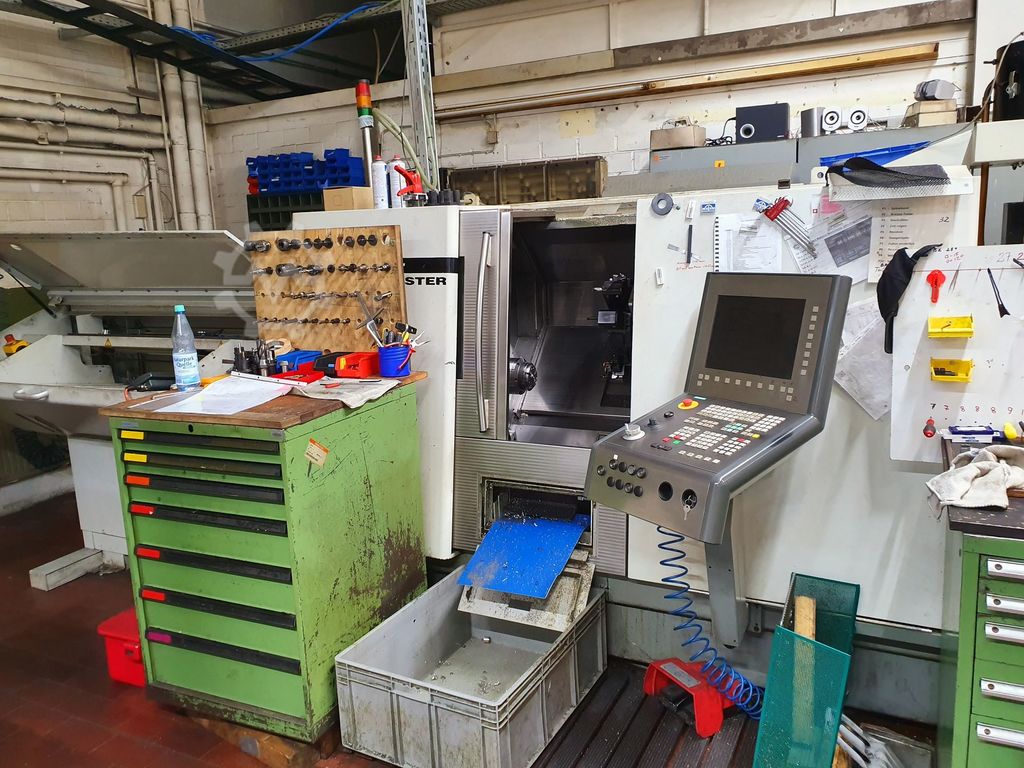
Avoid Costly Mistakes: Professional Tips for Purchasing a Pre-Owned / Second-Hand / used DMG CTX 320 Linear?
Here are detailed, professional-tips & warning signs to look for when inspecting a used DMG / DECKEL-MAHO Gildemeister CTX 320 Linear turning / turn-mill centre. This is a high-precision, high-flexibility machine, so defects can be costly; being thorough can spare you big trouble.
What the CTX 320 Linear Is & What Specs You Should Know
First, know what “standard” is for this machine, so you can detect discrepancies. Some of its technical data include:
- It’s a turn-mill / turning centre with driven tools.
- X-axis travel ~ 210 mm, Z-axis travel ~ 450 mm in many V3 versions.
- Spindle power ~ 16 kW with a max spindle speed in many units around 6000 rpm.
- Accessories often include a 12-station driven tool turret, tailstock, collet chucks, bar feeder or part conveyor; some units have C-axis, probing, etc.
Knowing what “standard” attachments come with it (turret, live tools, probing, tailstock) is important, as missing or worn accessories can add cost.
What to Inspect / Test
Below are areas you must check, tests to run, and what to look for. Always try to inspect under real or simulated load, not just idle.
| Component / System | What to Inspect / Test | Why It Matters / Common Problems |
|---|---|---|
| Spindle & Bearings | • Run spindle at multiple speeds (low / mid / high). Listen for noise, vibration. • Check run-out at nose / taper using dial indicator. • Inspect spindle bore & inside for wear, scoring. • Check how quickly spindle heats up under load. • Inspect seals / oil / lubrication flow. | Spindle damage or worn bearings cause vibration, poor surface finish, shorter tool / insert life. Replacements are expensive. Heat or vibration also accelerate wear elsewhere. |
| Turret & Driven Tools | • Operate all turret indexing cycles; check for mis-indexing, slop, binding. • Test driven tools: are the live tools functioning at claimed RPMs / torque; are gears, bearings noisy. • Inspect holders in turret: condition, wear, clamping strength. • Check sensors / interlocks related to turret deadlocks safety. | A failing turret or worn live tools degrade machining capability, accuracy. If the turret or driven tools are worn or out of spec, the cost to repair or replace is high. |
| Axes (X, Z, possibly Y if applicable) | • Move X & Z axes full travel; check for smooth motion, stick/slip, any dead spots. • Test backlash (move in one direction, reverse, measure offset) especially in X & Z screws or gears. • Check the guideways/linear rails for wear, scoring, or rust. • If linear motor or glass scale options are included, test calibration, read-backs. | Worn axes reduce accuracy & repeatability; fixing worn rails or screws is expensive. Glass scales or linear motors if misaligned or damaged cost a lot. |
| Control System, Electrical / Software | • Power up; check that control panel / display / HMI works; emergency stops, limit switches, door interlocks all functional. • Verify software / firmware version; ask if backups are available. • Check for error history: spindle overloads, axis fault, interruptions, drive alarms. • Inspect wiring: cable harnesses, connectors, any signs of burning, moisture, poor modifications. | Obsolete control parts can be hard to obtain; software issues may be hidden; wiring damage can produce intermittent failures. Email or OEM support issues may crop up later. |
| Probing, Measuring, Tailstock, Bar Feed / Support Accessories | • If there are probes (tool probe, part probe), check calibration & repeatability. • Tailstock (if fitted): check alignment, quill condition, play, clamping. • Bar feeder or guidance (if setup): check feed accuracy, alignment, wear. • Fixtures & chucks: condition, jaw wear, ability to clamp tightly. | Poor auxiliary systems degrade part quality, increase scrap, slow production. Also, replacing or calibrating these accessories can cost. |
| Coolant, Lubrication & Thermal Stability | • Check coolant condition: clean, no sludge or microbial growth; pumps working; hoses & nozzles intact. • Lubrication of guideways, ball screws etc: auto lube (if applicable) working, check lubrication lines. • Thermal behavior: run machine for hours; check if parts drift or dimensional shifts occur due to heat. • Enclosures & guards to avoid coolant / chips leaking into axes or electronics. | Poor cooling or lubrication accelerates wear, causes rust, causes thermal distortion, affecting precision. Heat build-up often causes operational issues over time. |
| Structural Integrity & Mechanics | • Look for damage or warping in bed, cross slide, spindle housing. • Check for visible cracks or weld repairs, especially near high load or stress areas. • Ensure machine is level; inspect base for signs of settling or distortion. • Assess condition of all moving mechanical parts: chucks, chuck drawbars, tailstock, turret slide etc. | Mechanical misalignments or prior damage often lead to recurring issues. Uneven base or misleveling accelerates wear. Structural damage often costly or impossible to fully fix. |
| Test Part / Production Run | • Using material you’ll use in production, run a typical part. Check surface finish, tolerances, repeatability over time. • Perform longer run tests to see if problems develop after heating / after continuous load. • Test combinations: turning + driven tool machining, tool changes, especially with live tools. • Check how the machine behaves under rapid moves and heavy cuts. | Many defects (thermal drift, spindle flex, wear) only show under real cutting. If the machine can’t maintain specs in real conditions, its value drops significantly. |
| Documentation / Maintenance History / Spare Parts | • Get all manuals, wiring diagrams, service history, parts replaced, usage hours (both power on and actual cutting). • Ask about previous repairs, any crash incidents, any parts modified or replaced out of spec. • Check availability of spare parts: spindle bearings, motor drives, control parts, glass scales etc. • Ask whether the seller includes spare consumables or parts (tool holders, adapters etc.). | Without documents & parts, diagnosing future problems or maintaining machine becomes much more difficult and costly. Hidden past damage can lead to ongoing problems. |
| Safety, Environmental, Infrastructure | • Emergency stop, guards, interlocks operational. • Enclosure seals, chip / coolant containment. • Electrical supply: voltage, phase, stability, room for power draw of spindle + live tools etc. • Foundation, floor strength, access for removal / transport. • Temperature control, vibration/ambient noise, coolant disposal. | Non-compliance with safety or electrical norms can lead to retrofit costs, delays. Poor infrastructure may degrade performance or lifespan of the machine. |
Specific Weaknesses / Common Problems Seen in CTX 320 Linear
From forum reports & used-machine listings, here are issues that owners often observe or that come up in practice:
- Coolant leaks (especially around spindle nose or headstock flattenings). Sometimes hole plugs (blanking plugs) are missing or fitted poorly.
- Software / parameter misconfiguration: wrong software version, errors in parameter settings causing axis faults, alarms.
- Wiring or sensor issues: loose connectors, badly crimped wires, moisture or coolant intrusion into electrical cabinets.
- Way lube / guideway lubrication issues: leaks, pressure drops, non-functional automatic lubrication systems. Dry guideways lead swiftly to wear.
- Wear in turret indexing or alignment of live tools: misalignment causes tool chatter, inconsistent cuts.
- Missing or incorrectly fitted sealing (guards, doors), causing ingress of chips or coolant into moving parts.
- Under-spec accessories or missing attachments (tailstock, bar feeder, probes) which may require new purchase to get full utility.
- Age / hours: many CTX 320 Linear machines are older (early 2000s), so cumulative wear is expected. Units with very high hours often need more refurbishment.
Red Flags / Deal-Breakers
If you observe any of the following, be very cautious—either negotiate a much lower price, require repairs / guarantees, or walk away:
- Spindle with noticeable vibration, excessive run-out, heat generation, or bearing noise.
- Turret mis-indexing, large backlash, or failure to drive tools correctly.
- Major guideway wear: scoring, rust, pitting, especially if lubrication is compromised.
- Electrical or control system damage: moisture, burnt components, missing boards, outdated / unsupported firmware.
- Missing documentation: manuals, parts lists, software backups, parameter history.
- Accessories missing or worn beyond usable limits (e.g. live tools, tailstock, probes). If you are paying expecting them, their absence will cost you.
- Safety devices or interlocks not functioning. Doors, guards in poor shape.
- Problems during test run: drift in dimensions, thermal instability, surface finish issues, poor accuracy.
- Undisclosed crash or overload history.
- Poor infrastructure compatibility: rating of power, environmental cooling, etc., if the machine cannot be installed properly.
How to Negotiate & Mitigate Risk
- Make a conditional offer: subject to passing a test-cut job, inspection of major components, measurement of tolerances, or perhaps third-party inspection.
- Budget for “bring to spec”: refurbishing spindle or bearings; regrinding guideways; repairing or replacing worn live tools; cleaning or repairing coolant / lubrication systems; maybe replacing seals etc.
- Check spare parts cost for critical wear items (bearing sets, motor drives, control boards). It’s often the replacement parts (and downtime) that cost much more than old wear items.
- Ask for any included extras: tooling, holders, collets, bar feeder, probes etc. These are often not included or in bad condition.
- Require inspection of prior maintenance history. If the seller can show regular maintenance, that reduces risk.