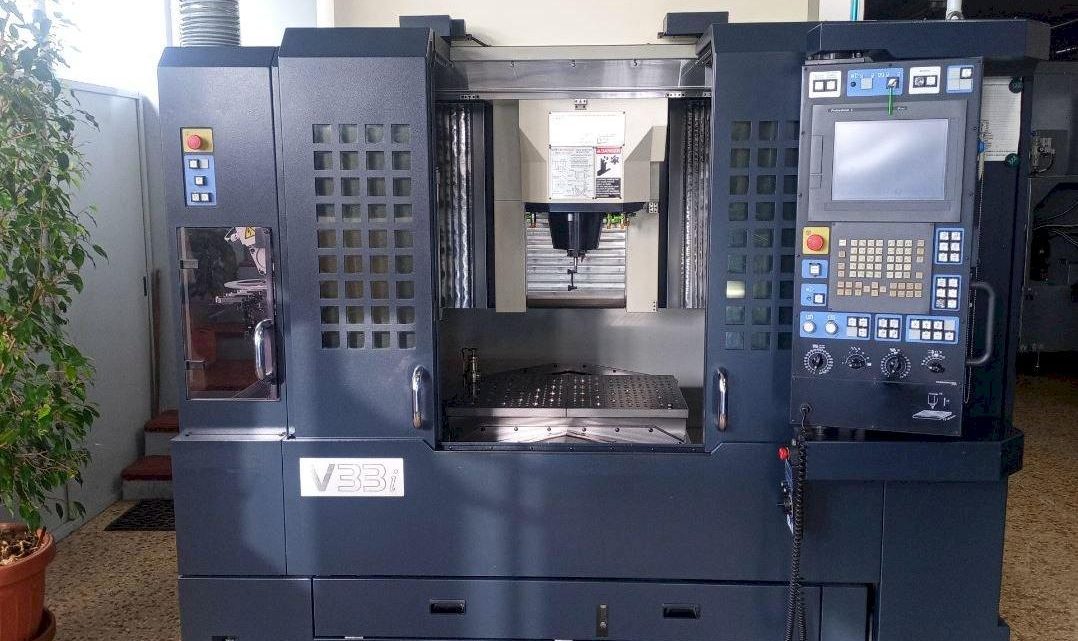
Avoid Costly Mistakes: Professional Tips for Purchasing a Pre-Owned / Second-Hand / used Makino V33i A15F CNC Vertical Machining Center
Here’s a thorough, professional checklist and set of tips to help you avoid costly mistakes when purchasing a pre-owned / second-hand Makino V33i (or variant, e.g. V33i-5XB) vertical machining center (VMC). Because the V33i is a high-precision, high-speed machine, small defects or misalignments can have major downstream costs. Use this as a roadmap and adapt it to the specific machine you inspect.
0. Know the benchmark specs & critical features for the V33i series
Before going onsite, understand what the “normal” / ideal capabilities are for a Makino V33i, so you can spot exaggerations, mis-specs, or mismatches.
Here are key published specs for the Makino V33i (and options) to use as reference:
- Travel (X × Y × Z): ~ 650 × 450 × 350 mm (approx)
- Table size (work envelope): ~ 750 × 450 mm, payload ~ 300 kg
- Spindle speed: 20,000 rpm standard; optional variants up to 30,000 or 40,000 rpm on special builds
- Spindle taper: CAT40 (or optional HSK-63)
- Rapid traverse / feedrate: ~ 20,000 mm/min in published marketing materials
- ATC (tool changer) capacity: 25 standard (optionally more)
- Control: Makino “Professional 6” architecture, with tight thermal control, cooled axes, internal lubrication & temperature stabilization design features
These specs inform your acceptance criteria — if a machine claims vastly more or less, demand proof or adjust your expectations.
1. Pre-Screening & Documentation Request (before visiting)
A lot of risk can be filtered out before you even travel to see the machine.
- Ask for serial number, build year, and model variant (e.g. whether it is a V33i “Graphite,” or has optional upgrades, or is a 5-axis version).
- Request as many documents as possible: original mechanical, electrical, pneumatic, hydraulic manuals; wiring diagrams; parts lists; control software backups; calibration / alignment reports; maintenance logs; spindle rebuild history.
- Ask for videos of the machine running (preferably under load, showing tool changes, axis motion, and spindle).
- Ask for or confirm the control version and software (whether it’s “Professional 6,” or with Makino’s SGI control technology) and whether all licenses / backups / parameters / macros are included.
- Determine the usage history: hours of operation, cutting vs idle, types of work (hard milling, mold & die work, regular roughing vs finishing).
- Ask whether any major modifications, retrofits, or structural repairs have been done (e.g. spindle rebuilds, column replacements, guideway regrounds, etc.).
- Ask for current geometric / alignment data, if available (laser or other metrology checks).
- Check whether spare parts (especially for the control, spindle, axes, drives) are still available or easy to source locally (or via Makino).
- Confirm transport logistics: machine weight, envelope, lifting points, disassembly requirements, site clearances.
If the seller cannot or will not provide credible documentation or data, that is a red flag.
2. Structural & Mechanical Inspection
These are foundational checks: if the structure or guides are compromised, no amount of electronics or tuning will fix it.
a) Frame, base & casting integrity
- Visual inspection for cracks, weld repairs, patches, evidence of tampering or prior collision damage.
- Use long straightedges, precision levels, or optical methods to check for warp, twist, or misalignment in major reference surfaces (table mounting faces, column faces, base surfaces).
- Check for signs of differential wear, sagging, or creeping shifts in structure (e.g. over time drift).
- Inspect mounting surfaces for damage or corrosion.
b) Guideways / rails / slide surfaces / gibs
- Traverse each axis (X, Y, Z) manually (if possible) and look/feel for zones where movement is rough, sticky, or inconsistent.
- Check for pitting, scoring, corrosion, groove wear in the guide surfaces.
- Inspect the adjustment or preload / gib mechanisms: whether adjusting screws, shims, or spring preloads are intact, functioning, and not excessively worn or loose.
- Assess whether protective wipers, scrapers, bellows, covers are intact and effective.
c) Ball screws / feed screws / coupling & backlash
- Reverse direction (small movements) in each axis and measure the backlash with a dial indicator (or more precise gauge). Make sure it’s within acceptable limits (for a machine of this class, low single-digit microns ideally).
- Feel for binding, friction, or nonuniform motion along travel— zones where motion is harder or smoother may indicate local wear or damage.
- Inspect couplings between motors and screws for looseness, wear, misalignment.
- Examine ball nut assemblies (if visible) for signs of wear or leakage.
d) Spindle & spindle assembly
- Mount a test bar and use a high-precision dial indicator to measure radial and axial runout. Even small deviations matter in high-speed, high-precision work.
- Run the spindle at a variety of speeds (idle) and listen/feel for noise, vibration, or bearing hum.
- After running, measure spindle housing temperature: any hot spots or abnormal heating are red flags.
- Inspect the spindle nose, taper, keyways, clamping mechanism, drawbar, and interface surfaces.
- Check whether the spindle has been rebuilt or modified; ask for rebuild records.
e) Tool magazine / tool changing mechanisms
- Cycle the ATC (tool changer) multiple times; observe speed, accuracy, consistency, noise, jamming, or mis-indexing.
- Inspect wear in magazine pockets, slides, carousel mechanism, indexing mechanism.
- Check tool mounting accuracy, possible wobble, alignment, and repeatability.
- Test any tool changer lube / air blast / blow-off systems.
f) Coolant, lubrication & auxiliary systems
- Inspect all coolant lines, pumps, filters, tanks and check for leaks, sludge, rust, or contamination.
- Examine lubrication circuits (central lubrication, oil / grease feeds) and check that all moving surfaces receive proper lubrication.
- Check any hydraulic systems (if present for tool clamps, axis locks, etc.) for leaks, stable pressure, smooth operation.
- Confirm chip handling, chip conveyors, and coolant splash guards are intact and functional.
3. Electrical & Control System Tests
A very common pitfall with used high-end machines is outdated, damaged or unsupported controls/electronics.
- Power the machine up carefully, preferably in a staged way. Look for unusual smells, smoke, tripped breakers, or voltage instability.
- Inspect the electrical cabinet (with permission) for brittle wires, cracked insulation, overheating marks, splices, wire harness issues, or poor repairs.
- Boot the CNC control: ensure the user interface, display, navigation, diagnostics screens, memory, and backup functions work properly.
- Jog each axis in manual / MDI mode: verify responsiveness, smooth motion, reversals, acceleration profiles.
- Test axis motion over full range in various speeds (slow, medium, fast), including reversals, looking for stuttering, vibrations, or missed steps.
- Verify encoder or feedback systems (linear scales, encoders, resolvers) give stable signals (no dropout or noise).
- Test limit switches, home switches, overtravel protection, emergency stops, interlocks.
- Ensure that the machine is delivered with all software, parameter backup files, custom macros, licensing dongles or tokens.
- If the control is old or proprietary, confirm that replacement modules or boards are still manufactured or available in the used parts market, or that retrofit options exist.
If the control is obsolete or lack of support, that may be a deal breaker.
4. Functional / Load Testing & Acceptance Trials
The real test is how the machine behaves under real cutting loads, not just idle motion.
- Bring or request a representative (real) test part or a similar workpiece, with tooling, to run a typical or challenging cut cycle.
- Run full axis ranges under load and observe whether motion remains smooth, without stalling or vibration.
- Perform return-to-zero / repeatability tests: move away, return, and measure deviation using a high-precision gauge.
- Execute a full machining program (a typical workpiece) and measure final critical dimensions: flatness, surface finish, positional tolerances, tool path reproducibility.
- Monitor thermal drift: run the machine for extended time, monitor temperatures and dimensional drift.
- Test tool changes mid-cycle, verify that tool change time and repositioning accuracy are acceptable.
- Test all auxiliary systems under production conditions: coolant-on, air-blasts, chip evacuation, tool lube, guards, etc.
- If the machine has temperature stabilization (core cooling, chilled axes, etc.), test whether they function and whether they stabilize performance during long runs.
If the seller refuses to run these tests under load, treat it as a serious red flag.
5. Alignment, Geometry & Compensation
Even a well-maintained machine may have drifted out of alignment. Check whether it’s correctable.
- Request or perform alignment / calibration reports (e.g. laser interferometry, ballbar, geometric checks).
- Using your own instrumentation or an external metrology service, check:
• Squareness between axes (X–Y, X–Z, Y–Z)
• Straightness of travel over full travel in each axis
• Repeatability and backlash compensation limit behavior
• Flatness and parallelism of table relative to axes
• Runout or tilt in spindle relative to axes - Check whether the control system supports geometric compensation, error mapping, or correction tables.
- If significant misalignment is found, assess whether re-alignment or correction is feasible and cost-effective.
6. Spare Parts, Service & Upgrade Path
One of the biggest risks in buying used is running into a failure you can’t fix or support.
- Check whether critical spares are still available: spindle parts, bearings, servo motors, amplifier boards, drive modules, encoders, linear scales, tool changer parts, coolant pumps, control boards.
- Ask whether Makino still supports (or can support) the V33i series in your region.
- Check whether local service contractors or rebuilders have experience with Makino V33i machines.
- Determine whether retrofitting (for example, newer controls, newer spindle, or updated software) is viable on that mechanical platform.
- Evaluate the tooling ecosystem: collets, toolholders, cutters, accessories compatible with the machine’s taper and travel.
- Ask whether previously replaced or used parts come with the sale (spare tool changer arms, extra motors, backup electronics modules, etc.).
If many parts or modules are obsolete with no replacement path, the machine’s long-term viability is jeopardized.
7. Contract Terms, Acceptance & Risk Mitigation
Use your findings to structure a contract that protects you.
- Insist on conditional acceptance / acceptance testing: final payment only when the machine meets a mutually agreed test under load.
- Define quantitative acceptance criteria: acceptable tolerances (runout, repeatability, positional error, finish, tool change accuracy).
- Negotiate a warranty period (e.g. 30–90 days) on critical systems like spindle, drives, control.
- Require delivery of all documentation (manuals, wiring, software backups, parameters, past calibration data).
- Clarify who pays for transport, rigging, leveling, re-grouting, and site work.
- Include a “burn-in / commissioning” period: defects discovered during initial production use must be remedied by the seller.
- Ask for disclosure (in writing) of all known defects, repairs, or structural modifications.
8. Transport, Installation & Commissioning
Even a perfect machine can suffer in transit or poor setup—plan carefully.
- Confirm the accurate weight, center-of-gravity, lifting points, footprint, disassembly needs.
- Use proper rigging, bracing, and crates to protect the machine during shipping.
- After arrival, re-level, re-anchor, or re-grout properly, taking care with foundation stiffness, vibration damping, floor flatness.
- Allow a commissioning / burn-in period under load before declaring acceptance.
- After the machine has “settled,” repeat alignment and calibration checks to confirm no shifts occurred in installation.
- Be present (or send your technician) during first production runs to monitor behavior and validate tolerances.
9. Red Flags & Deal-Breaking Issues
Here are warning signs that should make you reconsider or heavily discount:
- Seller refuses full inspection, disallows load tests, or hides components (spindle, internals).
- Structural repairs, welds, or patched castings without solid documentation or metrology validation.
- Spindle with unknown condition, bearing noise, excessive runout, or lacking rebuild records.
- Excessive backlash or axis play beyond what the control can compensate.
- Electronics, control modules, boards that are obsolete or unsupported, or difficult to source.
- Wiring harnesses, connectors, insulation in poor condition (cracks, brittle, splices, burn marks).
- Missing critical documentation (manuals, wiring diagrams, software backups, calibration records).
- Parts or modules unobtainable for key systems (spindle, drives, tool changer).
- Wear in guides, screws, or structural components so large that refurbishment cost approaches a comparable new machine.
- Evidence of collisions, misuse, flooding, coolant damage, or poor maintenance.
- No local or regional service or rebuild support for Makino machines in your area.