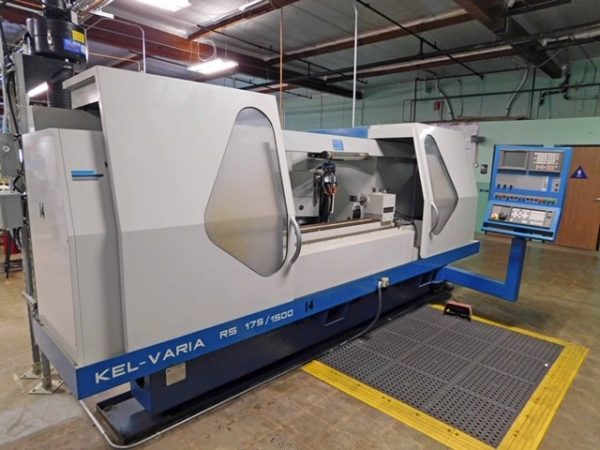
Avoid Costly Mistakes: Professional Tips for Purchasing a Pre-Owned / Second-Hand / used KELLENBERGER KEL VARIA RS 175/1000 CNC Cylindrical OD Grinder
Here’s a professional guide in English for evaluating a pre-owned / second-hand Kellenberger KEL VARIA RS 175/1000 CNC Cylindrical OD Grinder. This checklist will help you avoid costly mistakes and hidden repair expenses.
I. Typical Specs / Reference Values
Before inspection, know the expected specs so you can challenge seller claims:
| Feature | Typical Values (RS 175/1000) |
|---|---|
| Distance between centers | ~ 1,000 mm |
| Center height | 175 mm |
| X-axis travel (wheelhead) | ~ 320 mm |
| Z-axis travel (longitudinal) | ~ 1,150 mm |
| Grinding wheel size | Ø 400 × 50 mm (right wheel) |
| Wheelhead swiveling range | –210° to +30° |
| Workhead speed | 8 – 8,000 rpm |
| Control system | Typically Heidenhain CNC |
These are standard reference points. If the seller claims unrealistic numbers (e.g., 12,000 rpm workhead, 1,500 mm centers), demand proof.
II. Documentation & Provenance
Always request:
- Service and maintenance logs (spindle overhauls, bearing replacements, alignments).
- CNC control backups (parameters, macros, programs).
- Electrical, hydraulic, pneumatic schematics.
- Modification/retrofit records (control upgrades, drive replacements).
- Usage history (operating hours, materials processed, duty cycle).
- Accessories and spare parts included in the sale (chucks, steady rests, coolant units, tooling).
Weak or missing documentation = high risk.
III. Visual / Structural Inspection (Before Power-Up)
Check the machine’s condition without applying power:
- Castings / frame: Look for cracks, welded repairs, distortions.
- Guideways and slides: Check for scoring, pitting, rust.
- Covers, wipers, bellows: Missing or damaged covers allow chips/coolant to invade.
- Wheelhead, spindles, housings: Signs of oil/coolant leaks.
- Electrical cabinet: Check for corrosion, water damage, burnt boards.
- Coolant/filtration system: Leaks, rust, clogged filters.
- Overall cleanliness: Poor external condition often signals poor internal care.
IV. Motion / Mechanical Tests (With Power, No Cutting)
If the seller allows power-up, run these tests:
- Control boot: Look for alarms, missing modules, error logs.
- Axis jogging: Move X and Z axes through full travel at slow/medium speed.
- Check for binding, jerky motion, dead spots.
- Reverse direction to measure backlash with an indicator.
- Wheelhead swivel: Test full range; confirm smooth motion.
- Servo drives: Listen for abnormal whine, vibration, lag.
- Auxiliary systems: Run coolant pumps, lubrication, hydraulics; check flow, leaks, consistency.
V. Spindle & Wheelhead Tests
Critical for grinding accuracy:
- Spindle run (no load): Run through full speed range; listen for bearing hum, vibration.
- Runout test: Use a test bar to measure radial and axial runout over 360°.
- Wheel mounting faces: Inspect for scoring, burrs, or wear.
- Wheelhead swivel: Check for sag or misalignment at extreme angles.
- Balancing: Ensure wheels run smoothly without excessive vibration.
VI. Test Grinding / Accuracy Verification
This is the real proof of performance:
- Mount a reference bar or part. Check straightness, taper, roundness.
- Test repeatability: retract/return to the same position and measure deviation.
- Perform a light finishing grind; measure surface finish, dimensional accuracy, cylindricity.
- Test near axis travel limits (start, mid, end).
- Run machine for 20–30 minutes, then re-check dimensions to identify thermal drift.
VII. Common Wear Points / Hidden Costs
Be prepared for:
- Worn wheelhead or workhead bearings.
- Axis screw/nut backlash, guideway wear (may require re-scraping).
- Servo drives or motors nearing end of life.
- Obsolete control modules or electronics.
- Aging cabling, connectors, insulation failures.
- Coolant system pump/filter overhauls.
- Costly re-alignment or reconditioning after installation.
Budget 10–20% of the machine price as a refurbishment reserve.
VIII. Negotiation & Deal Safeguards
Protect yourself by structuring the deal:
- Require an acceptance test period (motion, spindle, grinding accuracy).
- Hold back part of payment until performance is proven.
- Demand all documentation and backups.
- Ask for a written condition disclosure from the seller.
- Negotiate a short warranty (30–90 days) on spindle, drives, wheelhead.
- Define responsibility for transport, installation, leveling.
- Request inclusion of tooling, wheels, accessories, spare parts.
IX. Red Flags (Walk Away If You See These)
- Seller refuses test cuts or motion tests.
- Excessive backlash, jerky axis motion.
- Spindle vibration, noise, or high runout.
- Wheelhead sag, poor swivel accuracy.
- Turret/fixture misalignment (if applicable).
- Burnt or corroded electronics.
- Cracked castings or welded repairs.
- Missing covers/guards.
- Spare parts unobtainable.