Avoid Costly Mistakes: Professional Tips for Purchasing a Pre-Owned / Second-Hand / used Kashifuji KN80 CNC Gear Hobber?
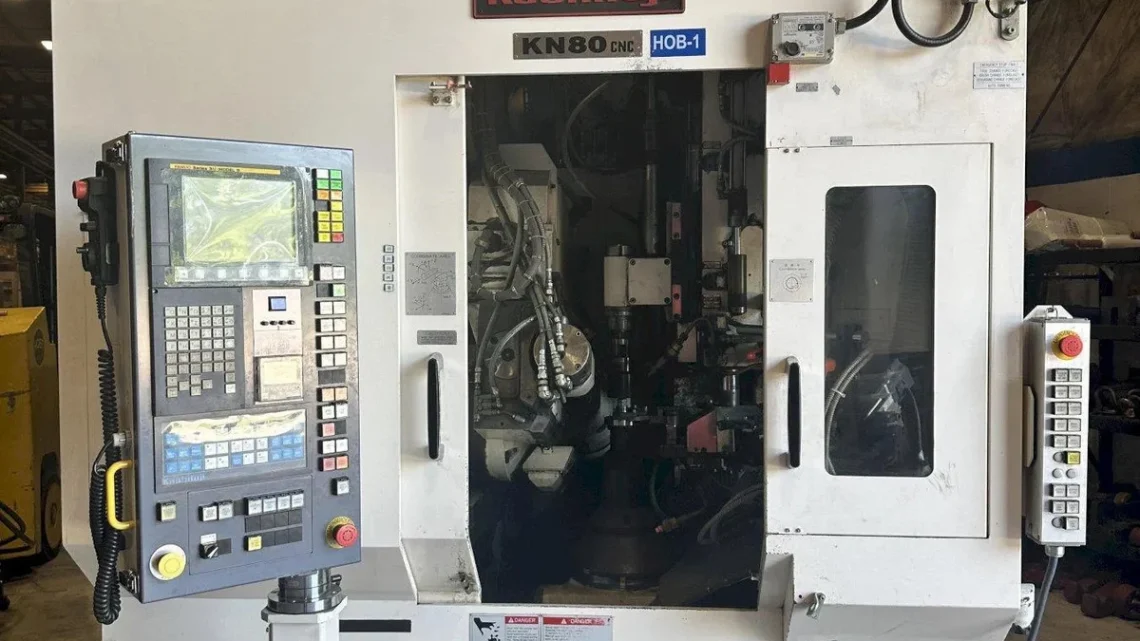
If you’re considering buying a used Kashifuji KN80 CNC gear hobber, it’s a specialized machine tool and there are many potential pitfalls. Getting it right means verifying many mechanical, electrical, tooling, and control aspects. Below are detailed, professional tips & red flags to watch out for.
What the Kashifuji KN80 Is / Key Specs to Know
Here are the published specs so you know what to expect, and what to confirm when inspecting.
| Spec | Typical Value |
|---|---|
| Max workpiece (gear) diameter | 80 mm |
| Max module (gear tooth size) | Module 4 |
| Axial feed travel (Z-axis) | 200 mm |
| Hob-head swivel (A axis) | ±45° |
| Hob shift travel (Y axis) | ~ 130 mm |
| Hob size (diameter × length) | ~ 110 × 180 mm |
| Hob spindle speed | ~ 200-2,660 rpm |
| Table (C-axis) max RPM | ~ 330 rpm |
| Control example | Fanuc 18I-MB, or Fanuc 31i Model B in more recent models |
These are your baseline; any unit you inspect should ideally meet or very closely approach them, unless the seller has clearly noted “downgraded” or “modified”.
What to Inspect / Test — Detailed Checklist
When you go to see the machine, check/verify the following. Bring measuring gear, test blanks, and ideally someone who knows gear hobbing.
| Area | What to Examine / Test | Why It Matters / What Can Go Wrong |
|---|---|---|
| Mechanical Alignment & Geometric Accuracy | • Check hob arbor/trunnion run-out: measure with a dial indicator to see wobble in the hob; any run-out can degrade gear tooth profile. • Check work table (gear blank) axis run-out and wobble; check spindle bore of table for wear. • Check swivel (A axis) alignment: hob-head swivel angle should be accurate and lock solidly without play. • Check clamping of the gear blank: how rigid is the fixture, arbor, bearing, tailstock etc. • Check backlash in gear and work spindles, and any feed screws. | Gear shape, tooth profile, pitch, helix error etc. are especially sensitive to misalignment or backlash. Poor alignment leads to errors in helix angle, pitch, run-out, and bad surface finish. Also affects repeatability. |
| Spindle / Hob Head & Hob Arbor / Drive | • Run hob spindle at different speeds; listen for unusual noises (bearing wear, gear mesh noise). • Inspect hob arbor for any bending or wear; check supports for arbor if present. • Check the condition of hob mounts, collets / clamping mechanism. • Inspect lubrication / oiling of spindle bearings; see if there has been overheating. • Check for how many hours of use under load vs idle. | Hob spindle issues degrade hob life, damage tooth form, reduce surface quality. Arbor issues (bending, run-out) are very problematic. Overheated or poorly lubricated spindle bearings are a common weak point. |
| Axes, Feed Mechanisms & Slides | • Move all axes (especially Z, Y, A, C) through full travel; check for smooth motion, no binding or stick-slip spots. • Check feed screws / ballscrews for backlash or play. • Check slide or way condition: wear, scoring, rust, pitting. • Check responsiveness of feed rates, tilting, table indexing etc. • Test whether hob-head shift (Y) and alignment work correctly. | Axis wear causes inaccuracy in tooth profile, helix error, varying gear quality. If slides are worn or unlubricated, precision degrades quickly. |
| Control System, Electronics & Software | • Power up the CNC / control: check display, panel switches, safety interlocks. • Review fault log / alarm history (if available): repeated errors in axes, spindle overloads etc. • Inspect electrical cabinet: wiring, heat damage, moisture, cleanliness. • Check that software / firmware versions for the CNC and motion control are available and preferably not obsolete. • Confirm that operator manuals, maintenance / parts manuals are present or obtainable. • Test dry operation (without hob) of all motions, indexing, swivels etc. | Electronics often fail or degrade first; if key control boards are obsolete, replacement is difficult or expensive. Safety interlocks missing or faulty increase risk of accidents and damage. Missing documentation makes maintenance, repairs, and future replacement harder. |
| Tooling, Hob & Cutter Condition | • Inspect the hob tool(s) used: condition of teeth, wear or damage. • Check if tool holders are straight, correctly mounted. • Check inventory of hobs and fixtures: do you have spares or will you need to purchase new ones (often costly). • Check if arbor holders, tailstock, workholding fixtures are complete and in good condition. • Check hob head shift travel & precision. | Worn or damaged hobs degrade gear quality and increase scrap. If tooling is scarce or specific, cost may be high. Also mismatched or worn fixtures cause misalignment or vibration. |
| Operational Testing / Trial Cutting | • If possible, provide a gear blank (or similar) and run a test hob; inspect gear tooth profile, surface finish, pitch accuracy, helix error, run-out. • Test full speed feeds, under load, not just idle movement. • Test changeovers / swiveling of hob head; observe whether the precision holds. • Observe cycle times, chatter, vibration during cutting. • Run a longer run test to see thermal drift or wear over time (e.g. after 1-2 hours of operation). | Many issues only show up under real load: heat expansion, chatter, dropping accuracy over time. Also identifies whether machine maintenance has been good. |
| Maintenance History & Usage | • Ask for usage hours, especially hours under load vs idle. • Service records: oil changes, bearing replacements, alignment checks, retiming or backlash compensation adjustments. • Environment: was machine used in clean or very dusty, dirty, or harsh environment (humidity, temperature swings)? • Any history of crashes, overloads, or past damage. • Whether machine was serviced by authorized personnel or appropriate gear-machine techs. | Good history reduces risk. Harsh environments or neglect make hidden damage likely. Previous damage may have been patched up but still show up later. |
| Parts Availability, Support & Tooling Costs | • Confirm whether spare parts (Hob arbors, bearings, gears, controls, feed screws, etc.) for KN80 are still available, either via Kashifuji or aftermarket. • Check whether the CNC / motion controllers / drives / feedback elements are supported. • Estimate costs of hobs, fixtures, tooling, and how many hobs you’ll need. • Check labor and cost to tune / calibrate / realign machine once delivered. • Availability of qualified service or repair techs in your region. | If parts are rare or expensive, maintenance cost will be high. Having to ship parts internationally adds downtime & cost. Tooling is a recurring cost; if you must order expensive imported hobs, that adds up. |
| Safety, Ancillaries & Infrastructure | • Check guarding, safety interlocks, emergency stops. • Check chip removal / coolant systems: is coolant used; what condition; are filters / pumps functioning; is cooling for hob or workpiece adequate. • Floor space & foundation: gear hobbers are heavy, need stable floor, vibration damping. • Electrical supply: voltage, phase, clean power, whether the location supports the required power. • EHS (environment / safety) compliance: local safety standards, dust / coolant disposal, noise etc. • Transport & installation requirements: lifting points, weight, rigging complexity. | Even a mechanically perfect machine can be problematic if installation is poor or safety missing; poor coolant or cleanliness accelerates wear; poor foundations or vibration cause precision loss. Transport and installation cost often underestimated. |
Red Flags / “Deal Breakers”
Here are conditions which, unless the price is greatly reduced and you have budget to remediate, should make you very cautious or walk away:
- Excessive run-out or wobble in hob arbor or table spindle, especially that cannot be eliminated with standard service.
- Large backlash in feed screws or axes that are used for hob head shift / gear blank positioning; especially if backlash compensation is non-functional.
- Hob head swivel mechanism is loose, damaged, or does not lock solidly at ±45°; wear in pivot bearings visible.
- Hob spindle bearing noise, overheating, or signs of wear; humming, etc.
- Poor condition of injected tooling / no menus / missing fixtures or hobs. If tooling set is missing or worn, cost to replace may be steep.
- Control or drive electronics are outdated / obsolete, fault logs indicate recurring errors; if spare cards or modules are unavailable.
- Missing or inoperable coolant / lubrication / chip conveyor systems. If dry cutting was used inappropriately, may have accelerated damage.
- Environmental damage: rust, moisture in mechanical or electrical areas; neglected maintenance.
- Safety features missing or compromised: guards, interlocks, emergency stops not working.
- No test job possible or seller refuses cutting test under working conditions.
Negotiation Tips & Hidden Costs to Budget For
When deciding on your offer, make sure you include these “hidden” or later costs in your calculations, so you don’t get hit by surprise expenses:
- Cost of refurbishing hob spindle bearings, arbor alignment, re-grinding or truing hob arbor.
- Cost of re-aligning or re-scraping any worn ways, slides, swivel joints.
- Replacing worn fixtures, tool-holding, gear arbors, perhaps even hobs with proper tooth profile.
- Cost of new tooling, hobs, fixtures. These can be costly, especially if module 4 or high quality.
- Electrical / CNC / drives repair or upgrade costs, spare parts, possibly software licensing.
- Transport, rigging, import costs; heavy machine, careful moving.
- Installation, alignment, calibration, level / foundation work.
- Safety compliance or upgrades needed for your location.
- Cooling / coolant / filtering / chip removal / waste disposal setup.
- Operator training or set-up time: getting the machine programmed and running parts, developing your hob profiles etc.