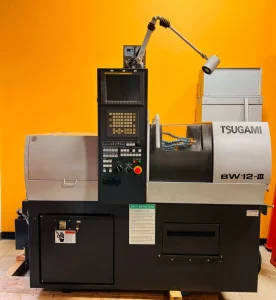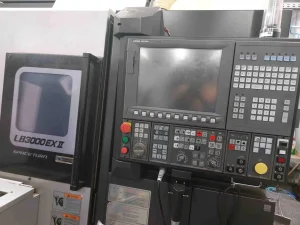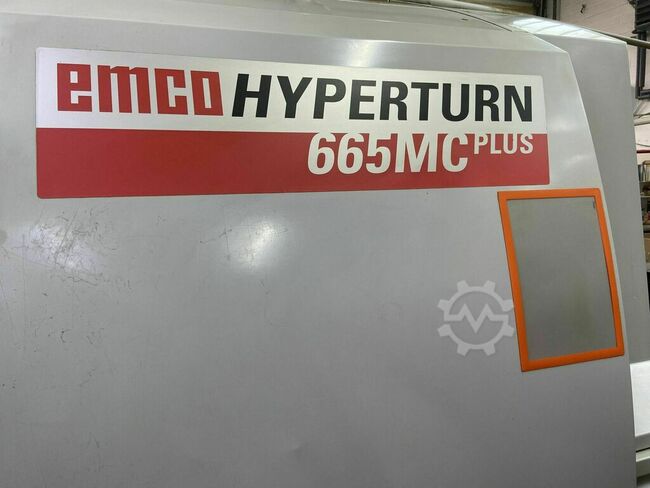
Avoid Costly Mistakes: Professional Tips for Purchasing a Pre-Owned / Second-Hand / used EMCO Hyperturn 665MC Plus?
Buying a used EMCO Hyperturn 665MC Plus (or similar “turn-mill / multi-axis” variant) is a complex purchase with many moving parts. Because these machines combine turning, milling, multiple axes, and tool turrets/spindles, there are more potential failure points than in a simpler lathe or mill. Below is a professional guide—things to check, red flags, negotiation strategies—to help you avoid costly mistakes.
1. Understand the Typical Specs & Configurations
Before inspecting a candidate, arm yourself with the “expected spec envelope.” That way you’ll spot exaggerations or discrepancies.
Here are representative spec features for the 665MC Plus (based on current used listings):
- Swing over bed: ~ 600 mm
- Swing over cross slide / face carriage: ~ 500 mm
- Maximum turning diameter: ~ 430 mm
- Maximum part length: ~ 744 mm
- Bar stock capacity: ~ 65 mm
- X / Z travels (for main turret): ~ X = 280 mm, Z = 900 mm
- Secondary turret (if present): X2 ~ 205 mm, Z2 ~ 750 mm
- Y-axis travel: ~ ±50 mm (i.e. Y = 100 mm total)
- Spindle speed (main): 0 – 5,000 rpm
- Spindle drive (main): ~ 29 kW, torque ~ 250 Nm
- Counter / sub spindle: up to ~ 7,000 rpm, ~ 22 kW
- Tool turrets: often 2 turrets, each ~12 stations (with driven / live tool capability)
- Milling / swivel B-axis / driven tool (PowerMill) options are often part of “Plus” configuration
- C-axis indexing on spindle(s): 0.001° resolution in many listings
These give you ballpark values—if a seller claims wildly different numbers (e.g. X travel = 500 mm) that’s a red flag unless heavily modified.
2. Documentation, History & Provenance
As with any used complex machine, the more you know about its past, the better.
- Service records, repair invoices, parts replacement logs — especially for spindles, turrets, electronics.
- Operating hours / cycles (if available). Even though hours don’t tell everything, a machine with extremely high hours demands extra scrutiny.
- Configuration and control backups / parameters — e.g. tool offsets, kinematic data, macro files.
- Original manuals, electrical schematics, hydraulic / pneumatic diagrams
- Modification history — whether the machine was upgraded (driven tools, milling spindle, B-axis, extra turrets) or parts replaced with non-OEM items
- List of included accessories: chucks, collets, tool holders, tooling, fixturing, bar feeders, coolant systems, conveyors
- Usage environment: Was it used in harsh conditions (coolant, abrasive materials, long hours)? Was maintenance regular?
- Spare parts inventory (if seller includes extra bearings, seals, tool holders, etc.)
Without credible documentation, you’re entering risk territory.
3. Physical & Structural Inspection
Start with a careful visual walkthrough before powering up.
- Inspect castings and structural parts (bed, columns, turret bodies, bridges) for cracks, repaired welds, distortions
- Check for corrosion, rust, pitting on slideways, cross slides, dovetails, tool carrier faces
- Examine way covers, bellows, guard seals, way wipers — damaged or ill-fitting covers are often correlated with internal wear
- Look for oil/coolant leakage, residue, stains around spindle head, turret bearings, hydraulic units
- Confirm that guards, covers, control panels, fasteners are present and undamaged
- Examine attached tooling / chucks / fixtures for excessive wear, damage, misalignment
Structural issues are among the most expensive to remedy (if possible at all).
4. Motion, Spindle & Mechanism Tests
This is critical for a machine with many axes — test each axis, spindle, turret, tool drive.
Axes & Slideways
- Jog each axis (X, Z, Y, any sub-axes) across full range (slow speeds and moderate speeds). Feel for jerkiness, binding, dead zones, stiffness changes
- Use a dial indicator to measure backlash on each axis. Excessive backlash suggests worn screws or nuts
- Detect “soft spots” or nonuniform motion—these often point to wear or alignment issues
- Listen for grinding, scraping, knocking noises during motion
- Inspect ball screws / lead screws / nut assemblies for wear, pitting, or irregularities
- Test lubrication or oiling systems for slideways and screws: ensure lines, pumps, reservoirs are intact and functioning
Spindle(s) & Toolholding
- Run the spindle (main) at different speeds (low, medium, high) without load. Listen for bearing hum, vibration, instability
- Mount a test bar or mandrel; check radial and axial runout with a dial indicator over 360°
- Check spindle taper or interface surfaces for damage, scarring, or wear
- Test automatic tool change / turret indexing: should consistently position and repeat without hesitation
- If the machine has driven tools / milling spindle / B-axis, run them (no load) and listen for vibration, stability, smooth transition
- For sub-spindle or counter spindle, run similarly and verify alignment, balance, noise
Turrets & Tool Carriers
- Cycle turret indexing repeatedly; watch for hesitation, misindexing, jitter
- Inspect tool pocket fit, side play, wear of pocket faces
- If turret includes live tooling, test each driven station (idle) for runout, vibration
- Observe the mechanism (cams, gears, servo drives) during indexing for mechanical noise, backlash
5. Control, Electrical & Software Examination
The “brains” of a multi-axis turn-mill machine are equally vital; neglect here is dangerous.
- Open the control / electrical cabinet; inspect for dust, burn marks, water damage, loose wiring, corrosion
- Check for missing modules, drives, power supplies, communication boards
- Power the control (if possible) and examine the boot process, alarm / fault log, error history
- Verify that operator interface panels (buttons, encoders, screens) all function
- Cycle the machine (idle) under control and monitor for heating, faults, or anomalies
- Check that control parameters, configuration menus, backups, tool libraries are accessible
- Verify control version / firmware and whether it is upgradable or obsolete
- If the machine has network connectivity, ensure communication modules work
6. Precision & Geometric Testing
Critical for a complex machine — test it under real conditions.
- Use a reference surface or granite plate to check flatness / straightness of slides
- Measure squareness (X vs Z, turret face vs spindle axis) with gauge blocks / indicators
- Perform tramming to ensure spindle axis aligns correctly with respect to work axis
- Conduct a test cut: do a finish pass on a known material, measure features (diameter, straightness, roundness, surface finish) at various positions
- Test repeatability: retract and re-approach same position, measure deviation
- Check performance near the ends of travel as well as mid-range; machines often degrade at extremes
- Verify that milling / driven tool cuts produce acceptable results (if present)
7. Hidden Costs & Risk Items to Assume
Even if the machine seems “fine,” you should budget for these likely repairs or upgrades:
- Spindle rebuild or bearing replacement (main or sub-spindle)
- Ball screw / nut replacement or refurbishment
- Slideway reconditioning or scraping / alignment work
- Repair / rebuild of turrets, indexing mechanisms, live tool drives
- Control or electronic module replacement or upgrades (especially if parts are obsolete)
- Cable harness refresh, connector replacement, aging insulation
- Calibration, alignment, tuning after installation
- Transport, rigging, leveling, foundation work, utilities installation
- Downtime during setup, alignment, and initial trials
- Sourcing of spare parts; some OEM parts may no longer be produced or available easily
Also consider the availability of aftermarket support: some older control electronics or turret drives may be difficult to service if they’re out of production.
8. Negotiation & Deal Structuring
You want to protect yourself, because “looks good” doesn’t guarantee performance.
- Insist on an inspection period where you can run the machine fully (axes, spindles, tool change, test cuts) before final payment
- Withhold a portion of payment until after your acceptance tests
- Require delivery of all documentation (manuals, schematics, control backups) as part of the sale
- Ask for a short-term guarantee (e.g. 30–90 days) covering major systems (spindles, turrets, drives)
- Request disclosure of any known problems in writing (so you’re not surprised post-purchase)
- If possible, negotiate inclusion of spare parts / tooling / fixtures in the deal
- Ask seller to assist (or subcontract) setup, alignment, calibration at your site
- Confirm responsibility for transport, rigging, leveling, and insurance during transit
9. Red Flags & Warning Signs
These are issues that deserve either heavy discounting or immediate walk-away:
- Seller refuses full access or limits your ability to run the machine
- Excessive backlash, binding, or inconsistency in any axis
- Spindle noise, vibration, or unacceptable runout
- Turret misindexing, hesitation, or erratic behavior
- Drive / motor / control malfunctions, alarms, missing modules
- Electrical cabinet shows burn marks, corrosion, missing parts
- Control software corrupted, missing backups, or inaccessible parameters
- Major components missing (e.g. live tooling, drives, turret parts)
- Prior modifications that appear sloppy or misaligned
- Parts or OEM modules are no longer available, making future repairs impractical